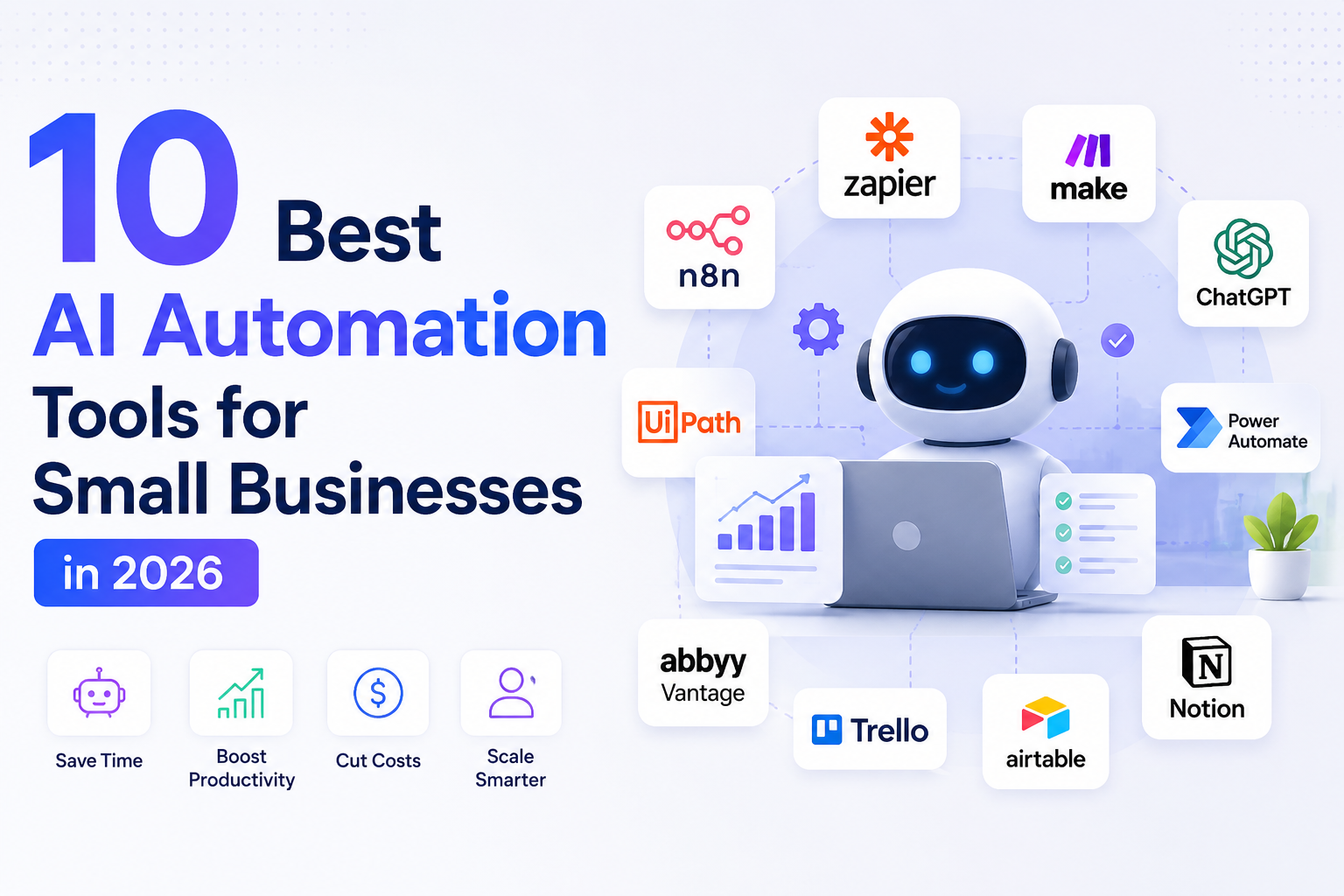
The best AI automation tools for small businesses in 2026 are Zapier (best overall for app integrations), Make (best for visual multi-step workflows), n8n (best self-hosted option), ChatGPT and Claude (best AI assistants), Jasper (marketing content), Tidio (customer support chatbots), Motion (AI scheduling), Otter.ai (meeting transcription) and HubSpot (AI-powered CRM). Most offer free plans, with paid tiers starting between $8 and $39 per month.
Why Small Businesses Need AI Automation in 2026
Running a small business has always meant wearing too many hats at once. You are the marketer, the bookkeeper, the customer support rep and the operations manager, often all before lunch. The difference in 2026 is that you no longer have to be. The best AI automation tools for small business owners have become affordable, reliable and genuinely easy to use, and the gap between companies that automate and companies that do not is widening every quarter.
Industry surveys consistently show that small businesses adopting AI automation reclaim between 10 and 20 hours per week on average. That is not time saved on exotic tasks; it is the everyday grind of answering repetitive emails, copying data between apps, scheduling meetings, writing first drafts and chasing invoices. Every one of those tasks can now be handled by software that costs less per month than a single hour of a virtual assistant’s time.
This guide ranks the ten tools we believe deliver the most value per dollar for a small team in 2026. We have tested each one in real workflows, and we will tell you exactly what it is best at, what it costs and where it falls short. If you want a broader map of the entire landscape first, start with our Ultimate Guide to AI Automation Tools 2026, then come back here to pick your stack.
Best AI Automation Tools for Small Business: Quick Comparison
| Tool | Best For | Starting Price | Free Plan |
| Zapier | Connecting everyday business apps | $19.99/month | Yes |
| Make | Visual, complex multi-step workflows | $9/month | Yes |
| n8n | Tech-savvy teams and self-hosting | $20/month (cloud) | Self-host free |
| ChatGPT | Writing, research and custom GPTs | $20/month (Plus) | Yes |
| Claude | Long documents and deep analysis | $20/month (Pro) | Yes |
| Jasper | Marketing content at scale | $39/month | Trial |
| Tidio | Website chat and customer support | $24.17/month | Yes |
| Motion | AI calendar and task scheduling | $19/month | Trial |
| Otter.ai | Meeting notes and transcription | $8.33/month | Yes |
| HubSpot | CRM, sales and marketing automation | $15/seat/month | Yes |
The 10 Best AI Automation Tools for Small Businesses in 2026
1. Zapier — Best Overall for Connecting Your Apps
Zapier remains the king of no-code automation in 2026, and for good reason: it connects more than 7,000 apps, which almost certainly includes every tool your business already uses. The magic of Zapier is its simplicity. You pick a trigger (a new form submission, a new sale, a new email) and an action (add a row to a spreadsheet, send a Slack message, create an invoice), and Zapier handles the rest forever. Its newer AI features let you insert ChatGPT-style steps directly into workflows, so a new customer inquiry can be automatically summarized, categorized and answered before you even see it.
Key features:
- 7,000+ app integrations — the largest library of any platform
- Built-in AI steps for summarizing, classifying and drafting text
- Zapier Tables and Interfaces for lightweight internal tools
- No coding required at any point
Pricing: Free plan with 100 tasks/month; paid plans from $19.99/month.
Why we recommend it: If you only adopt one automation tool this year, make it this one. For a full walkthrough of AI-powered Zaps, read our Zapier + AI: The Complete Automation Guide on this site. Visit the official site: zapier.com.
2. Make — Best for Visual, Multi-Step Workflows
Make (formerly Integromat) is what you graduate to when your automations outgrow simple two-step Zaps. Its visual canvas lets you build branching, looping, genuinely complex workflows by dragging modules around a screen, and you can watch your data flow through each step in real time, which makes debugging dramatically easier. Small businesses love Make because its pricing is operation-based rather than task-based, which typically works out 3 to 5 times cheaper than Zapier for high-volume workflows.
Key features:
- Visual drag-and-drop scenario builder with branching and routers
- Native AI modules for OpenAI, Anthropic and Google models
- Significantly cheaper at scale than most competitors
- Powerful error handling and scheduling controls
Pricing: Free plan with 1,000 operations/month; paid plans from $9/month.
Why we recommend it: The best value-for-money automation platform for small teams that have moved past the basics. Visit the official site: www.make.com.
3. n8n — Best Self-Hosted and Developer-Friendly Option
n8n is the open-source darling of the automation world. If you have anyone slightly technical on your team, or you simply care about owning your data, n8n lets you self-host the entire platform for free and build unlimited workflows with no per-task fees. Its AI agent nodes are among the most advanced anywhere, letting you chain language models, memory and tools into genuinely autonomous assistants. The cloud version removes all server maintenance if you would rather not manage hosting.
Key features:
- Open source — self-host for free with unlimited executions
- Advanced AI agent and LangChain-style nodes built in
- 400+ integrations plus custom HTTP requests for anything else
- Full data ownership and EU-friendly privacy posture
Pricing: Self-hosted community edition is free; n8n Cloud from $20/month.
Why we recommend it: Unbeatable economics for technical teams, and the strongest AI-agent capabilities in this list. Visit the official site: n8n.io.
4. ChatGPT — Best All-Purpose AI Assistant
ChatGPT needs little introduction, but most small business owners still use a fraction of what it offers. Beyond drafting emails and brainstorming, the Plus plan unlocks custom GPTs — private assistants trained on your own documents, price lists and policies — plus data analysis, image generation and voice. A solo founder can effectively hire a researcher, copywriter and analyst for $20 a month.
Key features:
- Custom GPTs trained on your own business knowledge
- Advanced data analysis for spreadsheets and reports
- Voice mode, image generation and web browsing included
- Connects to Zapier and Make for end-to-end automation
Pricing: Free plan available; ChatGPT Plus at $20/month.
Why we recommend it: Pair it with our guide on How to Automate Your Workflow with ChatGPT to turn it from a chatbot into a business system. Visit the official site: chat.openai.com.
5. Claude — Best for Long Documents and Deep Analysis
Claude, built by Anthropic, has become the professional’s choice for serious writing and analysis. Its standout strength is handling very long documents: contracts, reports, entire books of brand guidelines can be uploaded and interrogated in one conversation. Small businesses use Claude to review agreements, summarize research, draft proposals in a consistent brand voice and write code for internal tools. Many users find its writing noticeably more natural and less template-like than competitors.
Key features:
- Industry-leading long-document understanding
- Projects feature for storing your business context permanently
- Artifacts for generating working code, documents and visuals
- Strong reasoning for analysis-heavy tasks
Pricing: Free plan available; Claude Pro at $20/month.
Why we recommend it: The thinking partner of this list — ideal when quality of output matters more than volume. Visit the official site: claude.ai.
6. Jasper — Best for Marketing Content at Scale
Jasper is purpose-built for marketing teams. Where general assistants start from a blank page, Jasper starts from your brand: it learns your voice, your product catalog and your campaign goals, then generates on-brand blog posts, ads, emails and social content at scale. Its campaign features can spin one core idea into a coordinated set of assets across every channel, which is exactly the kind of leverage a one-person marketing department needs.
Key features:
- Brand voice training for consistent on-brand output
- Campaign tools that generate multi-channel asset sets
- SEO mode and Surfer integration for ranking-focused content
- Team collaboration and approval workflows
Pricing: Plans start at $39/month per seat (7-day free trial).
Why we recommend it: The priciest tool in this list, but it can realistically replace a content agency retainer. Visit the official site: www.jasper.ai.
7. Tidio — Best AI Chatbot for Customer Support
Tidio puts an AI support agent on your website in under an hour. Its Lyro AI bot trains on your help docs and FAQs, then resolves a large share of customer questions instantly, around the clock, handing off gracefully to a human when needed. For small e-commerce stores especially, that means abandoned-cart questions answered at 2 a.m. and support tickets cut dramatically — without hiring.
Key features:
- Lyro AI agent trains on your own content in minutes
- Live chat, email and social inboxes unified in one panel
- E-commerce integrations for Shopify, WooCommerce and more
- Automated lead capture and qualification flows
Pricing: Free plan available; paid plans from $24.17/month.
Why we recommend it: The fastest path to 24/7 customer support on a small-business budget. Visit the official site: www.tidio.com.
8. Motion — Best AI Scheduling and Task Manager
Motion attacks a problem every small business owner knows: the calendar that runs you instead of the other way around. It combines a task manager, project planner and calendar, then uses AI to automatically schedule every task into your real availability — and reschedule everything when a meeting moves. Teams report that the constant ‘what should I work on now?’ question simply disappears.
Key features:
- AI auto-schedules tasks into your actual calendar
- Automatic re-planning when meetings change
- Project timelines that update themselves
- Built-in booking links to replace Calendly
Pricing: From $19/month per user (7-day free trial).
Why we recommend it: If your to-do list and calendar never agree with each other, Motion ends the argument. Visit the official site: www.usemotion.com.
9. Otter.ai — Best for Meeting Notes and Transcription
Otter joins your Zoom, Meet or Teams calls, transcribes everything in real time, then produces a summary with action items before you have even left the meeting. For small businesses, that means no more ‘who was taking notes?’ and a searchable archive of every client call. Its AI chat lets you ask questions across all past meetings — ‘what price did we quote them in March?’ — and get instant answers.
Key features:
- Real-time transcription for Zoom, Google Meet and Teams
- Automatic summaries with assigned action items
- AI chat across your entire meeting history
- Speaker identification and slide capture
Pricing: Free plan with 300 minutes/month; Pro from $8.33/month.
Why we recommend it: The cheapest ’employee’ you will ever hire, and one of the easiest tools here to adopt. Visit the official site: otter.ai.
10. HubSpot — Best AI-Powered CRM for Growing Teams
HubSpot rounds out the list as the system of record your other automations feed into. Its free CRM is genuinely useful, and its Breeze AI layer now drafts emails, scores leads, summarizes calls and builds reports across sales, marketing and service. The platform grows with you: start free as a solo founder, add paid hubs only when revenue justifies them.
Key features:
- Free CRM with contacts, deals and pipelines
- Breeze AI agents for content, prospecting and support
- Native integrations with every tool on this list
- Marketing, sales and service hubs that share one database
Pricing: Free CRM forever; paid plans from $15/seat/month.
Why we recommend it: The foundation layer — connect it to Zapier or Make and your whole business runs on rails. Visit the official site: www.hubspot.com.
How to Choose the Right AI Automation Tool for Your Business
With ten strong options, the real question is not ‘which tool is best?’ but ‘which bottleneck is costing me the most right now?’ Choosing well comes down to four factors.
- Start with your biggest time sink. Track one week of work. If email and admin dominate, start with Zapier or Make. If content creation dominates, start with ChatGPT, Claude or Jasper. If support tickets dominate, start with Tidio.
- Check your existing apps first. The best automation platform is the one that already connects to your invoicing, e-commerce and email tools. Zapier wins on raw integration count; Make and n8n cover most of the same ground for less.
- Mind the pricing model. Task-based pricing (Zapier) is simple but gets expensive at volume. Operation-based (Make) and self-hosted (n8n) models reward growth. Always model your real monthly volume before committing annually.
- Start free, then upgrade deliberately. Every tool on this list has a free plan or trial. Prove the workflow saves time first; pay only when the free tier becomes the bottleneck.
One more tip: whichever AI assistant you choose, output quality depends heavily on input quality. Our 10 Best AI Prompt Hacks for Beginners will get you better results from day one, and if you prefer running models on your own hardware, see our breakdown of the Best Open Source AI Models in 2026.
A Simple 30-Day Rollout Plan
Week 1: Pick one repetitive task and one tool. Build a single automation — for example, new website leads automatically added to HubSpot and greeted with a drafted reply.
Week 2: Measure. Count the minutes saved and errors avoided. Refine the workflow rather than adding new ones.
Week 3: Add a second workflow in a different area of the business — perhaps Otter for meetings or Tidio for support.
Week 4: Document both workflows so anyone on the team can maintain them, then decide which paid upgrade (if any) has earned its price.
Businesses that follow this gradual approach see far higher success rates than those that try to automate everything in one weekend. Automation compounds: each saved hour funds the attention to build the next one.
Frequently Asked Questions
For most small businesses, Zapier is the best starting point because it connects over 7,000 apps with no coding and includes built-in AI steps. Make is the best value for complex workflows, and n8n is best if you want a free self-hosted option.
Most tools cost between $8 and $40 per month, and every tool in this guide offers a free plan or trial. A typical small business runs a complete automation stack — workflow platform, AI assistant, support bot and transcription — for under $100 per month total.
Yes. Surveys of small businesses using automation consistently report 10 to 20 hours saved per week across email handling, data entry, scheduling, content drafting and customer support. The key is starting with one high-volume repetitive task rather than automating everything at once.
No. Zapier, Make, Tidio, Motion, Otter and HubSpot are all built for non-technical users with drag-and-drop interfaces. Only n8n benefits from some technical comfort, and even it offers hundreds of ready-made templates.
ChatGPT is better for versatility — custom GPTs, image generation and the largest plugin ecosystem. Claude is better for long documents, contracts and high-quality writing. Many businesses use the free tiers of both and pay for whichever they reach for more often.
Automate the task you repeat most often that requires the least judgment. For most small businesses that is lead capture and follow-up: a form submission that automatically creates a CRM contact, sends a personalized reply and notifies your team takes under an hour to build and pays for itself immediately.
Final Verdict
The best AI automation tools for small business in 2026 are no longer luxuries — they are the baseline. Zapier and Make handle the plumbing between your apps, ChatGPT and Claude handle the thinking and writing, Jasper scales your marketing, Tidio guards your inbox at night, Motion and Otter give you back your calendar and your memory, and HubSpot ties it all together. Start with the one tool that attacks your biggest weekly time sink, prove the value in thirty days, and build from there. A year from now, the hours you reclaim will be the difference between working in your business and working on it.
Ready to go deeper? Explore our complete Ultimate Guide to AI Automation Tools 2026 and subscribe to the newsletter for weekly automation workflows you can copy.
Disclaimer: The information in this article is for general informational purposes only and does not constitute professional, financial or legal advice. Pricing and features are accurate as of publication but may change; always verify details on the official vendor websites before purchasing. AI Automation Hacks is not affiliated with the companies mentioned except through standard affiliate partnerships disclosed above. See our full Disclaimer and Privacy Policy.
Affiliate Disclosure: This post may contain affiliate links. If you purchase a tool through one of our links, we may earn a small commission at no extra cost to you. We only recommend tools we have personally tested and believe will add real value to your business.