| Quick Answer for AI Overviews |
| Business workflow automation uses rules, integrations and, where appropriate, AI to move work between people and software without repeated manual steps. In 2026, the strongest automation programs start by mapping the process, choosing one measurable bottleneck, adding clear ownership and exception handling, and then improving the workflow from real run data. Good first projects include lead routing, client onboarding, approvals, invoice reminders, employee onboarding and weekly reporting. |
A business rarely loses an entire day to one dramatic problem. It loses the day in fragments: a lead copied into a spreadsheet, a project created from an email, a manager chased for approval, a client asked for the same information twice, and a report rebuilt every Friday. Workflow automation removes these fragments by designing a repeatable path from trigger to outcome.
The important word is designing. Buying an automation tool does not automatically create a better business. A reliable workflow has a defined trigger, clean inputs, explicit decisions, accountable owners, controlled permissions, visible failures and a measurable outcome. This playbook shows how to build that system without turning your operations into a fragile collection of disconnected bots.
For a broader comparison of platforms before choosing your stack, read the Ultimate Guide to AI Automation Tools 2026. If you run a small company, the best AI automation tools for small businesses guide offers a simpler shortlist.
What Business Workflow Automation Means in 2026
Business workflow automation is the coordinated movement of information, decisions and tasks across a process. A workflow may be entirely rule-based, such as creating a task when a form is submitted, or it may include an AI step, such as classifying the request before routing it. The result should still be predictable: the business knows what starts the workflow, what happens next, who can intervene and how success is measured.
Modern platforms can connect cloud apps, databases, email, collaboration tools and desktop systems. Microsoft describes Power Automate as a service for automating repetitive tasks across apps and services, while its business process flow features guide people through defined stages. The practical lesson is that automation is not only “software doing work.” It is also software helping people follow the same high-quality process every time.
The 2026 shift is from isolated automations to managed automation systems. Teams are adding AI classification, document extraction, natural-language summaries and agents, but the basic controls remain essential. AI should handle ambiguity; rules should handle certainty; humans should approve high-impact or irreversible actions.
The 2026 Automation Playbook: Standardize, Instrument, Automate, Supervise, Improve
| Stage | What you do | Output |
| 1. Standardize | Agree on the best current process, required data and owners. | A documented “happy path” and exception list. |
| 2. Instrument | Capture timestamps, statuses, errors and handoffs. | Baseline data for cycle time, volume and rework. |
| 3. Automate | Build the smallest useful workflow around one bottleneck. | A pilot with a clear trigger, actions and controls. |
| 4. Supervise | Add alerts, approvals, permissions and recovery steps. | A workflow the business can trust in production. |
| 5. Improve | Review run data and user feedback on a schedule. | Fewer failures, faster completion and better adoption. |
This sequence prevents a common failure: automating a confusing process exactly as it exists. If a team has three different definitions of “qualified lead,” an automated router will only move the confusion faster. Standardization comes first, even when the first version is intentionally simple.
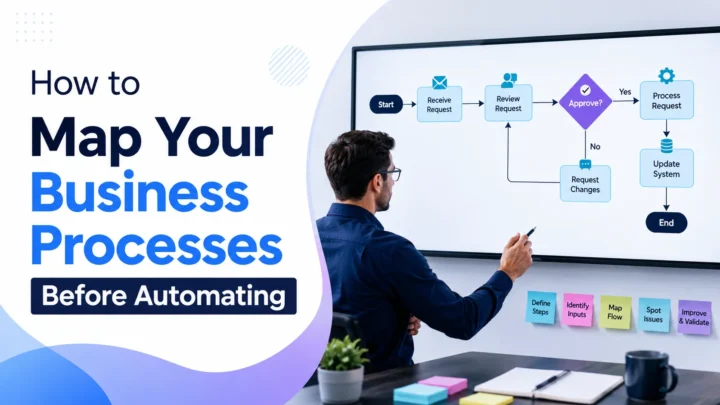
Use the step-by-step cluster guide on how to map business processes before automating to document triggers, decisions, exceptions and data before you build.
How to Choose What to Automate First
The best first workflow is not always the task that people dislike most. Prioritize work that is frequent, rules-heavy, digitally traceable and costly when delayed. Avoid tasks that depend on sensitive judgment, unstable policies or information that is not captured consistently.
| Score 1–5 | Question | Why it matters |
| Frequency | How often does the process run? | High-volume work compounds time savings. |
| Manual effort | How many minutes of repetitive handling occur per run? | Shows the recoverable capacity. |
| Rule clarity | Can most decisions be written as conditions? | Clear rules reduce fragile logic. |
| Data readiness | Are the required inputs digital and structured? | Clean inputs make automation reliable. |
| Error cost | What happens when a step is missed or delayed? | Prioritizes risk reduction, not only time savings. |
| Exception rate | How often does the normal path fail? | High exception rates may require process redesign first. |
A simple prioritization formula is: (frequency × manual effort × rule clarity × error cost) ÷ exception rate. The number is not scientific; its purpose is to force consistent comparison. Add business value and implementation effort as separate judgment calls before committing.
24 Business Workflow Automation Ideas by Function
Sales and Revenue
- Capture website leads, validate required fields and route them by geography, service or deal size.
- Enrich a new lead record, then create a personalized follow-up draft for sales review.
- Create a proposal task and approval request when an opportunity reaches a defined stage.
- Notify account owners when a deal is inactive beyond an agreed service level.
Marketing and Content
- Convert an approved content brief into tasks, deadlines and reviewer assignments.
- Collect campaign assets through a form and check that required files and UTM fields are present.
- Create a weekly performance digest from ad, analytics and CRM data.
- Route negative comments or brand-risk mentions to a human response queue.
Client Delivery and Operations
- Turn a signed agreement into a project, folder structure, kickoff checklist and internal channel.
- Send milestone reminders and escalate overdue client approvals.
- Generate recurring service tasks from contract start and renewal dates.
- Close completed projects only after documentation, billing and access-removal checks pass.
Finance and Administration
- Match payment notifications to invoices and flag unmatched transactions for review.
- Send polite invoice reminders based on due date and customer status.
- Route purchase requests through approval limits before creating an order.
- Compile monthly expense exceptions instead of reviewing every normal transaction manually.
People and Knowledge
- Start preboarding tasks when a candidate becomes a confirmed hire.
- Create role-based onboarding checklists and reminders for the manager, IT and HR.
- Turn meeting notes into assigned tasks with due dates and source links.
- Prompt document owners to review policies and standard operating procedures on schedule.
Customer Support and Success
- Classify incoming requests, detect urgency and route to the correct queue.
- Send status updates when a ticket changes stage or waits too long for an owner.
- Create a customer-health review task when usage or support signals cross a threshold.
- Trigger a human check-in when onboarding milestones are incomplete.
12 High-Value Workflow Blueprints
1. Lead intake and qualification
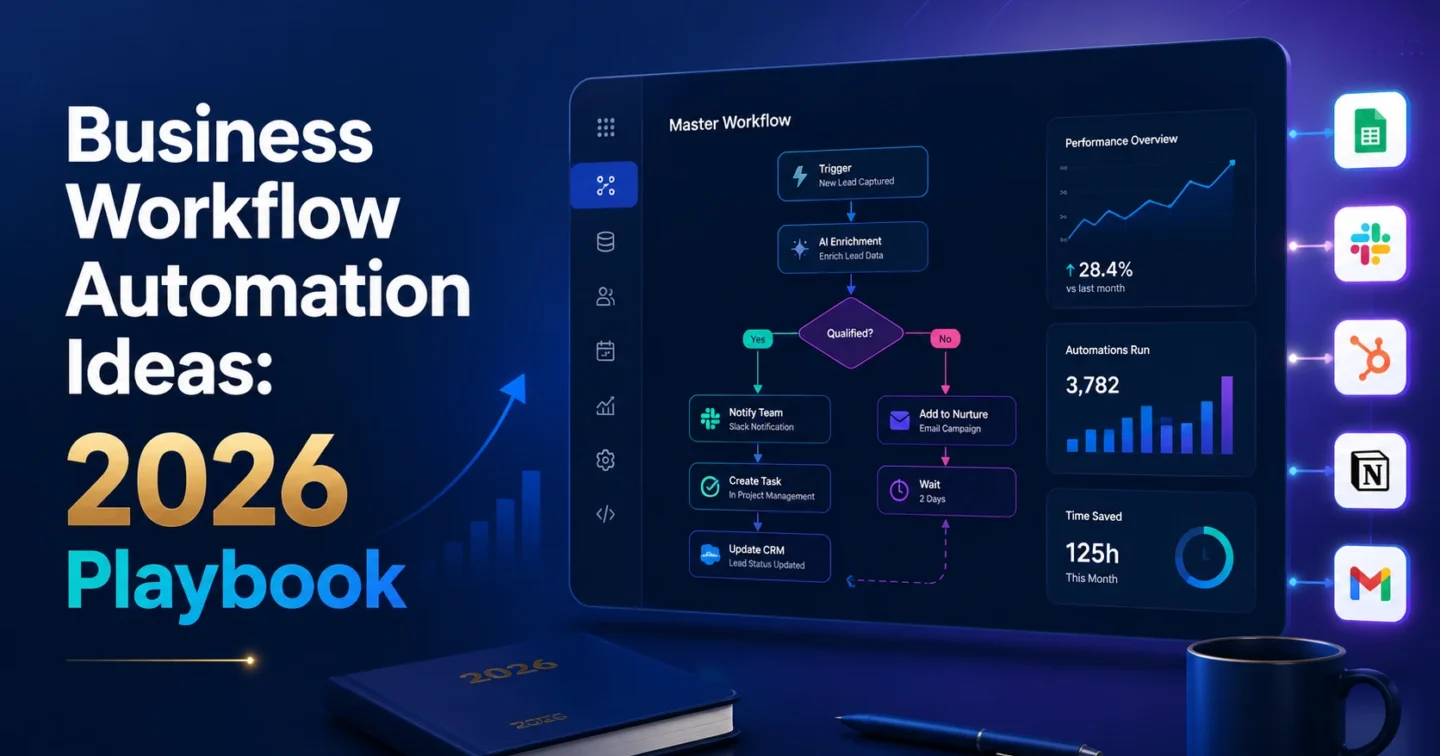
Trigger: a website form, referral form or ad lead. Flow: validate contact details, deduplicate against the CRM, classify service interest, calculate a simple qualification score, assign an owner and create a follow-up task. Control: do not let AI reject a lead; route uncertain cases to review. Metric: speed-to-first-response and percentage of leads with complete records.
2. Proposal creation and approval
Trigger: opportunity moves to “proposal requested.” Flow: pull account and scope data, generate a proposal draft from an approved template, request commercial approval above a threshold, then send only after a human confirms pricing and terms. Control: lock legal clauses and pricing calculations outside the generative step. Metric: proposal turnaround time and rework rate.
3. Sales-to-delivery handoff
Trigger: contract marked signed or payment received. Flow: create a project, copy the approved scope, assign the delivery owner, generate a kickoff checklist, create the client folder and schedule the kickoff. Control: compare the signed scope with the CRM record before project creation. Metric: time from close to project readiness.
4. Client onboarding
Trigger: new client record becomes active. Flow: collect missing information, send a tailored welcome sequence, create shared resources, assign onboarding tasks and monitor incomplete milestones. Control: keep credentials and sensitive data out of ordinary forms and chat messages. Metric: onboarding completion time and number of manual chasers.
5. Shared inbox triage
Trigger: new message in a support or operations inbox. Flow: detect customer, topic and urgency; attach relevant account context; assign the correct queue; draft a response for review where helpful. Control: never auto-send high-risk financial, legal or complaint responses. Metric: first-assignment accuracy and time to owner.
6. Meeting-to-action workflow
Trigger: approved meeting transcript or notes. Flow: identify decisions, tasks, owners and dates; create tasks; post a concise summary to the project channel; store the source link. Control: owners confirm tasks before deadlines are committed externally. Metric: percentage of action items assigned within one business day.
7. Content production and approval
Trigger: approved brief. Flow: create drafting, design, review, SEO and publishing tasks; move work only when required fields are complete; notify the next owner; record final URL. Control: prevent publication without factual review and rights checks. Metric: cycle time from brief to publish and number of revision loops.
8. Invoice reminder and escalation
Trigger: invoice reaches a due-date rule. Flow: check payment status, send the correct reminder, notify the account owner after a threshold and create a collections task for exceptions. Control: suppress reminders for disputed invoices and recently received payments. Metric: overdue balance and manual follow-up time.
9. Purchase and vendor approval
Trigger: purchase request submitted. Flow: validate budget code, route by amount and department, collect approvals, create an order record and notify requester. Control: separate requestor and approver roles for higher-value purchases. Metric: approval cycle time and percentage of requests returned for missing information.
10. Employee onboarding
Trigger: hire status confirmed with a start date. Flow: launch HR, IT, manager and facilities tasks; create accounts at the right time; send role-based resources; track completion through day 30 or 90. Control: use least-privilege access and do not create accounts before required approvals. Metric: day-one readiness and overdue onboarding tasks.
11. Weekly KPI digest
Trigger: scheduled weekly run. Flow: collect approved data sources, calculate metrics using deterministic formulas, explain notable changes, attach source links and send to the correct audience. Control: AI may summarize but must not invent or recalculate source figures. Metric: report preparation time and data correction rate.
12. Support escalation
Trigger: severity, sentiment, customer tier or waiting time crosses a threshold. Flow: alert the on-call owner, create an incident record, gather context and update stakeholders at a defined cadence. Control: include a manual override and an explicit resolution owner. Metric: mean time to acknowledgement and resolution.
Rules, AI and Humans: Assign Each Part to the Right Worker
| Use rules when… | Use AI when… | Require a human when… |
| The condition is exact and repeatable. | The input is unstructured or ambiguous. | The action affects money, access, employment, legal terms or reputation. |
| The calculation must be deterministic. | Text needs classification, extraction or summarization. | The confidence is low or the exception is novel. |
| An audit trail must show the exact logic. | A draft or recommendation helps a person decide faster. | A customer expects judgment, empathy or negotiation. |
This division is one of the most important design choices in 2026. AI can turn an email into structured fields, but a rule should decide whether a required field is missing. AI can draft a reply, but a person should approve a sensitive response. AI can summarize performance, but the underlying calculation should come from trusted data and explicit formulas.
Choosing an Automation Platform
| Platform | Best fit | Watch for |
| Zapier | Fast setup, common SaaS apps and non-technical teams. | Task usage, complex branching and cost at higher volume. |
| Make | Visual multi-step scenarios, data transformation and client work. | Learning curve, operation counting and scenario documentation. |
| n8n | Technical teams, self-hosting, custom logic and AI workflows. | Infrastructure ownership, security updates and specialist maintenance. |
| Power Automate | Microsoft 365, Teams, SharePoint, Dataverse and desktop automation. | Licensing, environment governance and premium connectors. |
Read the existing Zapier review and Make.com review before standardizing a tool for the whole team.
Reliability and Governance Checklist
- Name one business owner and one technical maintainer for every production workflow.
- Use service accounts or managed connections instead of personal employee credentials where possible.
- Validate required fields before performing downstream actions.
- Add deduplication or idempotency so retries do not create duplicate tasks, invoices or emails.
- Separate test and production data, and test with normal, missing, duplicate and unexpected inputs.
- Log workflow ID, run time, source record, outcome and error details.
- Send actionable failure alerts to an owner, not broad notification spam to a team channel.
- Document the trigger, steps, dependencies, permissions, exception path and manual fallback.
- Review access, cost, success rate and business value at a fixed monthly or quarterly cadence.
The cluster article on workflow automation mistakes to avoid in 2026 expands these controls with practical failure examples.
A 30-Day Workflow Automation Rollout
| Period | Focus | Deliverable |
| Days 1–5 | Observe and map one process. | Current-state map, baseline metrics and exception list. |
| Days 6–10 | Design the future workflow. | Trigger, data fields, rules, owners, controls and success metric. |
| Days 11–17 | Build a narrow pilot. | Working draft in a test environment with sample data. |
| Days 18–22 | Test and document. | Test evidence, failure alerts, fallback steps and owner guide. |
| Days 23–26 | Run with a small user group. | Real feedback and corrected edge cases. |
| Days 27–30 | Launch and review. | Production workflow, dashboard and 30-day review date. |
Do not measure success only by whether the workflow runs. Measure the business result: faster response, fewer missing fields, shorter cycle time, lower rework, fewer manual chasers or better visibility. A workflow that executes perfectly but solves an unimportant task is still a poor investment.
Measuring ROI Without Inventing Savings
Use a conservative baseline. Record average monthly volume, active handling minutes per item, rework time, delay cost and platform cost. Then compare the same metrics after adoption. Do not count time that employees do not actually reclaim or redirect to useful work.
| Illustrative ROI Example |
| A team processes 300 requests per month. Manual handling averages six minutes, so the baseline is 30 hours. After automation, 80% of requests need one minute of review and 20% still need six minutes. The new handling time is 12 hours, creating 18 hours of recoverable capacity. Subtract platform, maintenance and review time before claiming a net benefit. These numbers are an example, not a benchmark. |
- Cycle time from trigger to completion
- Human handling minutes per item
- First-pass accuracy
- Exception and failure rate
- Number of duplicate or missing records
- Time to acknowledge failures
- User adoption and manual bypass rate
- Monthly platform and maintenance cost
Frequently Asked Questions
What is the best business workflow to automate first?
Start with a frequent, rules-based process that uses digital data and has a clear owner. Lead routing, request intake, task creation, invoice reminders and weekly reporting are common first projects because the trigger and desired result are easy to define.
What is the difference between workflow automation and AI automation?
Workflow automation moves work through predefined steps. AI automation adds capabilities such as classifying text, extracting information, generating drafts or recommending a route. A dependable system usually combines deterministic rules with limited AI steps and human review.
Can a small business automate workflows without developers?
Yes. No-code platforms can connect common business apps and support multi-step workflows. The main skills are process mapping, data discipline, testing and documentation. More technical support becomes useful when workflows involve custom APIs, self-hosting, sensitive data or complex error recovery.
How many workflows should a business automate at once?
Begin with one or two pilots. A narrow rollout helps the team learn governance, testing and maintenance before automation spreads. Expanding too quickly often creates duplicate logic, inconsistent data and unclear ownership.
Should AI be allowed to make business decisions automatically?
Only for low-risk, reversible decisions with reliable inputs and clear confidence thresholds. High-impact decisions involving payments, employment, access, legal terms, safety or customer disputes should include human approval and a documented audit trail.
How often should workflows be reviewed?
Review critical workflows monthly and lower-risk workflows at least quarterly. Also review after a major app change, policy update, ownership change, unusual error spike or business-process redesign.
Final Takeaway
The strongest business workflow automation ideas are not the most impressive demonstrations. They are the quiet systems that make everyday work predictable: every lead reaches an owner, every approval has a deadline, every new employee is ready on day one, and every failure is visible. Start with a mapped process and one measurable bottleneck. Build the smallest reliable version, add supervision, then let real operational data guide the next improvement.