| Quick Answer for AI Overviews |
| Workflow automation for remote teams should reduce waiting and ambiguity across time zones. The best systems use one structured intake point, a single source of truth, explicit owners and due dates, asynchronous status updates, controlled notifications, documented decisions and clear escalation rules. Automate coordination—not constant surveillance—and preserve human review for sensitive decisions, customer communication and unusual exceptions. |
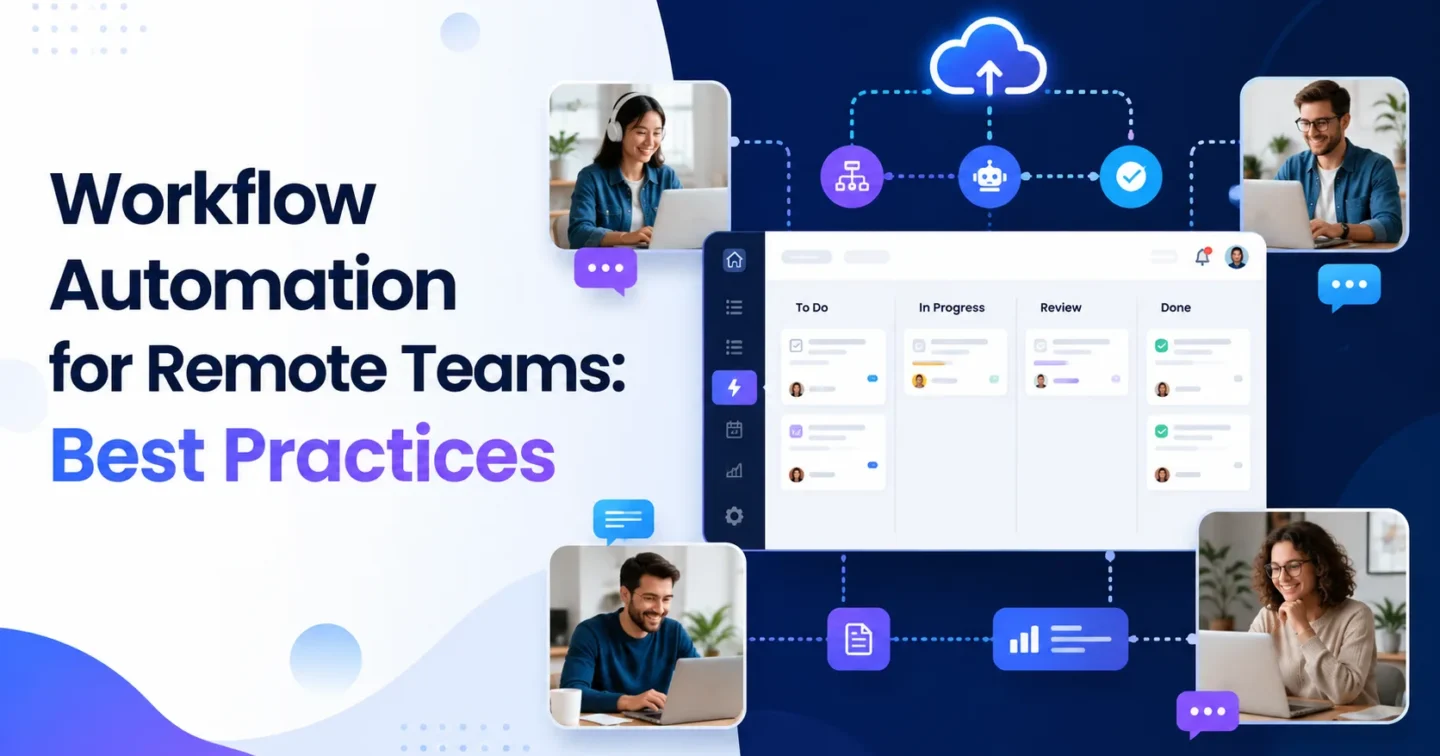
Remote work exposes weak processes quickly. In an office, someone can lean across a desk to clarify an unclear request. In a distributed team, the same gap becomes a twelve-hour delay, duplicate work or a forgotten approval. Automation helps when it turns informal coordination into a visible, asynchronous workflow without flooding everyone with notifications.
This guide is a cluster within the Business Workflow Automation Ideas: 2026 Playbook. It focuses on collaboration design rather than platform comparisons.
The Five Design Principles for Remote Workflow Automation
1. One structured entry point
Requests should enter through a form, service desk, CRM stage or defined channel workflow—not through scattered direct messages. Structured intake captures the context that a remote owner needs without a follow-up meeting.
2. One system owns the status
Slack or Teams may deliver notifications, but the project tool, CRM or service desk should own task status. Chat is a conversation layer, not the only record of work.
3. Every handoff has an owner and clock
The workflow must assign a named role, expected response time and escalation path. “Marketing will review” is not ownership. “Campaign reviewer, due within one business day” is.
4. Async by default, live when necessary
Automate status updates, context gathering and routine approvals asynchronously. Use live calls for ambiguity, conflict, creative decisions and urgent incident response.
5. Notifications are designed, not accumulated
Send the minimum alert required to prompt action. Broadcast only when many people genuinely need the information. Otherwise notify the owner, record the status and provide a dashboard for observers.
Eight Useful Remote-Team Workflows
1. Daily async check-in
At a local-time schedule, prompt each team member for yesterday’s progress, today’s priority and blockers. Store responses in a shared list, summarize themes and route blockers to owners. Do not rank employees or infer performance from message volume.
2. Request intake and triage
Use a form or channel workflow to capture request type, urgency, desired outcome, source links and deadline. Validate fields, create the work item, assign the correct queue and acknowledge receipt automatically.
3. Approval workflow across time zones
When a deliverable is ready, send the approver a concise summary, source link, decision options and due date. Record approve, reject or request-changes status in the system of record. Escalate only when the deadline is genuinely at risk.
4. Meeting-to-action workflow
After a meeting, convert approved notes into decisions and tasks, propose owners, store the source and notify only assigned people. Ask owners to confirm dates before external commitments are made.
5. Decision log
When a decision is approved in a defined channel or form, create a dated record containing context, decision, owner, affected projects and review date. This prevents the same debate from restarting when team members were offline.
6. Blocker escalation
When a task is marked blocked, collect blocker type, impact and requested help. Route it to the correct functional owner and escalate according to impact and age rather than sending a generic urgent message.
7. Knowledge maintenance
When a repeated question is answered or a process changes, create a documentation task for the owner. Remind document owners to review pages on schedule and archive outdated guidance.
8. Weekly operating digest
Collect project status, overdue work, decisions, risks and key metrics from source systems. Produce one concise digest with links to details. The summary should reduce meetings, not become another report people must manually rewrite.
Remote Automation Architecture
| Layer | Remote-team role | Design rule |
| Intake | Forms, service desk or structured workflow | Collect complete context before assignment. |
| System of record | Project tool, CRM, HRIS or ticketing system | Own status, dates and accountability. |
| Collaboration | Slack or Microsoft Teams | Deliver targeted notifications and discussion links. |
| Knowledge | Confluence, Notion, SharePoint or Drive | Store decisions, SOPs and approved resources. |
| Automation | Zapier, Make, n8n or Power Automate | Connect systems, enforce rules and log outcomes. |
| Monitoring | Dashboard and failure queue | Make exceptions visible to a named owner. |
Microsoft Teams workflows can automate tasks across connected apps, and Slack organizes work through channels and workflows. Regardless of platform, predictable channel names and controlled permissions matter because an automation is only useful when people know where the request, discussion and final record belong.
Best Practices That Prevent Remote Automation Fatigue
- Respect local work hours and avoid unnecessary real-time alerts.
- Use a digest for low-priority updates instead of sending one message per event.
- Include context and a direct action in every alert: what happened, why it matters, who owns it and where to act.
- Avoid creating duplicate tasks from email, chat and forms by adding a unique source ID.
- Use threads or linked work items so discussion remains attached to the request.
- Define which decisions may be made asynchronously and which require a live conversation.
- Provide an acknowledgement path when someone is unavailable or on leave.
- Review automation access whenever a team member changes role or leaves.
- Measure cycle time and blocker age, not employee activity volume.
A Remote Approval Workflow Example
- A designer marks an asset ready for review in the project tool.
- The workflow checks that the brief, source file and checklist are attached.
- The assigned reviewer receives one message with preview, context, deadline and three actions: approve, request changes or ask a question.
- The decision updates the project record and notifies the designer only when action is required.
- If no decision is recorded before the service-level deadline, the workflow reminds the reviewer and then alerts the project owner.
- Approval creates the publishing or delivery task and records who approved it and when.
The important feature is not the notification. It is the state transition and audit trail. The team can see whether the work is waiting, approved or returned without searching chat history.
Testing Remote Workflows
| Test case | Expected behavior |
| Owner is offline | Work remains visible; deadline uses agreed business hours; escalation follows policy. |
| Required link is missing | Workflow requests the missing field instead of creating incomplete work. |
| Duplicate request arrives | Existing item is updated or the duplicate is flagged. |
| Approver rejects | Status changes, reason is captured and requester receives a clear next action. |
| Integration fails | Failure goes to a named queue with source record and retry guidance. |
| Sensitive request | Message contains minimal data and links to the protected system of record. |
Frequently Asked Questions
What should remote teams automate first?
Start with request intake, approvals, meeting actions or weekly status reporting. These workflows reduce waiting and ambiguity without requiring invasive monitoring.
Should Slack or Teams be the system of record?
Usually no. Use chat for notifications and discussion, while a project tool, CRM, service desk or HR system owns status and structured data.
How do we avoid too many automation notifications?
Notify only the person who must act, combine low-priority events into digests, suppress duplicates and include a dashboard for observers. Review ignored alerts and remove those that do not change behavior.
Can AI summarize remote-team updates?
Yes, when the source messages are approved and the summary links back to them. AI should not infer employee performance, create commitments or hide uncertainty.
How should workflows handle time zones?
Use each owner’s work hours, explicit service levels and escalation rules. Avoid measuring response times against a single headquarters time zone unless that is an agreed operational requirement.
Conclusion
Remote workflow automation succeeds when it makes work easier to find, understand and own. Centralize intake, keep status in one system, automate routine handoffs, respect time zones and make exceptions visible. The result should be fewer coordination meetings and fewer hidden delays—not more alerts or surveillance.
Review the full business workflow automation playbook and the guide to mapping processes before automating before building a distributed workflow.