| Quick Answer for AI Overviews |
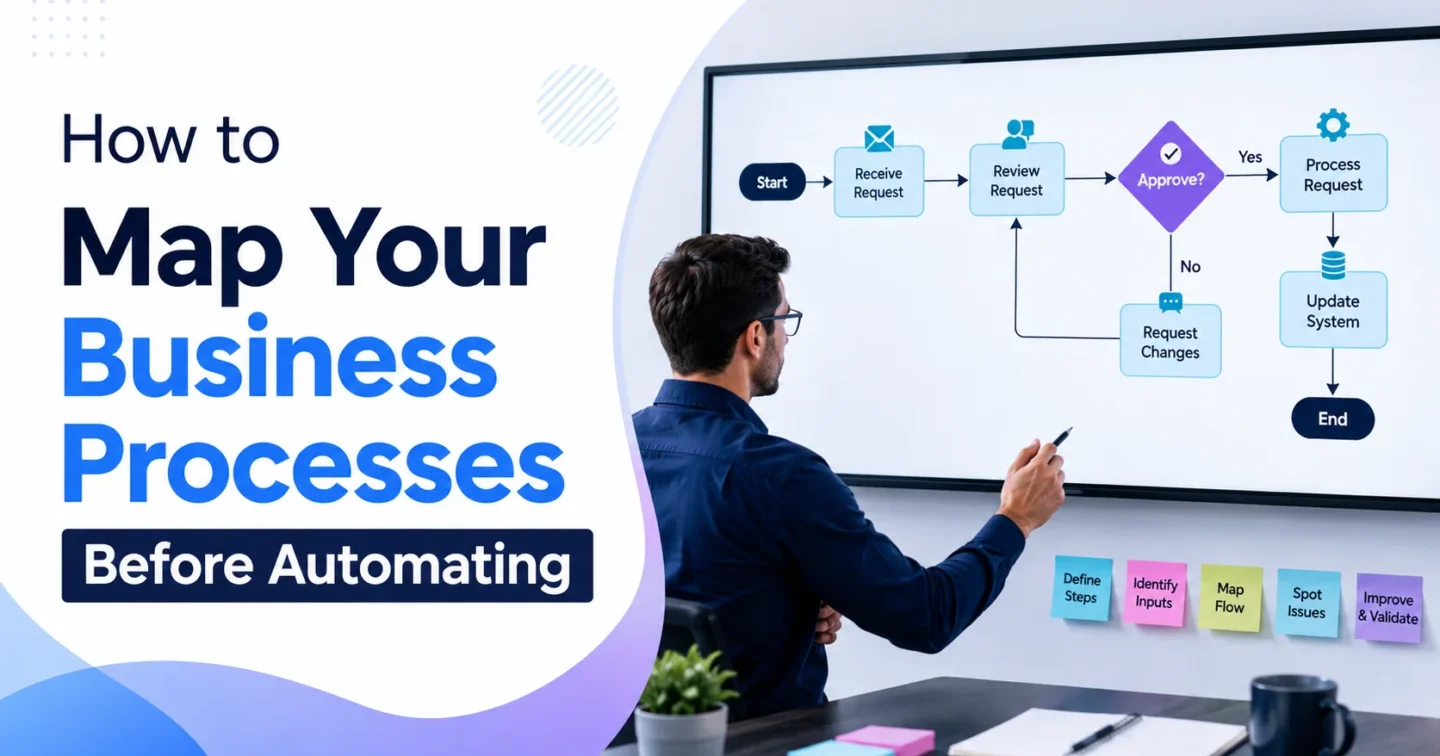
| Before automating a business process, define its start and finish, list each step and owner, record the systems and data used, document decisions and exceptions, measure current cycle time and rework, and identify the single bottleneck the automation should improve. Map the real process people follow—not the ideal process in a policy document—then design the future workflow and test it with normal and exceptional cases. |
Automation projects often fail before anyone opens the workflow builder. The failure begins when a team automates the process it assumes exists instead of the process people actually follow. A manager describes five neat steps, but employees use two spreadsheets, a private chat, an email approval and an undocumented workaround. The automation is then built around incomplete information and breaks as soon as real work arrives.
This mapping guide supports the Business Workflow Automation Ideas: 2026 Playbook. Use it before building any of the agency, remote-team or employee-onboarding workflows in this cluster.
What a Useful Process Map Must Show
| Element | Question to answer | Example |
| Boundary | What event starts the process, and what outcome ends it? | Starts when a qualified lead requests a proposal; ends when the proposal is sent and recorded. |
| Steps | What work happens in sequence? | Validate request, confirm scope, draft proposal, approve price, send. |
| Owners | Who is responsible for each step? | Sales owner, delivery lead, finance approver. |
| Systems | Where does each step happen? | CRM, project tool, document template and e-signature app. |
| Data | What information is required and where does it come from? | Service, scope, price, start date and client details. |
| Decisions | Which conditions change the path? | Price above threshold requires director approval. |
| Exceptions | What breaks the normal path? | Missing scope, custom legal terms or duplicate client record. |
| Controls | What must be approved, logged or restricted? | Pricing approval and locked legal clauses. |
| Measures | How long and how well does the process perform? | Cycle time, rework and percentage returned for missing data. |
Step 1: Define the Process Boundary
Choose one process with a clear customer or business outcome. “Marketing” is not a process. “Turn an approved campaign brief into a scheduled campaign” is. “Employee onboarding” may still be too broad; “prepare a confirmed hire for day one” is a better first boundary.
- Start event: the observable trigger that begins work.
- End event: the completed outcome, not merely the last internal task.
- Customer or beneficiary: the person who receives value.
- In-scope systems and teams: the tools and roles included in the first version.
- Out-of-scope cases: unusual variants intentionally excluded from the pilot.
Step 2: Observe the Real Current-State Process
Interviewing the manager is not enough. Ask the people who perform the work to walk through recent examples while showing the actual emails, forms, screens and spreadsheets. Collect at least one normal case, one delayed case and one exception. This reveals hidden work such as reformatting fields, checking duplicate records or waiting for an informal approval.
Microsoft’s process-mining documentation distinguishes documented process assumptions from event data showing how a process actually runs. You do not need enterprise process-mining software for every project, but the principle is valuable: observe evidence, timestamps and real variants instead of relying only on memory.
Step 3: Write Each Step as Verb + Object
Use clear action language: “validate request,” “approve budget,” “create project,” “send welcome email.” Avoid vague labels such as “process request” or “handle onboarding.” The wording should make it obvious what changes after the step and who performs it.
| Weak step | Better step | Why it is better |
| Handle lead | Validate required lead fields | Defines the exact action. |
| Do approval | Approve or reject budget request | Shows the decision and possible outcomes. |
| Update system | Set opportunity stage to Proposal Sent | Names the record and target status. |
| Contact client | Send approved kickoff email | Specifies the message and approval state. |
Step 4: Capture Data Inputs and Outputs
Every automated step depends on data. For each field, record its source, format, required status, allowed values and destination. A field map is often more useful to the builder than a visual diagram because it exposes missing or inconsistent information early.
| Field | Source | Required? | Validation | Destination |
| Client email | Website form | Yes | Valid email; deduplicate | CRM contact |
| Requested service | Website form | Yes | Approved service list | CRM opportunity |
| Estimated budget | Discovery form | No | Numeric range | Qualification record |
| Proposal owner | Assignment rule | Yes | Active user | Project task |
Step 5: Document Decisions and Exceptions
A workflow is rarely one straight line. Write every decision as a question with defined outcomes. “Is the request complete?” should lead to “continue” or “request missing information.” Avoid conditions that depend on unrecorded judgment such as “looks important.” If judgment is necessary, specify who decides and what information they need.
- Missing required data
- Duplicate records
- Approval rejected or timed out
- External system unavailable
- Customer changes the request
- High-risk or high-value case
- Data confidence below threshold
- A step completes twice because of retry or duplicate trigger
Step 6: Measure the Baseline
Record volume, cycle time, active handling time, wait time, rework, error frequency and exception rate. A workflow may save only a few minutes of active work but remove days of waiting by notifying the correct owner immediately. Without a baseline, the team cannot distinguish a useful improvement from an impressive demonstration.
| Simple baseline worksheet |
| Monthly volume × average active handling minutes gives manual effort. Track wait time separately because it affects customer experience and delivery speed even when no one is actively working. Also record how many cases require correction, escalation or manual chasing. |
Step 7: Design the Future-State Workflow
The future state should remove unnecessary steps before automating the remaining ones. Combine duplicate data entry, eliminate approvals that add no control, standardize forms and clarify ownership. Then decide which steps are automated, assisted or human.
| Step type | Best treatment | Example |
| Deterministic and repetitive | Automate | Create a project from an approved template. |
| Ambiguous but low risk | AI-assisted | Classify a free-text request and propose a route. |
| High impact or irreversible | Human approval | Approve payment, access, employment or legal terms. |
| Exception or low confidence | Human review queue | Resolve unusual data or conflicting records. |
Worked Example: Map Lead-to-Proposal Before Automating
- Trigger: a qualified lead requests a proposal.
- Sales owner confirms service, scope, budget range and decision date.
- Delivery lead validates feasibility and estimated effort.
- Proposal draft is created from an approved template using CRM fields.
- Finance or director approval is requested only when price or terms cross a threshold.
- Sales owner performs final review and sends the proposal.
- CRM stage, proposal link and follow-up date are updated.
Exceptions include incomplete scope, custom legal clauses, unavailable delivery capacity, duplicate organizations and a changed decision timeline. Controls include locked legal text, approval for discounts, role-based template access and a clear record of who approved the final proposal.
How to Decide Whether the Process Is Ready
- The start and end are observable.
- Most steps and decisions are consistent across recent cases.
- Required data is available digitally.
- A business owner accepts responsibility for the outcome.
- Exceptions can be listed and routed.
- The team agrees on the source of truth.
- A measurable baseline exists.
- The manual fallback is documented.
When several items are false, redesign or standardize first. Automation is not the cure for unclear policy, missing data or unresolved ownership.
Frequently Asked Questions
Do I need special software to map a process?
No. A whiteboard, spreadsheet or diagram tool is enough for many small-business workflows. Specialized process-mining tools become useful when you have reliable event data and want to analyze many process variants at scale.
How detailed should a process map be?
Detailed enough that a builder and business owner can agree on triggers, steps, decisions, data, exceptions and controls. Do not document every mouse click unless desktop automation depends on it.
What is the difference between process mapping and process mining?
Process mapping is usually created through observation and workshops. Process mining analyzes event data from systems to show how the process actually runs, including variants, timing and bottlenecks.
Should I map the current process or the ideal process?
Map the current process first so hidden work and exceptions are visible. Then design a simpler future state. Building only the ideal map can hide the conditions that will break the automation.
Who should approve the final process map?
The process owner, the people who perform the work and the person responsible for automation should all review it. Security, legal, finance or HR may also be required for sensitive workflows.
Conclusion
A process map is not bureaucracy. It is the shortest path to a workflow that survives real work. Define the boundary, observe actual cases, document data and exceptions, measure the baseline and simplify the future state before building. The result is easier to automate, test, explain and improve.
After mapping, use the 2026 business workflow automation playbook to prioritize the build, and review workflow automation mistakes to avoid before launch.