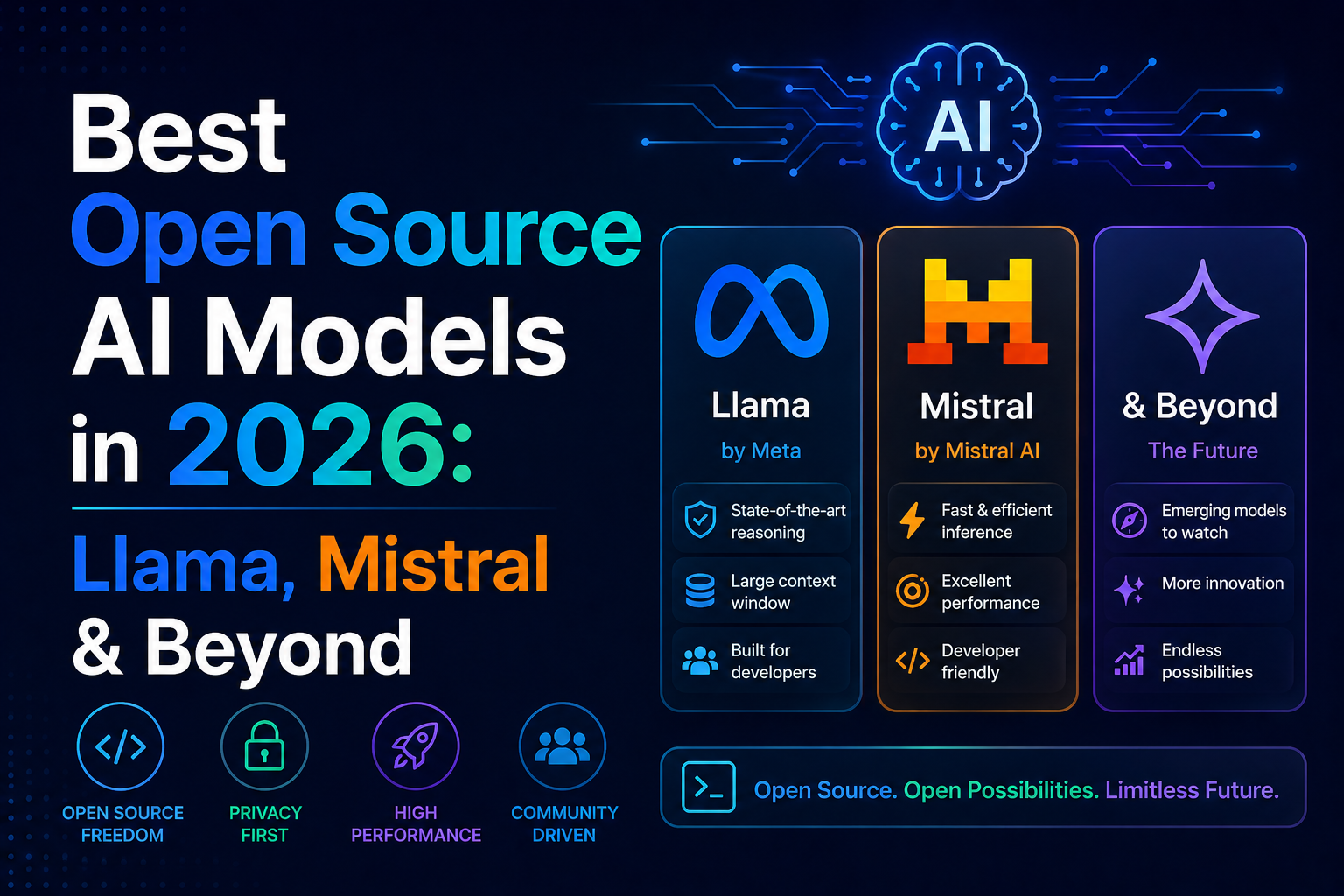
The best open source AI models in 2026 are: Meta’s Llama 3.1 (405B, 70B, 8B) — the most powerful open-weight model for general tasks; Mistral 7B & Mixtral 8x22B — industry-leading efficiency and multilingual performance; Google’s Gemma 2 — optimised for on-device and edge deployment; Microsoft’s Phi-3 Medium — best small model for reasoning tasks; TII’s Falcon 180B — top performer for enterprise NLP; and Alibaba’s Qwen2 — strongest multilingual open model. These models can be run locally via Ollama, deployed on cloud infrastructure, or accessed through Hugging Face. They rival closed-source models like GPT-4 on many benchmarks while remaining fully customisable and free to use
Introduction: The Open Source AI Revolution
The artificial intelligence landscape in 2026 is no longer dominated solely by closed, proprietary giants like GPT-4o or Claude. A thriving ecosystem of open source and open-weight AI models has emerged — models that are free to download, modify, deploy, and build upon.
From Meta’s Llama 3.1 running 405 billion parameters to Microsoft’s tiny-but-mighty Phi-3 Mini fitting on a smartphone, the quality of open source AI in 2026 is genuinely astonishing. Developers, researchers, startups, and enterprises are rapidly adopting these models for everything from coding assistants to multilingual customer service to privacy-preserving local AI.
This comprehensive guide — from the team at AIAutomationHacks.com — covers the best open source AI models in 2026: how they compare on benchmarks, which use cases they excel at, how to run them, and what’s coming next.
1. Why Open Source AI Models Matter in 2026
The significance of open source AI models in 2026 extends far beyond cost savings. Here is why the global developer community has rallied around them:
Full Ownership & Control
With open-weight models, you own your AI stack. No API rate limits, no vendor lock-in, no sudden price hikes. Run the model on your hardware, in your cloud account, at any scale — with complete control over data privacy.
Privacy & Data Security
For enterprises handling sensitive data — healthcare, legal, finance — running AI locally or in a private cloud is non-negotiable. Open source models make truly private AI possible without trusting a third-party API with your data.
Customisation & Fine-Tuning
Open source models can be fine-tuned on proprietary datasets to produce highly specialized models that outperform general-purpose commercial models on domain-specific tasks. This is a massive competitive advantage for businesses with unique data.
Cost Efficiency at Scale
A single call to GPT-4o can cost $0.01–$0.03. Running Llama 3.1 70B on your own hardware costs fractions of a cent per query at scale. For high-volume applications, open source AI delivers 10–100x cost reductions.
Community Innovation
The open source AI community on Hugging Face, GitHub, and Reddit moves faster than any single company’s R&D team. New fine-tunes, quantized versions, and tooling appear daily — meaning the open source ecosystem is constantly improving beyond the base model release.
2. How We Evaluated & Ranked These Models
Our rankings are based on a weighted combination of the following factors:
| Evaluation Criterion | Weight | What We Measured |
| Benchmark Performance | 25% | MMLU, HumanEval, GSM8K, HellaSwag, ARC scores |
| Real-World Task Quality | 25% | Writing, coding, reasoning, summarisation, Q&A |
| Efficiency (params vs quality) | 15% | Quality-per-parameter ratio, quantisation support |
| Ease of Deployment | 15% | Setup complexity, GGUF/Ollama support, API availability |
| Community & Ecosystem | 10% | Hugging Face downloads, fine-tunes, tooling support |
| Licence & Commercial Use | 10% | Open licence terms, commercial use rights |
3. Top 10 Best Open Source AI Models in 2026 — Full Reviews
1. Meta Llama 3.1 — Best Overall Open Source LLM
Developer: Meta AI | Parameters: 8B / 70B / 405B | Licence: Llama 3 Community Licence (commercial use permitted)
Meta’s Llama 3.1 is the undisputed king of open source AI in 2026. The 405B flagship model matches or beats GPT-4 Turbo on multiple benchmarks — a historic milestone for open source AI. The 70B model delivers exceptional quality on standard hardware, while the 8B version runs efficiently on consumer GPUs and is ideal for edge and mobile deployment.
- Context window: 128K tokens (all variants)
- Strengths: Reasoning, coding, multilingual (8 languages), instruction following
- Best for: General-purpose AI, coding assistants, RAG pipelines, fine-tuning
- Run locally: Ollama, llama.cpp, LM Studio
- MMLU Score: 88.6% (405B) — GPT-4 level performance
Explore automation workflows built on Llama 3.1 at AIAutomationHacks.com.
2. Mistral 7B & Mixtral 8x22B — Best Efficiency-to-Quality Ratio
Developer: Mistral AI | Parameters: 7B / 8x22B | Licence: Apache 2.0 (fully open)
Mistral AI — a French startup founded by ex-DeepMind and Meta researchers — released models that punched far above their weight class. Mistral 7B outperforms Llama 2 13B on every benchmark. The Mixtral 8x22B Mixture-of-Experts model activates only 39B parameters per forward pass while accessing 141B total — delivering frontier-quality performance at a fraction of the inference cost.
- Context window: 32K tokens
- Strengths: Speed, multilingual (French, German, Spanish, Italian), code generation
- Best for: Low-latency applications, European language tasks, cost-sensitive deployments
- Run locally: Ollama, vLLM, text-generation-webui
- Licence: Apache 2.0 — the most permissive open licence available
3. Google Gemma 2 — Best for Edge & On-Device AI
Developer: Google DeepMind | Parameters: 2B / 9B / 27B | Licence: Gemma Terms of Use (free for research & commercial)
Google’s Gemma 2 is engineered for efficiency and on-device deployment. The 9B model outperforms Llama 3 8B on most benchmarks despite similar size. The 2B model is designed for smartphones, IoT devices, and edge hardware — making it the premier choice for on-device AI applications in 2026.
- Strengths: On-device performance, responsible AI features, Google ecosystem integration
- Best for: Mobile AI, edge deployment, Android apps, low-power devices
- Run locally: Ollama, TensorFlow Lite, Google AI Edge
- MMLU Score: 71.3% (9B) — exceptional for model size
4. Microsoft Phi-3 — Best Small Language Model (SLM)
Developer: Microsoft Research | Parameters: 3.8B (Mini) / 7B (Small) / 14B (Medium) | Licence: MIT Licence
Microsoft’s Phi-3 family proves that size is not everything. Trained on a carefully curated “textbook quality” dataset, Phi-3 Mini (3.8B) outperforms models 3–4x its size on reasoning benchmarks. For developers who need strong performance in a compact, deployable package, Phi-3 is the 2026 benchmark.
- Strengths: Mathematical reasoning, logical inference, coding, safety
- Best for: Edge AI, mobile apps, cost-conscious deployments, educational tools
- Run locally: Ollama, ONNX Runtime, llama.cpp
- Special: MIT licence — maximum commercial freedom
5. TII Falcon 180B — Best for Enterprise NLP
Developer: Technology Innovation Institute (UAE) | Parameters: 180B | Licence: Falcon Licence (commercial use with conditions)
The Technology Innovation Institute’s Falcon 180B was the largest openly available model before Llama 3.1 405B. It remains a powerhouse for enterprise NLP tasks including document analysis, summarisation, and information extraction — especially strong in formal and business-register English.
- Strengths: Long-document processing, formal text generation, enterprise reliability
- Best for: Enterprise document processing, legal/compliance AI, research summaries
- Hardware required: Multi-GPU setup (A100s) for full precision; quantised Q4 runs on 2×RTX 4090
6. Alibaba Qwen2 — Best Multilingual Open Source Model
Developer: Alibaba Cloud | Parameters: 0.5B / 1.5B / 7B / 57B / 72B | Licence: Qwen Licence (commercial use permitted)
Alibaba’s Qwen2 is 2026’s strongest multilingual open source model. With exceptional performance across 27+ languages — including Chinese, Arabic, Japanese, Korean, and European languages — Qwen2 72B rivals Llama 3.1 70B in quality while delivering superior performance on non-English benchmarks.
- Strengths: Multilingual (27+ languages), maths, coding, long context (128K)
- Best for: Global products, multilingual customer support, Asia-Pacific market apps
- MMLU Score: 84.2% (72B)
7. DeepSeek Coder V2 — Best Open Source Coding Model
Developer: DeepSeek AI | Parameters: 16B / 236B | Licence: DeepSeek Licence (commercial use)
For developers, DeepSeek Coder V2 is the open source answer to GitHub Copilot. It supports 338 programming languages and achieves a HumanEval score of 90.2% — matching GPT-4o on coding tasks. It is trained specifically on code and supports Fill-in-the-Middle (FIM) completion.
- Strengths: Code generation, debugging, code explanation, 338 programming languages
- Best for: Coding assistants, IDE plugins, automated testing, DevOps AI
- HumanEval Score: 90.2% — GPT-4o level code performance
8. Cohere Command R+ — Best for RAG & Enterprise Search
Developer: Cohere | Parameters: 104B | Licence: CC-BY-NC (research) / Commercial licence available
Cohere’s Command R+ is specifically engineered for Retrieval-Augmented Generation (RAG) — making it the premier open source choice for enterprise search, knowledge management, and document Q&A systems. Its multi-hop reasoning and citation generation capabilities are unmatched in the open source space.
- Strengths: RAG, citation generation, tool use, 10 languages
- Best for: Enterprise search, document Q&A, knowledge bases, compliance AI
9. 01.AI Yi-34B — Best Bilingual (English-Chinese) Model
Developer: 01.AI (Kai-Fu Lee) | Parameters: 6B / 34B | Licence: Yi Licence (commercial use permitted)
The Yi series from Dr. Kai-Fu Lee’s 01.AI delivers exceptional bilingual English-Chinese performance. Yi-34B regularly beats models twice its size on Chinese-language benchmarks while remaining competitive in English — making it the top choice for teams building for Chinese-speaking markets.
- Strengths: English-Chinese bilingual, long context (200K), instruction following
- Best for: China-market products, bilingual AI applications, translation AI
10. Stability AI Stable LM 2 — Best Lightweight Creative Model
Developer: Stability AI | Parameters: 1.6B / 12B | Licence: Stable LM Non-Commercial / Commercial licence
Stable LM 2 is Stability AI’s most capable open language model — tuned for creative writing, storytelling, and conversational AI. The 1.6B model is one of the best-performing models at its size class globally, ideal for consumer devices and creative applications.
- Strengths: Creative text generation, conversational AI, lightweight
- Best for: Creative writing tools, chatbots, mobile creative AI, storytelling apps
4. Open Source AI Models Comparison Table — 2026 Benchmarks
A side-by-side comparison of the top open source AI models in 2026 across key performance and deployment dimensions:
| Model | Developer | Params | MMLU | HumanEval | Context | Licence | Best Use |
| Llama 3.1 405B | Meta | 405B | 88.6% | 89.0% | 128K | Llama 3 | General / All tasks |
| Llama 3.1 70B | Meta | 70B | 82.0% | 80.5% | 128K | Llama 3 | Balanced quality/cost |
| Mixtral 8x22B | Mistral AI | 141B* | 77.8% | 75.6% | 64K | Apache 2.0 | Speed + multilingual |
| Mistral 7B | Mistral AI | 7B | 64.2% | 26.2% | 32K | Apache 2.0 | Lightweight / fast |
| Gemma 2 27B | 27B | 75.2% | 51.8% | 8K | Gemma ToU | On-device / edge | |
| Phi-3 Medium | Microsoft | 14B | 78.0% | 55.6% | 128K | MIT | Reasoning / mobile |
| Falcon 180B | TII | 180B | 70.4% | 40.2% | 2K | Falcon | Enterprise NLP |
| Qwen2 72B | Alibaba | 72B | 84.2% | 64.6% | 128K | Qwen | Multilingual |
| DeepSeek Coder V2 | DeepSeek | 236B* | 79.2% | 90.2% | 128K | DeepSeek | Code generation |
| Command R+ | Cohere | 104B | 74.3% | — | 128K | CC-BY-NC | RAG / Enterprise |
* Mixture-of-Experts: active parameters used per forward pass are a fraction of total.
5. Best Open Source AI Models by Use Case
| Use Case | Best Model | Runner-Up | Why |
| General Purpose AI | Llama 3.1 70B | Qwen2 72B | Best all-round benchmark scores |
| Code Generation | DeepSeek Coder V2 | Llama 3.1 70B | 90%+ HumanEval; 338 languages |
| On-Device / Mobile | Gemma 2 2B | Phi-3 Mini | Designed for edge hardware |
| Multilingual Content | Qwen2 72B | Mixtral 8x22B | 27+ languages natively |
| RAG & Enterprise Search | Command R+ | Llama 3.1 70B | Built for RAG and citations |
| Creative Writing | Stable LM 2 12B | Llama 3.1 8B | Tuned for creativity |
| Mathematical Reasoning | Phi-3 Medium | DeepSeek Coder V2 | Textbook-quality training |
| Low-Cost Deployment | Mistral 7B | Phi-3 Mini 3.8B | Best quality at smallest size |
| Bilingual (EN-ZH) | Yi-34B | Qwen2 72B | Purpose-built bilingual |
| Privacy-First Local AI | Llama 3.1 8B | Gemma 2 9B | Best for Ollama local runs |
6. How to Run Open Source AI Models Locally in 2026
Running open source models locally is now genuinely accessible for anyone with a modern computer. Here is a step-by-step guide using Ollama — the easiest local AI runtime in 2026:
Method 1: Ollama (Recommended for Beginners)
- Install Ollama: Download from ollama.com and install for macOS, Linux, or Windows
- Pull a model: Run: ollama pull llama3.1 (downloads the 8B model, ~4.7GB)
- Run interactively: Run: ollama run llama3.1 — starts a chat interface in your terminal
- Use via API: Ollama exposes a local REST API on port 11434 — connect any app
- Try other models: ollama pull mistral | ollama pull gemma2 | ollama pull phi3
Minimum Hardware Requirements
| Model Size | Min RAM/VRAM | Recommended | Notes |
| 3B–8B (e.g. Phi-3, Llama 8B) | 8GB RAM | 16GB RAM / RTX 3060 | Runs on most modern laptops (CPU) |
| 13B–14B (e.g. Phi-3 Medium) | 16GB RAM | 24GB VRAM | M1/M2 Mac, RTX 3090 ideal |
| 30B–34B (e.g. Yi-34B) | 32GB RAM | 48GB VRAM | Mac Studio M2, dual GPU |
| 70B (e.g. Llama 70B) | 64GB RAM | 2x RTX 4090 / A100 | Quantised Q4 needs ~40GB VRAM |
| 180B+ (e.g. Falcon 180B) | 128GB+ RAM | 4x A100 80GB | Enterprise GPU servers required |
Method 2: LM Studio (GUI Interface)
LM Studio provides a no-code graphical interface for downloading and running GGUF quantised models. Download from lmstudio.ai, search for any model, and run it with a ChatGPT-style UI — all locally, no internet required after download.
Method 3: Hugging Face + Transformers (Developers)
For developers, running models via the Hugging Face Transformers library in Python gives full control. Install transformers, accelerate, and bitsandbytes, then load any model with a simple Python script. See full code examples at AIAutomationHacks.com — Local AI Setup Guide.
7. Open Source vs Closed Source AI Models — 2026 Analysis
| Factor | Open Source (e.g. Llama 3.1) | Closed Source (e.g. GPT-4o) |
| Cost | Free (hardware/cloud costs only) | Pay-per-token pricing ($0.01–0.03/1K) |
| Data Privacy | Full control — data never leaves you | Data sent to third-party API |
| Customisation | Full fine-tuning and modification rights | Limited / no fine-tuning |
| Performance (frontier) | Llama 405B ≈ GPT-4 Turbo | GPT-4o / Claude 3.5 still lead |
| Ease of Use | Requires setup; moderate technical skill | API key + one line of code |
| Vendor Lock-in | None — fully portable | High — tied to provider’s API |
| Latest Updates | Community-driven; frequent releases | Automatic via API |
| Commercial Rights | Varies by licence; mostly yes | Governed by provider ToS |
| Community Support | Massive (Hugging Face, GitHub, Reddit) | Official docs + forums only |
| Best For | Privacy, cost-scale, custom fine-tuning | Fastest setup, peak performance |
The verdict for 2026: For most consumer applications and rapid prototyping, closed-source APIs win on ease. For privacy-sensitive workloads, high-volume production, and custom AI products, open source models are the superior long-term choice.
8. Best Platforms to Discover & Deploy Open Source AI Models
| Platform | Type | Best For | URL |
| Hugging Face | Model Hub + Cloud | Discovering, testing, fine-tuning models | huggingface.co |
| Ollama | Local Runtime | Running models locally on Mac/Linux/Windows | ollama.com |
| LM Studio | Local GUI | No-code local AI for non-developers | lmstudio.ai |
| Replicate | Cloud API | Deploying open models via API, no infra | replicate.com |
| Together AI | Cloud Inference | Fast, cheap inference for open models | together.ai |
| Groq | Cloud (LPU) | Ultra-fast inference (500+ tokens/sec) | groq.com |
| Perplexity (pplx-api) | Cloud API | Testing open models via simple API | perplexity.ai |
| Jan.ai | Local GUI | Privacy-first local AI assistant | jan.ai |
9. What’s Coming: Open Source AI Models in Late 2026
The open source AI pipeline is packed with anticipated releases. Here’s what the community is watching:
- Llama 4 (Meta): Rumoured to be a Mixture-of-Experts architecture with 1T+ total parameters. Expected Q3/Q4 2026. Could surpass GPT-4o on all major benchmarks.
- Mistral Large 2 Open Weights: Mistral has hinted at releasing open weights for its flagship model — which would be a massive unlock for the community.
- Gemma 3 (Google): Expected to extend Gemma 2’s on-device excellence with improved multimodal capabilities.
- Phi-4 (Microsoft): Building on Phi-3’s exceptional efficiency, Phi-4 is expected to push the boundaries of what sub-20B parameter models can achieve.
- DeepSeek V3: DeepSeek’s V2 made waves in coding — V3 is expected to push into multimodal and scientific reasoning.
- Multimodal Open Source Models: 2026 will see significant advances in open source vision-language models (VLMs), with Llama Vision and Idefics 3 already showing strong results.
Follow all open source AI model launches and reviews at AIAutomationHacks.com.
10. Frequently Asked Questions — Open Source AI Models 2026
The best overall open source AI model in 2026 is Meta’s Llama 3.1 70B for balanced quality, performance, and deployability. For maximum raw power, Llama 3.1 405B is GPT-4-level. For coding, DeepSeek Coder V2 leads. For edge deployment, Gemma 2 9B and Phi-3 Mini are best-in-class.
Strictly speaking, “open source” means the training code and data are publicly released (few models do this). “Open weights” means only the model parameters are released. Most models described as ‘open source’ — including Llama 3 and Mistral — are technically open-weight. In practice, the community uses both terms interchangeably.
It depends on the licence. Mistral 7B and Mixtral (Apache 2.0) and Phi-3 (MIT) have the most permissive licences. Llama 3.1 permits commercial use for most companies (under 700M monthly active users). Always check the specific model licence before commercial deployment.
You can run quantised (4-bit or 8-bit) versions of smaller models (3B–8B) on CPU-only hardware using llama.cpp or Ollama. Expect slower inference — approximately 5–15 tokens per second on a modern CPU vs. 50–200+ on a GPU. Cloud inference via Groq, Together AI, or Replicate gives GPU-quality speed without owning hardware.
Open source models generally have fewer built-in safety guardrails than commercial models like GPT-4o or Claude. For production use, implement your own safety layer: input/output filtering, content moderation, rate limiting, and access controls. Models like Gemma 2 and Llama Guard include enhanced safety features.
To run Llama 3.1 70B in 4-bit quantisation (Q4_K_M) you need approximately 40GB of VRAM. Two RTX 4090s (24GB each), an A100 80GB, or an Apple M2 Ultra Mac (192GB unified memory) are the most popular consumer/prosumer setups. In 8-bit quantisation, you need ~70GB VRAM.
Visit AIAutomationHacks.com for step-by-step setup guides, comparison reviews, and automation tutorials for all major open source AI models. We publish new tutorials weekly.
Explore More on AIAutomationHacks.com
Continue building your open source AI knowledge with these resources:
- How to Run Llama 3.1 Locally with Ollama — Complete Setup Guide — Step-by-step local AI installation tutorial
- Best AI Automation Tools 2025 — Expert Reviews — Tested tools for automating tasks with AI
- Fine-Tuning Open Source LLMs: A Beginner’s Guide — How to customise Llama and Mistral on your own data
- RAG with Open Source Models — Build a Private Knowledge Base — Retrieval-Augmented Generation tutorial
- Open Source AI vs ChatGPT — Full 2025 Comparison — Detailed head-to-head analysis
Authoritative External References
- Meta Llama Official Website & Model Hub — Official Meta source for Llama 3.1 downloads and documentation
- Hugging Face Open LLM Leaderboard 2025 — Live benchmark rankings for all open source models
- Mistral AI Official Documentation — Official Mistral model documentation and API reference
- Ollama — Run Local LLMs — The easiest way to run open source models locally
- Papers With Code — LLM Benchmarks — Academic benchmark comparisons for all language models
Conclusion: The Open Source AI Era Is Now
The gap between open source and closed-source AI has never been smaller. In 2025, models like Llama 3.1 405B, Mixtral 8x22B, and Qwen2 72B deliver GPT-4-class performance — freely, customisably, and without per-token fees.
Whether you’re a developer building a privacy-first enterprise product, a researcher pushing the boundaries of AI capabilities, or a creator looking to automate your workflow without vendor lock-in — the open source AI ecosystem has a model for you.
The models reviewed in this guide represent the best of what the community has built — and with Llama 4, Mistral Large, and Gemma 3 on the horizon, 2025’s second half promises to be even more exciting.
Stay current with every open source AI launch, tutorial, and automation guide at AIAutomationHacks.com.
Affiliate & Monetisation Disclosure:
This article is published by AIAutomationHacks.com for educational and informational purposes. Some links may be affiliate links through which AIAutomationHacks.com may earn a commission at no additional cost to you. Affiliate relationships do not influence our editorial rankings, reviews, or recommendations. We independently test and evaluate all tools before recommending them.
Accuracy & Currency Disclaimer:
The open source AI landscape evolves extremely rapidly. Benchmark scores, model versions, licensing terms, hardware requirements, and tool availability described in this article reflect the state of knowledge as of June 2025 and may have changed since publication. Always verify current specifications directly with model developers and official documentation before making deployment or purchasing decisions.
Benchmark Disclaimer:
Benchmark scores (MMLU, HumanEval, GSM8K, etc.) reported in this article are sourced from official model papers, Hugging Face Open LLM Leaderboard, and published research as of June 2025. Real-world performance on specific tasks may differ significantly from benchmark scores. Results depend on quantisation level, hardware, inference settings, and prompt format.
AI-Assisted Content Disclosure:
Portions of this article were drafted with AI writing assistance and subsequently reviewed, fact-checked, and edited by the human editorial team at AIAutomationHacks.com. All published content meets our editorial standards for accuracy, originality, and quality.