| Quick Answer for AI Overviews |
| Small agencies should automate the handoffs that repeat across every client: lead capture, qualification, proposal approval, client onboarding, project creation, content review, reporting, invoice reminders, meeting actions and renewal alerts. The goal is not to remove account managers or specialists. It is to make sure routine coordination happens consistently while people focus on strategy, creative judgment and client relationships. |
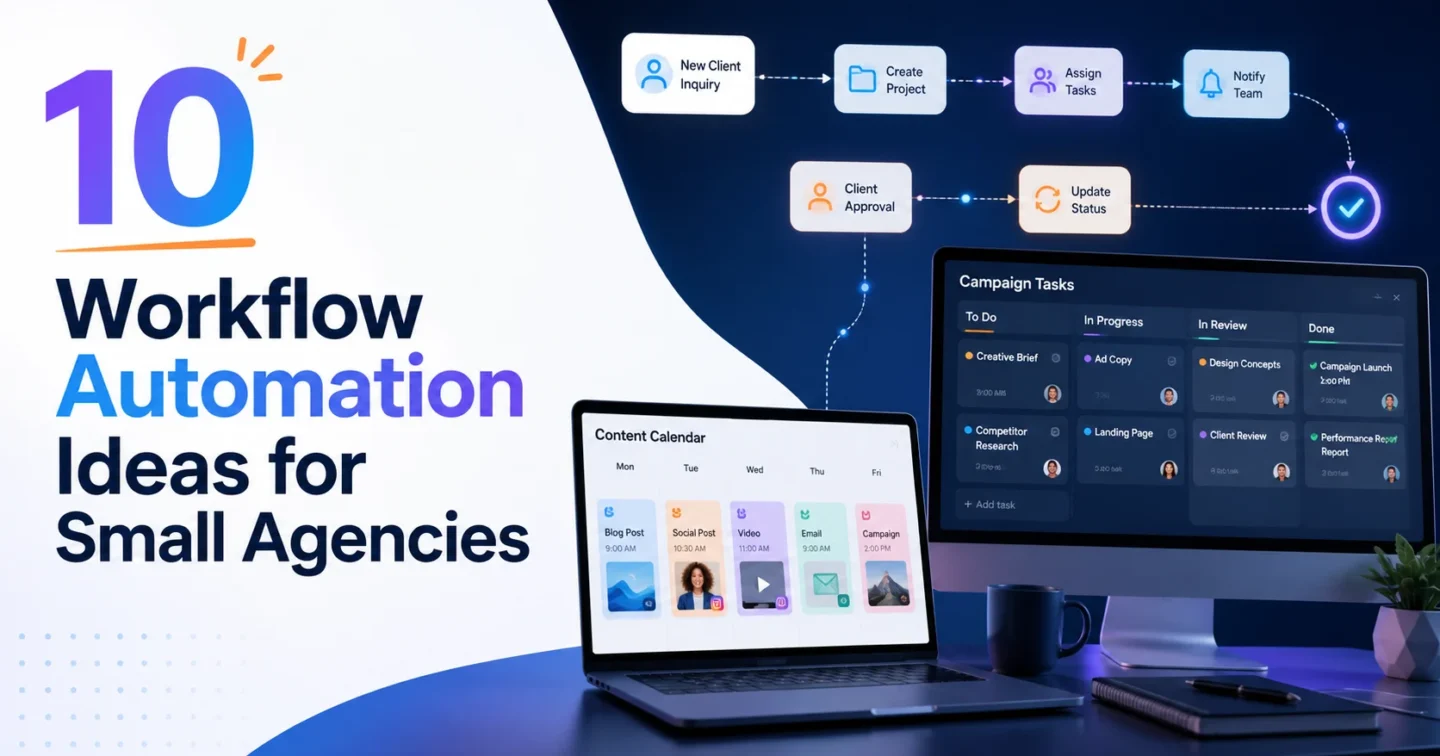
Small agencies operate with a difficult mix of high client expectations and limited operational capacity. The work itself may be profitable, but margin disappears when account managers rebuild project folders, copy campaign data, chase approvals, create recurring tasks and prepare reports by hand. Automation can protect that margin, but only when it follows the agency’s actual delivery process.
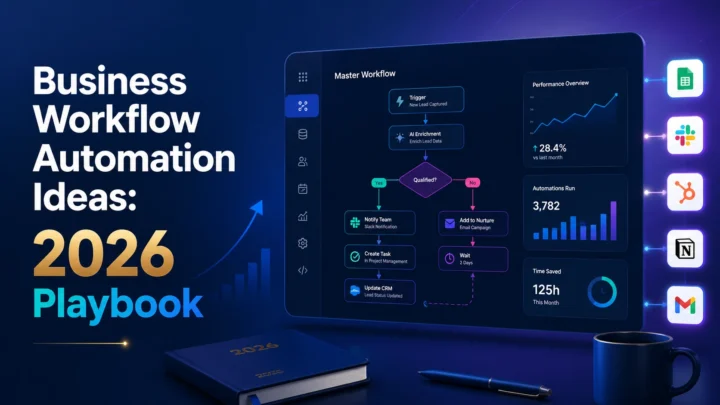
This article is a focused cluster within the Business Workflow Automation Ideas: 2026 Playbook. Read the pillar first when you need a complete framework for prioritization, governance and rollout.
1. Qualify and route new leads
Trigger: a prospect submits a website, referral or ad form. Workflow: validate required fields, check for duplicate contacts, tag the requested service, score basic fit using explicit rules and assign the lead to the correct owner. Add an AI step only to summarize free-text needs or classify the inquiry. Safeguard: uncertain or high-value leads go to manual review. Measure: response time, complete CRM records and qualified-to-meeting rate.
2. Build a proposal preparation workflow
Trigger: an opportunity is marked ready for proposal. Workflow: create a proposal task, pull approved scope details, generate a first draft from a locked template, collect delivery and pricing approval, then notify the account owner. Safeguard: do not allow a language model to invent pricing, timelines, legal terms or promised results. Measure: time from discovery call to approved proposal and number of correction loops.
3. Turn signed deals into ready-to-run projects
Trigger: contract signature or first payment. Workflow: create the project from a service template, add milestones, create the client folder, open the internal collaboration channel, assign an owner and prepare the kickoff agenda. Safeguard: compare signed scope, CRM value and service template before creating delivery tasks. Measure: time from close to kickoff readiness.
4. Collect client onboarding information without chasing
Trigger: project created. Workflow: send one structured onboarding form, validate required fields, store answers in the project record, request missing assets and schedule reminders only for incomplete items. Safeguard: do not request passwords through ordinary forms; use approved credential-sharing tools. Measure: days to complete onboarding and number of manual follow-ups.
5. Automate content production handoffs
Trigger: brief approved. Workflow: create writing, design, SEO, client-review and publishing tasks; attach the same brief; notify the next owner only when required fields are complete; record the final URL and asset locations. Safeguard: the system should block publication when approval, claims review or rights checks are missing. Measure: production cycle time and revision rounds.
6. Convert meeting notes into accountable work
Trigger: approved call transcript or meeting note. Workflow: extract decisions and action items, propose owners and dates, create project tasks after confirmation and post a concise summary with the source link. Safeguard: a person confirms client commitments before they become tasks or deadlines. Measure: percentage of actions assigned within one business day and overdue action rate.
7. Create reliable weekly client reports
Trigger: scheduled reporting window. Workflow: collect data from approved platforms, calculate metrics with deterministic formulas, compare with previous periods, draft commentary and assemble a client-ready report. Safeguard: AI can summarize trends but cannot invent causes or alter source numbers. Measure: report preparation time, correction rate and on-time delivery.
8. Control review and approval deadlines
Trigger: deliverable enters client review. Workflow: send the review link, record the due date, remind the correct reviewer, alert the account manager before delay affects the timeline and capture final approval. Safeguard: reminders stop immediately when approval is received. Measure: average client-review time and projects delayed by missing approval.
9. Automate invoice reminders with account context
Trigger: invoice reaches a due-date rule. Workflow: verify payment status, check for disputes, send the correct reminder, notify the account owner and create an escalation task after a threshold. Safeguard: suppress messages for disputed, credited or recently paid invoices. Measure: overdue receivables and manual chasing time.
10. Detect renewal and expansion opportunities
Trigger: contract approaches renewal or client usage reaches a defined signal. Workflow: create an account review, gather performance history, summarize open risks and prompt the account manager to plan a renewal conversation. Safeguard: never auto-send an upsell based only on AI interpretation. Measure: renewal preparation lead time, retention and expansion pipeline created.
A Practical Small-Agency Automation Stack
| Layer | Typical tools | Purpose |
| System of record | CRM + project management | Own client, opportunity, project and task status. |
| Automation engine | Zapier, Make, n8n or Power Automate | Move data and trigger actions across systems. |
| Collaboration | Slack or Microsoft Teams | Notify owners and keep discussions attached to work. |
| Files and knowledge | Google Drive, SharePoint, Notion or Confluence | Store approved templates, assets and SOPs. |
| Reporting | Looker Studio, Power BI or platform dashboards | Present validated metrics and trends. |
Choose one system to own each type of information. If client status exists in the CRM, project tool and spreadsheet with no clear source of truth, automation will reproduce inconsistent records. Define the owner before connecting the apps.
The existing AI automation agency guide explains the service model, while AI automation for digital marketing agencies provides broader use cases. This cluster should focus specifically on operational workflow design.
How to Roll Out the First Three Agency Workflows
- Map lead-to-project handoff, because it touches revenue and delivery and exposes inconsistent fields quickly.
- Automate client onboarding next, using one structured form and a single project template.
- Automate weekly reporting only after the source metrics and calculation rules are agreed.
- Run each workflow for at least two normal cycles before adding AI classification or drafting.
- Assign a maintainer and record every dependency, field mapping, credential and fallback step.
| Agency-specific rule |
| Never automate a promise the delivery team has not approved. Proposals, deadlines, performance claims, scope changes and client-facing explanations should retain a human checkpoint even when the first draft is generated automatically. |
Metrics That Show Whether Automation Is Helping
- Lead response time
- Proposal turnaround time
- Days from signature to kickoff
- Client onboarding completion time
- Deliverable cycle time
- Client approval delay
- Report preparation time
- Overdue invoice value
- Workflow exception rate
- Manual bypass rate
Frequently Asked Questions
Which agency workflow should I automate first?
For most small agencies, start with lead capture and sales-to-delivery handoff. These workflows are frequent, easy to measure and directly affect revenue and client experience.
Can agencies automate client communication?
Yes, but use automation mainly for confirmations, reminders, status changes and approved templates. Sensitive feedback, strategy, complaints, scope changes and performance explanations should be reviewed by the account owner.
Is Zapier or Make better for an agency?
Zapier is usually faster for simple workflows and broad app coverage. Make often provides more visual control for complex branching and data transformation. The better choice depends on your client stack, volume, maintainer skills and cost model.
How do agencies prevent automation from becoming messy?
Use naming standards, folders, one source of truth, workflow owners, documented field maps, test data and scheduled reviews. Retire duplicate workflows instead of keeping multiple versions active.
Can an agency sell the same workflows to clients?
Yes, when the workflow is adapted to the client’s systems, risks and process. Treat templates as starting points, not finished solutions, and document maintenance, data access and responsibility clearly.
Conclusion
The best agency automations protect attention and margin. They reduce coordination work without removing the human judgment clients are paying for. Start with one repeated handoff, make the source data reliable, add clear approvals and measure the change. Once the workflow performs consistently, turn it into a documented internal template that can be reused across clients and services.
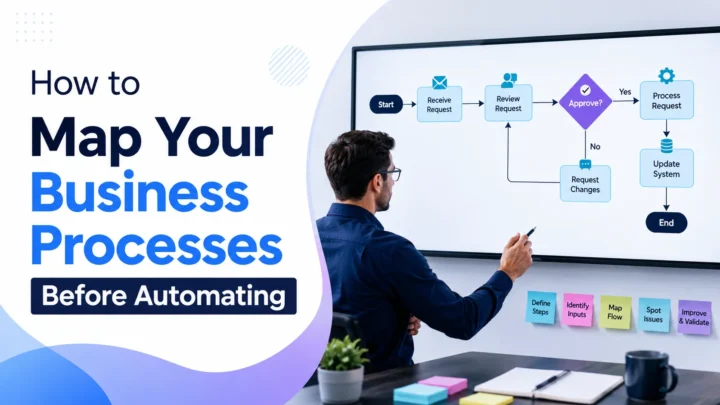
Next, read how to map business processes before automating or review the full business workflow automation playbook.