
AI Overview: The short answer
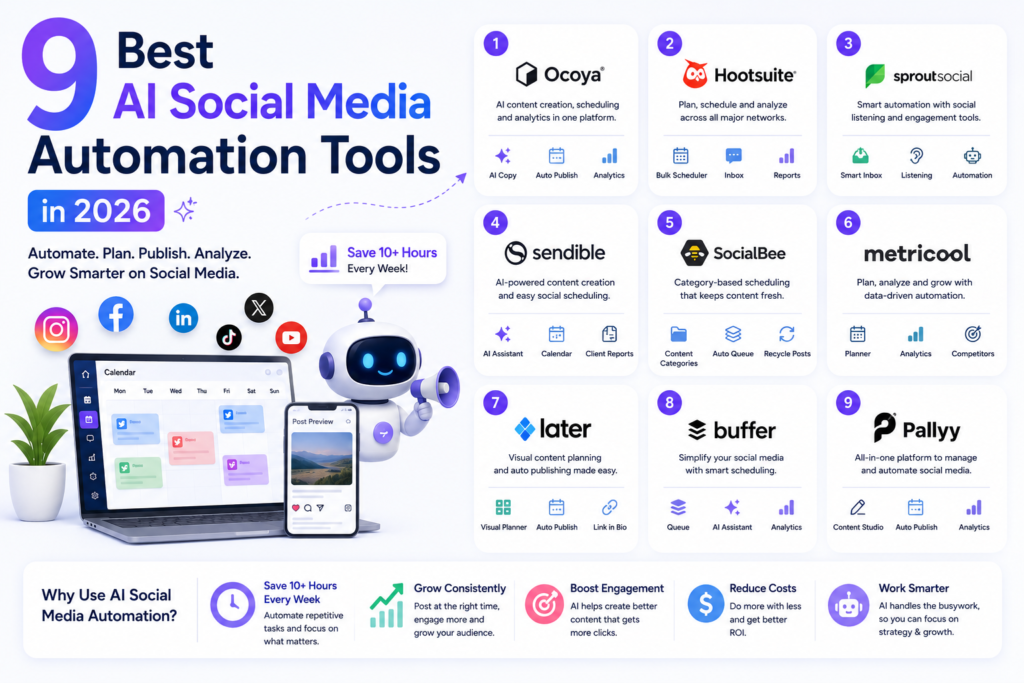
For generating social titles, captions, descriptions and hashtags without code, start with a scheduler that supports drafts and approvals, then add AI assistance for variations. Buffer, SocialBee, Publer and similar tools suit different publishing workflows; selection depends on channels, approvals, brand context and total usage costs.
This is a buyer guide for teams that need consistent posting without losing editorial control. A good tool reduces repetitive formatting and scheduling, but it should not invent product claims or publish unfinished AI text.
Who this guide is for, and what it does not promise
Small agencies, solo marketers and brand teams that publish across two or more channels but do not want a complicated integration project. A caption generator makes text. A scheduling platform moves approved content into queues. A workflow platform connects briefs, approval records and publishing systems. Combining these functions intelligently matters more than choosing one fashionable AI brand.
The practical outcome is a system that another person can inspect, operate and improve. Any timings, costs, or examples below are planning examples rather than measured private benchmarks. A result in your own business depends on data quality, integration limits, permissions, process design and the people responsible for exceptions.
Step-by-step implementation and buying framework
Step 1: Identify the real bottleneck
Count the minutes spent researching topics, drafting captions, formatting each platform and scheduling. Pick the slowest repeatable step.
Practical example: A brand may draft captions quickly but lose time turning one approved campaign into five platform-specific posts.
Safeguard: Record cycle time and revisions before choosing a subscription.
Write the output of this step as a clear field or decision that the next owner can understand. The objective is a repeatable operational decision, not a one-off demonstration that works only with perfect sample data.
Step 2: Separate ideation from publishing
Use AI to propose angles, hooks and headline variants, but keep source material and factual claims attached to each idea.
Practical example: A webinar transcript can yield three editorial angles, each linked to the original recording and claim owner.
Safeguard: Reject posts that introduce benefits, discounts or statistics missing from the source.
Before wiring apps together, check a representative record with both complete and missing information. The objective is a repeatable operational decision, not a one-off demonstration that works only with perfect sample data.
Step 3: Compare native AI assistance
Evaluate the editor, template library, brand instructions, languages, reuse options and how easily an editor can improve the draft.
Practical example: A small agency benefits from reusable client tones and separate calendars more than flashy image generation.
Safeguard: Ask whether the plan limits seats, channels, AI uses or approvals.
Avoid adding an AI model merely because it is available; a deterministic check is often easier to audit. The objective is a repeatable operational decision, not a one-off demonstration that works only with perfect sample data.
Step 4: Build a platform-specific brief
Store the intended audience, objective, call to action, approved offer, character limits and forbidden phrases.
Practical example: A LinkedIn thought-leadership post needs context and nuance; an Instagram caption needs an opening line and clear visual reference.
Safeguard: Avoid identical posts on every platform.
Record where the input came from and what an authorized team member may change. The objective is a repeatable operational decision, not a one-off demonstration that works only with perfect sample data.
Step 5: Design a human approval step
Drafts should enter an approval queue with the asset, copy, link and publishing date visible together.
Practical example: The client approves copy after reviewing the actual image rather than a caption in a disconnected spreadsheet.
Safeguard: Restrict publishing permissions and keep an edit history.
Decide what should happen when the source is late, blank or inconsistent with another system. The objective is a repeatable operational decision, not a one-off demonstration that works only with perfect sample data.
Step 6: Test the publishing integration
Verify each channel, permissions, link format, image size, alt text and what happens when a social API rejects a post.
Practical example: A carousel may require different handling than a simple image post.
Safeguard: Keep failed posts visible and never assume an API success means publication succeeded.
Keep the workflow observable: a user should be able to locate the run and inspect what failed. The objective is a repeatable operational decision, not a one-off demonstration that works only with perfect sample data.
Step 7: Track performance by creative concept
Use tagged links and a campaign identifier, then compare meaningful outcomes beyond vanity engagement.
Practical example: A useful metric is demo requests per approved post rather than raw impression counts alone.
Safeguard: Do not let AI attribute sales when tracking data is missing.
Test normal, duplicate and deliberately incorrect inputs before increasing volume. The objective is a repeatable operational decision, not a one-off demonstration that works only with perfect sample data.
Step 8: Choose a sensible cost structure
Model total channel connections, users, AI credits, content volume and required integrations before upgrading.
Practical example: A low entry fee may cost more when every client brand requires separate workspaces.
Safeguard: Check official pricing pages for current allowances and billing terms.
Compare the value of this step with its ongoing subscription and maintenance burden. The objective is a repeatable operational decision, not a one-off demonstration that works only with perfect sample data.
A realistic end-to-end example
A two-person marketing team publishes weekly product tips on LinkedIn, Instagram and Facebook. They record a factual source paragraph and image asset in Airtable, ask AI for channel-specific draft angles, send three drafts into an approval view, and let a scheduler publish only approved versions. On failure the system creates a task with the platform error rather than retrying indefinitely. The team compares approval turnaround and posts that actually went live each week.
A useful pilot starts with a small, permissioned sample set and explicit success criteria. Observe one standard case, a missing-data case, a duplicated event and an upstream service failure. Make sure the expected human is notified when manual action is needed. Once the normal path is trustworthy, increase volume gradually and check that costs remain in the intended range.
Inputs, outputs and exception ownership
| Element | What to define | Why it matters |
|---|---|---|
| Trigger | One unambiguous event or approved status | Prevents premature or duplicate activity |
| Required input | Typed fields, approved content and source identifiers | Stops a plausible AI answer being treated as verified data |
| Expected output | The record, draft, action or decision created | Makes success objectively testable |
| Owner | A human who can review and repair the result | Prevents silent failure |
| Audit record | Source ID, timestamp, outcome and relevant change history | Supports troubleshooting and safer corrections |
A process becomes expensive when it cannot answer a basic question: which source event created this action, what rule was applied and who can reverse it? Keeping these definitions next to the workflow also helps new team members maintain it.
How to compare effort, cost and reliability
Use the same test scenario across candidate platforms. Record setup effort, number of billable actions or credits, user and channel limits, exception visibility, integration permissions, and the time required to make a small change. These are decision inputs, not universal rankings. A cheaper entry plan may become a costly production option when support, usage and retried events are added.
For a simple break-even calculation, start with the actual monthly minutes spent on the process, multiply by the number of occurrences and compare with the software, review and maintenance effort after automation. Include rework and incident response rather than counting only the happy path. Financial estimates are illustrative until you measure your own baseline.
Common mistakes and how to avoid them
One prompt for every network
Platform conventions differ; adapt structure, CTA and visual context instead of cloning one generic paragraph. Define a clear owner, validation rule and recovery path; if the workflow cannot explain what happens when this problem occurs, it is not ready to handle business-critical records unattended.
Publishing unreviewed claims
An AI assistant may confidently invent a feature or promotion; require a source link and owner approval. Define a clear owner, validation rule and recovery path; if the workflow cannot explain what happens when this problem occurs, it is not ready to handle business-critical records unattended.
Ignoring permissions and outages
Channel permissions expire and APIs change. Keep a manual fallback and an exception queue. Define a clear owner, validation rule and recovery path; if the workflow cannot explain what happens when this problem occurs, it is not ready to handle business-critical records unattended.
Optimizing only for quantity
More scheduled posts can create noise. Audit qualified engagement, leads and content quality. Define a clear owner, validation rule and recovery path; if the workflow cannot explain what happens when this problem occurs, it is not ready to handle business-critical records unattended.
Monitoring, safety and iteration
Monitor three outcomes separately: whether the trigger occurred, whether the downstream action succeeded and whether the final business outcome was correct. A green API response does not prove a customer saw the correct message or a team member received a usable record. Review exceptions on a schedule suited to business risk and keep a clearly labeled manual override.
Protect data by limiting credentials to required scopes, preferring service-owned connections, rotating secrets and removing personal details from prompts that do not need them. Make sure customer-facing automation observes applicable privacy and communication requirements. When AI is involved, test malicious and irrelevant input, require grounded responses and route uncertain decisions to a person.
Related guides on AI Automation Hacks
Explore AI automation agency guide for an adjacent implementation or buying decision.
Explore Make vs Zapier comparison for an adjacent implementation or buying decision.
Explore business workflow automation playbook for an adjacent implementation or buying decision.
Explore process mapping before automation for an adjacent implementation or buying decision.
Frequently asked questions
What is the best no-code tool for titles and hashtags?
Choose based on your channels and approval needs, then test three samples with your brand brief. A capable AI caption assistant inside a scheduler may be sufficient.
Can AI post directly to Instagram or LinkedIn?
Supported scheduling integrations can publish certain content formats after the account is authorized; availability and limitations depend on the network and content type.
Should hashtags be AI-generated?
AI can suggest candidates, but relevance matters more than volume. Remove irrelevant or repetitive hashtags.
Is one tool enough for an agency?
A scheduler may be enough at low volume; larger teams often add a source library, workflow automation and client approvals.
How should success be measured?
Track approved posts published successfully, hours spent revising, website visits and qualified leads rather than making assumed ROI claims.
Official documentation and further reading
- Official product or documentation page
- Official product or documentation page
- Official product or documentation page
Final recommendation
Begin with the narrowest useful workflow or decision in this guide and measure its real outcomes before scaling. Keep the published explanation aligned with the functionality you can verify, the price units your team will actually pay and the exceptions you can handle. The best automation is the one that solves a defined task reliably, with understandable ownership and no unearned claims about results.