Affiliate Disclosure: This post may contain affiliate links. If you purchase a tool through one of our links, we may earn a small commission at no extra cost to you. We only recommend tools we have personally tested and believe will add real value to your business. Read our full Disclaimer for details.
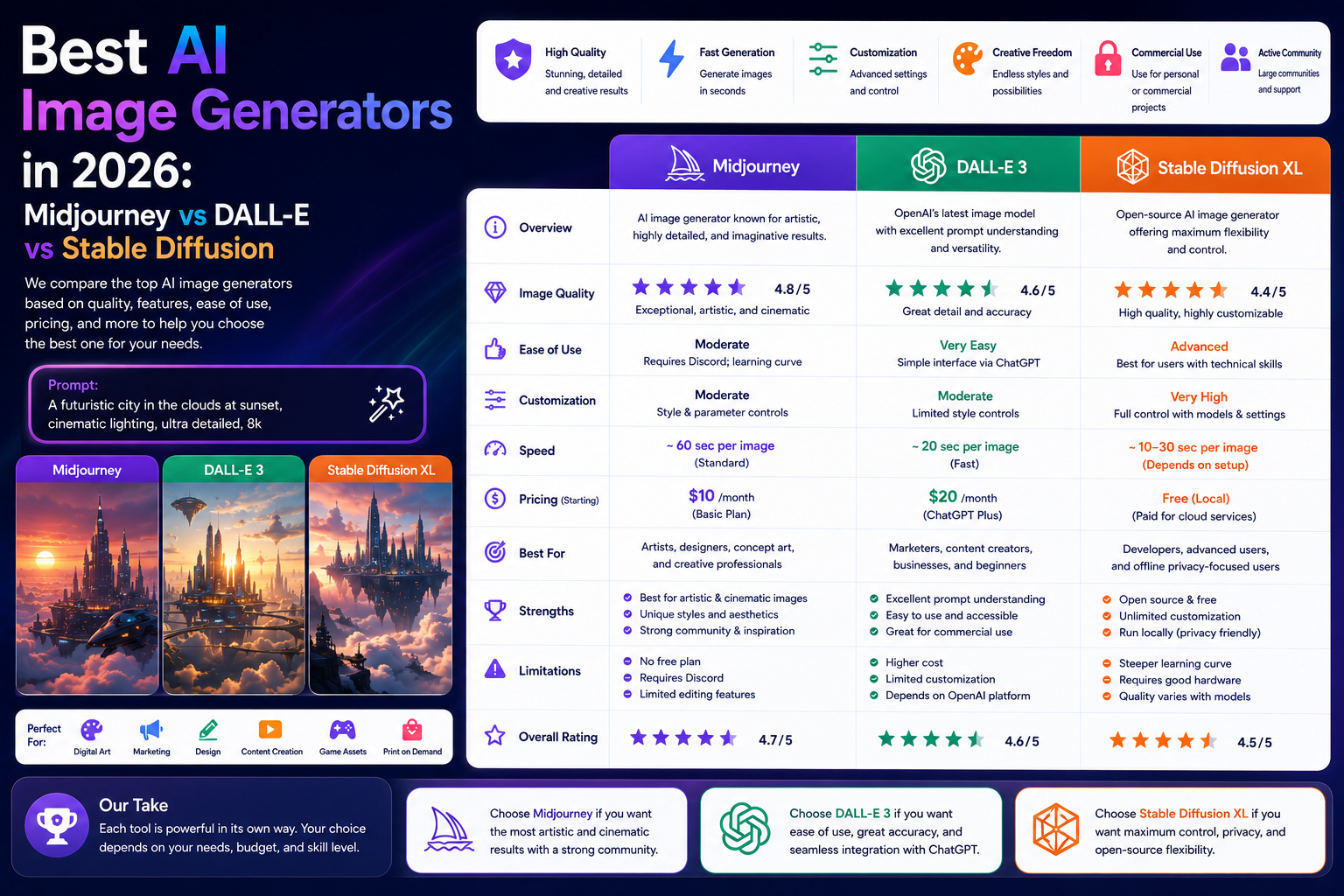
| Quick Answer (AI Overview snippet) In 2026, Midjourney is the best AI image generator for aesthetic quality — the most beautiful default output for marketing and art, from $10/month. DALL-E (via ChatGPT) is the best for ease, accurate text in images and conversational editing, included with ChatGPT plans. Stable Diffusion is the best for control, customization and cost — free and open source, run locally or via services, with fine-tuned models and total commercial freedom. Most businesses pick Midjourney for polish, DALL-E for convenience, Stable Diffusion for scale. |
Three Generators, Three Different Bets
Every list of AI image generators eventually collapses into the same three names, because Midjourney, DALL-E and Stable Diffusion are not just products — they are the three philosophies the whole field organized around. Midjourney bet on aesthetics: a model with taste, tuned relentlessly toward images people find beautiful. OpenAI bet on accessibility: DALL-E lives inside ChatGPT, where making an image is just another sentence in a conversation. And Stability bet on openness: Stable Diffusion’s weights are downloadable, remixable and free, spawning an ecosystem of fine-tuned models and tools nobody centrally controls.
For a small business, the choice has practical stakes: it decides how good your visuals look, how long they take, what they cost at volume, and what you are legally allowed to do with them. The good news is that the trade-offs are clean and stable — each generator wins a different game, and once you know which game you are playing, the choice mostly makes itself.
We ran all three through an identical battery — product shots, blog heroes, social graphics, text-in-image designs, brand-style consistency tests — and this comparison reports what we found. Images are half of a content pipeline; the moving half is covered in our Best AI Video Generators guide.
Midjourney vs DALL-E vs Stable Diffusion at a Glance
| Factor | Midjourney | DALL-E (ChatGPT) | Stable Diffusion |
| Default image quality | Best-in-class aesthetics | Very good, clean | Varies by model — good to excellent |
| Ease of use | Moderate (web app + Discord) | Easiest — just chat | Hardest locally; easy via services |
| Text in images | Improved, still imperfect | Best of the three | Model-dependent |
| Control & customization | Style refs, params | Conversational edits | Total — fine-tuning, LoRAs, ControlNet |
| Price | From $10/month | With ChatGPT (free tier limited) | Free open source; services vary |
| Commercial use | Yes on paid plans | Yes | Yes — most permissive |
| Privacy | Public by default (private on higher tiers) | Private | Fully private if run locally |
Image Quality: Midjourney Still Sets the Bar
Quality in 2026 needs splitting into two questions. On technical fidelity — coherent hands, accurate objects, prompt adherence — all three have largely solved the embarrassments of the early years. On aesthetics — does the image look like something a designer would proudly ship — Midjourney remains distinctly ahead. Its default output has lighting, composition and color grading that the others reach only with effort; the same lazy prompt produces a poster in Midjourney and a decent stock photo elsewhere.
DALL-E’s strength is a different kind of quality: correctness. It follows complicated instructions faithfully, renders legible text in images better than anything else — a genuine superpower for social graphics, thumbnails and mockups — and its conversational editing (“make the background warmer, move the logo left”) iterates toward exactly what you asked for. Stable Diffusion’s quality depends entirely on which model you run: base models are merely good, while the best community fine-tunes rival or beat the big two within their specialty — photorealistic portraits, anime, architecture — because that is precisely what they were tuned for.
Winner: Midjourney for beauty, DALL-E for accuracy and text, Stable Diffusion for specialized peaks.
Ease of Use: DALL-E Wins Without Trying
DALL-E’s interface is a sentence. If you can describe what you want to ChatGPT, you can generate, refine and edit images with zero learning curve — which makes it the only one of the three a busy non-designer will still be using in month six. Midjourney’s web app has matured far beyond its Discord origins into a pleasant studio with visible parameters and organized galleries, but learning to prompt it well — style references, aspect ratios, weirdness and stylize values — is a real (and rewarding) skill.
Stable Diffusion spans the whole spectrum. Through hosted services and apps it is as easy as the others; run locally through interfaces like ComfyUI it becomes a node-graph power tool with installation, model management and GPU requirements. That difficulty buys the highest ceiling of control in the field — but nobody should pretend the entry stairs aren’t steep.
Winner: DALL-E, by a mile, for normal humans.
Control and Customization: Stable Diffusion Is Untouchable
Here the open model lapse the field. Stable Diffusion can be fine-tuned on your products, your art style, your face. LoRAs — small trainable add-ons — teach it specific styles or subjects in an afternoon. ControlNet locks composition to a sketch, a pose or a depth map, giving pixel-level governance no prompt can match. For a brand that needs every image in one exact style, or an e-commerce store generating thousands of on-model product shots, this customization isn’t a luxury — it is the entire business case.
Midjourney offers the middle path: style and character references let you anchor a consistent look or recurring subject across generations, covering most brand-consistency needs without any training. DALL-E offers the least structural control, compensating with the easiest iteration loop — you don’t configure consistency, you ask for it, with mixed but improving results.
Winner: Stable Diffusion, and it isn’t close.
Pricing and Commercial Rights
| Midjourney | DALL-E | Stable Diffusion | |
| Free option | No | Limited free via ChatGPT | Yes — weights are free |
| Typical paid | $10–$30/month | $20/month (ChatGPT Plus) | $0 local; ~$10–$30 hosted |
| High volume | $60–$120/month tiers | API per-image pricing | Hardware cost only — cheapest at scale |
| Commercial use | Yes on paid plans (company size caveats) | Yes, per OpenAI terms | Yes — most permissive licenses |
Three pricing notes that matter in practice. First, Midjourney’s default visibility is public — your generations appear in the community feed unless you pay for higher tiers with stealth mode, a real consideration for unannounced products. Second, copyright on purely AI-generated images remains unsettled in many jurisdictions — most offer no copyright protection for fully automated output — so treat generated images as usable but not necessarily ownable, and keep humans meaningfully in the creative loop for assets you must protect. Third, at serious volume (thousands of images monthly), locally-run Stable Diffusion’s marginal cost of approximately zero beats every subscription by an order of magnitude.
Winner: Stable Diffusion on cost and freedom; DALL-E on bundled value if you already pay for ChatGPT.
Which Should You Choose?
Choose Midjourney if…
- Visual quality is the point — marketing, branding, social content where images must stop scrolls and look expensive.
- You will invest a few hours learning to prompt well and want the highest aesthetic return on that investment.
Choose DALL-E if…
- You already use ChatGPT and want very good images with zero additional cost, tools or learning.
- Your images involve text — thumbnails, quote graphics, mockups — where DALL-E’s rendering leads the field.
Choose Stable Diffusion if…
- You need brand-exact consistency, fine-tuned styles or compositional control beyond what prompting offers.
- Volume or privacy rules the decision — unlimited local generation with nothing leaving your machine.
The Honest Answer: Most Businesses Use Two
In practice, the most common professional setup is DALL-E for the everyday — quick blog images, drafts, anything with text — because it is already there in ChatGPT, plus Midjourney for the work that represents the brand publicly, because the quality gap is visible to customers. Stable Diffusion enters when one of its unique properties — fine-tuning, volume economics, privacy — becomes a requirement, at which point it tends to take over that workload completely rather than share it.
Whichever you choose, prompting skill compounds across all three: subject, style, lighting, composition, mood — specified in that order — outperforms vague requests everywhere. Our prompt hacks for beginners translate directly from text to image prompting.
Worth a Mention: The Challengers
The big three no longer have the field to themselves, and two challengers earn a paragraph. Google’s Imagen models — available through Gemini — produce excellent photorealistic output and inherit Gemini’s pricing generosity, making them a strong fourth option for Google-centric users. And Ideogram built its reputation specifically on typography, contesting DALL-E’s text-rendering crown for poster-style and logo-adjacent work. Neither displaces the trio above for general use yet, but both are free to try and occasionally win specific jobs — a fifteen-minute test against your real use case costs nothing.
Playbook: The Right Generator for Each Business Job
Blog featured images: DALL-E for speed — describe the article’s concept conversationally and iterate twice. Switch to Midjourney for cornerstone posts where the hero image doubles as the social share card and first impressions carry weight.
Social media graphics with text: DALL-E or Ideogram, full stop — legible typography is their lane. Generate the visual with the text placeholder described precisely (“bold white sans-serif headline reading ‘SUMMER SALE’ top center”), then verify spelling before posting; even the best models occasionally drop a letter.
Ads and brand campaigns: Midjourney with style references locked to your brand look. Build a reference set of 3–5 approved images first; every subsequent generation anchored to them keeps campaigns coherent across months and team members.
E-commerce product visuals at volume: Stable Diffusion fine-tuned on your product photography. The upfront training day pays back on the first hundred images, and ControlNet keeps angles and compositions catalog-consistent in a way no prompt-only tool can.
YouTube thumbnails: DALL-E for the text and layout, Midjourney for background art when you want the cinematic pop — composited in any editor in two minutes. Thumbnails are the highest-ROI image job in content marketing; spend accordingly.
Internal decks and docs: Whatever is closest at hand — which is DALL-E for ChatGPT users and Gemini’s Imagen for Google users. Polish is wasted on slide 14 of an internal review.
Three Mistakes That Waste Your Image Budget
- Prompting all three the same way. Midjourney rewards mood-and-style language, DALL-E rewards explicit instructions, Stable Diffusion rewards structured prompts plus negative prompts. Reusing one prompt style across all three guarantees two of them underperform.
- Ignoring aspect ratios until export. Generate at the destination ratio — 16:9 heroes, 9:16 stories, 1:1 feed posts. Cropping a square masterpiece into a banner discards the composition the model worked to balance.
- Publishing the first acceptable result. Generation is nearly free; mediocrity is not. Professionals generate 4–8 variants, pick the strongest and refine once — a two-minute habit that visibly separates amateur from polished feeds.
Frequently Asked Questions
Midjourney produces the most aesthetically impressive images and is the best choice for marketing and brand visuals. DALL-E inside ChatGPT is the easiest to use and the best at rendering text in images. Stable Diffusion offers the most control and the lowest cost at scale as free open-source software. The best choice depends on whether polish, convenience or control matters most.
For visual beauty and artistic quality, yes — Midjourney’s default output remains the industry benchmark. DALL-E wins on ease of use, instruction-following, conversational editing and text rendering. Many professionals use both for different jobs.
Yes — the model weights are open source and free to download and run on your own hardware with no usage limits. Costs arise only from your GPU hardware or from optional hosted services, which typically charge $10–$30/month for convenience.
Generally yes: Midjourney paid plans, OpenAI’s terms and Stable Diffusion’s licenses all permit commercial use. Note that purely AI-generated images may not qualify for copyright protection in many jurisdictions, and you remain responsible for avoiding trademarked content and recognizable real people in outputs.
DALL-E leads for accurate, legible text rendering, making it the default for thumbnails, quote cards and mockups, with Ideogram as a strong specialist alternative for typography-heavy designs.
A computer with a modern GPU — ideally 8GB+ of VRAM — plus an interface like ComfyUI or a one-click installer app. Setup takes under an hour following current guides, after which generation is unlimited and completely private.
Final Verdict
Midjourney for beauty, DALL-E for ease, Stable Diffusion for power — the 2026 verdict fits in a sentence because each generator kept its founding bet and won it. A small business can stop at DALL-E and be well served; a brand that lives on visuals should pay for Midjourney without agonizing; and any operation where images are infrastructure — volume, consistency, privacy — will eventually arrive at Stable Diffusion because nothing else can follow it there. Start with the one matching your nearest deadline, and let your real usage, not the discourse, decide where you settle.
Build the full visual pipeline with our Best AI Video Generators comparison, and see where image generation slots into business workflows in the Ultimate Guide to AI Automation Tools 2026.
Disclaimer: The information in this article is for general informational purposes only and does not constitute professional, financial or legal advice. Pricing and features are accurate as of publication but may change; always verify details on the official vendor websites before purchasing. AI Automation Hacks is not affiliated with the companies mentioned except through standard affiliate partnerships disclosed above. See our full Disclaimer and Privacy Policy.