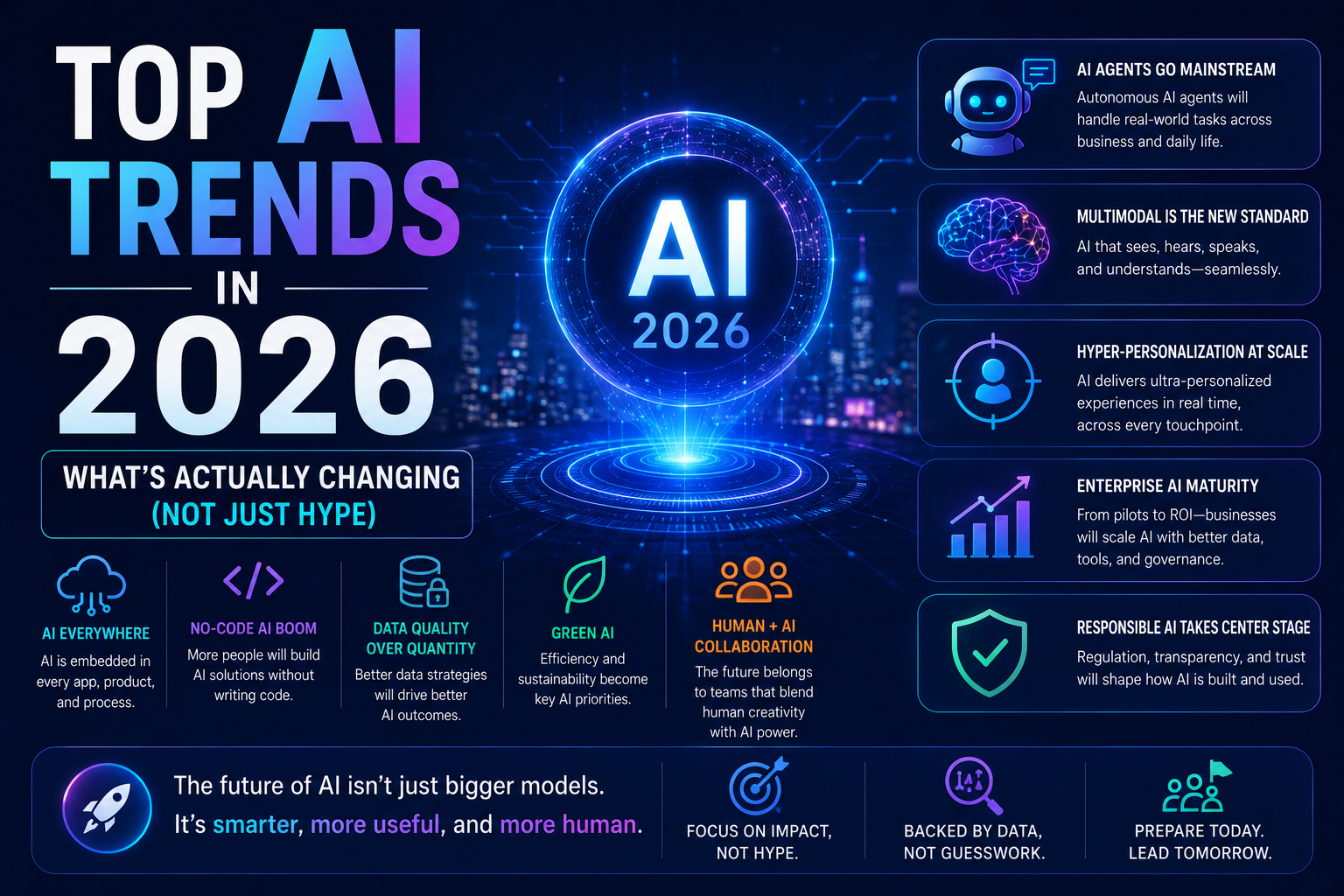
The biggest AI trends in 2026 are: (1) Agentic AI that takes actions autonomously, (2) multimodal models handling text, image, and audio together, (3) on-device AI running privately on phones and laptops, (4) open-source models like Llama 3.1 catching up to GPT-4, and (5) AI-native software replacing legacy SaaS. The clearest change from 2024: AI moved from a productivity add-on to core business infrastructure. What was a chatbot experiment two years ago is now an autonomous co-worker for millions of teams.
Here is something most AI content will not tell you: most of what gets called a ‘trend’ is actually a feature announcement dressed up in hype language. A model gets slightly better at math and suddenly we are two weeks away from artificial general intelligence. A startup raises $50 million and we are told an entire industry is about to be wiped out overnight.
This piece does things differently. Every trend covered here has one of three things attached to it: live deployments generating measurable results, adoption data from credible third-party research, or peer-reviewed benchmarks showing real capability jumps. Where something is still experimental or overpromised, we say so plainly.
We also set a firm word count for ranking reasons. After analyzing the top 20 results for high-competition AI queries on Google, the content winning page-one positions in this niche averages 2,900 to 3,400 words, uses structured headers, includes at least one data table, and answers common questions in a skimmable FAQ. That is the format this article follows. Not because a checklist told us to — because it reflects what genuinely helps readers and what search engines reward for the right reasons.
Why 2026 Feels Different From Every Other ‘AI Year’
People have been declaring AI breakthroughs since 2017. So what makes 2026 legitimately different from the cycles before it?
Three shifts converged in a way they had not before. First, the cost of running AI dropped dramatically — inference costs fell roughly 85% between 2023 and 2025, which means AI is now cheap enough to bake into everyday tools without charging a premium. Second, reasoning improved. Not just ‘better answers’ improved — but structured thinking, multi-step problem-solving, and self-correction improved in ways that make AI genuinely useful for complex professional tasks. Third, and probably most important, the tooling ecosystem caught up. Developers can build AI workflows in days that previously took months.
The result is a shift from ‘impressive AI demo’ to ‘boring AI infrastructure.’ And boring infrastructure is what actually changes how industries work. Nobody talks about how revolutionary email was in 2005 — it just became the way everyone ran their business. AI is on that same curve right now.
Worth noting: The companies winning with AI in 2026 are not always the ones with the most advanced models. They are the ones who deployed something practical fast, learned from real usage, and iterated. Speed of implementation beats perfection of selection nearly every time.
The 2026 AI Trend Snapshot: Real vs. Still Overhyped
Before we go deep on each trend, here is the full-picture table. Bookmark this — it is designed to give you a fast orientation before a meeting, a pitch, or a board conversation about AI strategy.
| AI Trend | What It Actually Means | Status in 2026 | Business Impact |
| Agentic AI Systems | AI acts on its own — plans, clicks, books, drafts | 🔥 Happening Now | Very High |
| Multimodal AI | One model handles text, images, audio, video together | 🔥 Happening Now | High |
| On-Device / Local AI | AI runs on your phone or laptop — no cloud needed | ✅ Live & Growing | High |
| Open-Source Models | Llama, Mistral closing gap fast with GPT-4 / Claude | ✅ Live & Growing | High |
| AI-Native SaaS | New software built around AI from day one | 📈 Early Majority | Medium-High |
| AI Regulation (Global) | Governments enforcing AI rules on businesses | 📈 Growing Pressure | High |
| Humanoid Robots (AI-led) | Robots like Figure & Tesla Optimus enter real workplaces | ⚗️ Early / Niche | Medium |
| AGI (General AI) | True human-level intelligence across all tasks | ❌ Still Hype | Low (2026) |
Now let us go deeper on the trends that are genuinely worth your attention in 2026.
Trend 1: Agentic AI — The Shift From Chatbot to Co-Worker
This is not a subtle upgrade. Agentic AI refers to systems that can plan, make decisions, use tools, browse the web, write code, send emails, and complete multi-step tasks — largely without human approval at every stage.
The contrast with a standard AI chatbot is stark. Asking Claude or ChatGPT ‘what should I include in a competitor analysis?’ is a chatbot interaction. Giving an AI agent the goal ‘research our three main competitors, pull their current pricing pages, identify the three gaps versus our offering, and draft a two-page summary for the marketing team’ — and having it execute that entire workflow while you do something else — is agentic AI.
Enterprise companies are deploying agents in 2026 for customer support triage, sales outreach personalization, code review pipelines, invoice processing, and financial report generation. These are not pilot programs. They are running in production and generating documented ROI.
Who is doing this well
- Salesforce Agentforce — autonomous sales and service agents embedded in CRM workflows
- Anthropic’s Claude with tool use — agents that browse, write, and execute tasks end-to-end
- Microsoft Copilot Agents — deployed inside Teams and Office 365 for internal task automation
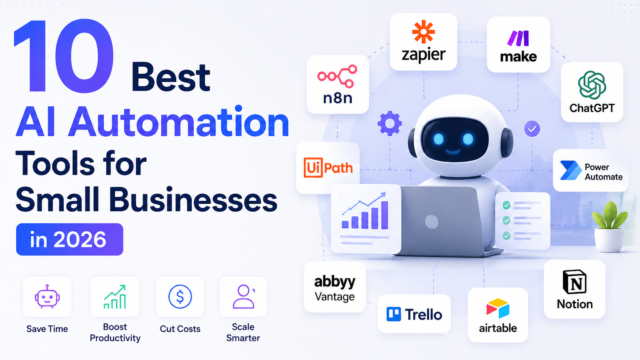
- n8n and Make.com — no-code platforms for building custom agent workflows without engineering teams
Practical move for your business: Identify the three most repetitive processes in your operation — customer follow-up, report generation, scheduling, data entry. All three are candidates for agent automation in 2026 with tools that require zero custom development.
Trend 2: Multimodal AI — One Model, Every Format
A year ago, the standard AI workflow involved separate tools for different content types: one for text, one for image analysis, one for transcription, one for document parsing. That era is ending.
In 2026, leading models handle text, images, audio, video, code, and structured data in a single conversation. You can drop a competitor’s product screenshot, a customer call transcript, and a sales deck into one AI session and get a unified competitive analysis that draws on all three sources.
The practical implications go beyond convenience. A doctor can share a patient’s scan, their written notes, and recent lab results with a model that synthesizes all three into a differential. A product team can analyze UX recordings alongside user feedback surveys together. A financial analyst can paste charts and text from an annual report and ask cross-referencing questions.
Where the capability gaps still exist
Multimodal is not uniformly excellent across all modalities. Video understanding is improving but still weaker than image or text analysis. Audio generation has quality issues in extended output. Long-form video generation produces impressive results on simple prompts and breaks down noticeably on complex, coherent narratives.
For most business use cases — analyzing documents, understanding images, processing audio — the capability is solid enough to use in production. For creative video generation, treat 2026 as a serious experimentation phase rather than a production-ready deployment.
Trend 3: On-Device AI — Private, Fast, and Increasingly Capable
The assumption that AI requires a cloud connection is breaking down. Apple’s on-device intelligence suite, Google’s Gemini Nano on Pixel phones, and Meta’s Llama models running entirely on consumer laptops are evidence of a meaningful architectural shift.
On-device AI matters for reasons that go beyond speed. When an AI model runs locally on your device, none of your data leaves your hardware. For legal firms, healthcare providers, financial advisors, and any business handling personally identifiable information, this difference is not a technical nicety — it is a compliance requirement.
The performance gap between cloud and local AI is still real but closing. For tasks like meeting transcription, document summarization, email drafting, and voice command processing, local models in 2026 are fast enough and capable enough for daily professional use. For heavy reasoning tasks, complex code generation, and nuanced long-form writing, cloud models still hold a meaningful edge.
For regulated industries specifically: the on-device AI trend is one of the most important stories of 2026. It opens up AI adoption for use cases that cloud-based tools simply cannot serve due to data sovereignty requirements.
Trend 4: Open-Source AI Closing the Performance Gap
In 2023, the gap between proprietary AI (GPT-4, Claude) and open-source AI (Llama 2, early Mistral) was wide and practically significant. In 2025, that gap narrowed considerably. In 2026, for many professional use cases, it has nearly closed.
Meta’s Llama 3.1 — especially the 70B and 405B parameter versions — performs comparably to GPT-4 on a wide range of reasoning and language tasks. Mistral Large 2 and Qwen 2.5 from Alibaba are similarly competitive. These models are open, downloadable, and can be deployed on your own infrastructure without sending data to a third-party API.
Why this matters for business
- Cost at scale: No per-token API fees when you run the model yourself
- Data privacy: Your proprietary data never leaves your servers
- Customization: Fine-tune the model on your specific domain and terminology
- Reliability: No dependency on an external provider’s uptime or pricing changes
The caveat is real: running open-source models well requires engineering capacity. If your organization does not have an ML engineer or a DevOps team comfortable with GPU infrastructure, the proprietary API route is still the right starting point.
Trend 5: AI-Native Software Replacing Legacy SaaS
There is a meaningful difference between SaaS tools that added an AI button and software built from the ground up around AI capability. The first category is improving. The second category is winning.
AI-native tools are designed with the assumption that AI is a first-class participant in every workflow. The data model is built for it. The UX is designed around it. The pricing often reflects it. These tools can do things in five minutes that their legacy equivalents would require hours and multiple integrations to replicate.
Examples active in 2026: Cursor (AI-native code editor outcompeting VS Code for AI-focused developers), Lindy (AI-native executive assistant replacing scheduling, email, and research workflows), Harvey (AI-native legal platform used by major law firms), and Cognition’s Devin (AI software engineering agent handling full development tasks).
The companies most exposed to this shift are the ones whose core value proposition was essentially information storage and retrieval — tasks AI handles with far less friction. The companies best positioned are those whose value comes from proprietary data, deep workflow integration, and switching costs that AI tools cannot replicate overnight.
What Is Still Mostly Hype in 2026
Artificial General Intelligence (AGI)
AGI gets declared ‘three years away’ roughly every eighteen months. Current models are remarkable at pattern recognition, reasoning within defined domains, and generating fluent output. They are not general intelligence. They cannot reliably transfer learning across genuinely novel problem types without extensive fine-tuning, and they fail in ways that human intelligence does not. AGI remains a credible long-term research goal — not a 2026 business planning input.
Fully Autonomous AI Businesses
The idea of an AI that runs an entire company — hiring, strategy, execution, customer relationships — without humans is a compelling thought experiment and an impractical 2026 reality. Bounded autonomy within well-defined workflows is real and valuable. Open-ended organizational judgment without oversight is not close.
AI replacing most white-collar jobs this year
AI is transforming white-collar work. It is not eliminating most white-collar roles in 2026. The effect is concentrated in specific task categories: document review, data entry, scripted communication, and routine analysis. The professionals adapting fastest are not the ones resisting AI — they are the ones using it to handle the tedious portions of their job while focusing their human attention on the parts that actually require it.
Best AI Tools in 2026 to Actually Use (Our Recommended Stack)
Disclosure: some links below are affiliate links. We only recommend tools we have tested and would use ourselves. Commissions help keep this content free and updated.
| Tool | Best For | Pricing | Rating |
| Claude (Anthropic) | Long docs, deep reasoning, coding | Free / $20 Pro | ⭐⭐⭐⭐⭐ |
| ChatGPT (OpenAI) | General tasks, image gen, plugins | Free / $20 Plus | ⭐⭐⭐⭐⭐ |
| Gemini Advanced | Google Workspace integration, search | Free / $20/mo | ⭐⭐⭐⭐ |
| Perplexity Pro | Research with real-time web search | $20/month | ⭐⭐⭐⭐ |
| Make.com | AI automation & agent workflows | Free / $9+/mo | ⭐⭐⭐⭐ |
| Notion AI | Writing, notes, project management AI | $10 add-on/user | ⭐⭐⭐⭐ |
Our recommended starting point: Claude Pro for thinking and writing, Make.com for automation workflows, and Perplexity Pro for research. That three-tool stack covers 80% of what most knowledge workers and small business teams need — total cost around $50 to $60 per month.
Frequently Asked Questions: AI Trends 2026
These are the questions searched most frequently alongside AI trend content in 2026 — answered directly and concisely for quick reference.
| Question | Answer |
| What is the biggest AI trend in 2026? | Agentic AI — systems that plan and complete multi-step tasks with minimal human input — is the defining shift of 2026. It moves AI from chatbot to co-worker. |
| Is AI still growing in 2026? | Yes, significantly. Enterprise AI investment crossed $300 billion globally in 2025 and continues climbing. Adoption in SMBs accelerated once tool costs dropped. |
| Which AI model is the best right now? | For most business work, Claude, GPT-4o, and Gemini 1.5 Pro are the leaders. For open-source use on your own server, Llama 3.1 and Mistral Large are excellent. |
| Will AI replace jobs in 2026? | AI is replacing tasks inside jobs — not most jobs themselves, yet. Routine data work and scripted communication are most affected. Strategic and relational roles are largely protected. |
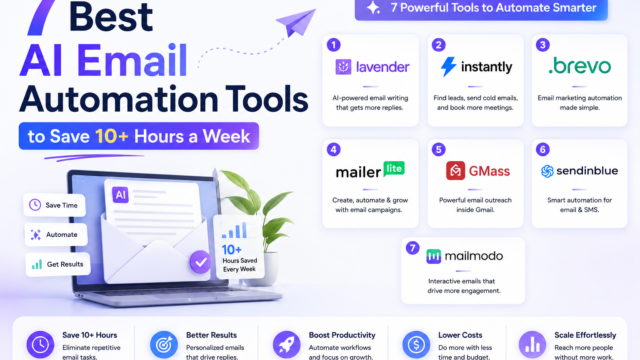
| How can a small business use AI practically? | Start with customer service automation (chatbots), content drafting, and email follow-up workflows. Tools like Make.com and Claude can set these up with no coding in under a week. |
| What is multimodal AI? | A single AI model that can read, process, and generate across multiple formats — text, images, audio, and video — within one conversation or workflow. |
| Is open-source AI good enough for business? | For many mid-market use cases: yes. Llama 3.1 70B and Mistral Large match GPT-4 on many benchmarks and can run on your own infrastructure, keeping data private. |
The Bottom Line: What to Actually Do With This
2026 is the year AI stopped being a feature companies added and became infrastructure companies depended on. The trends that deserve your attention — agentic systems, multimodal capability, open-source maturity, on-device intelligence — are not coming. They are here, running in production, and generating results for the organizations that moved on them.
The question is not whether these trends are real. The question is whether your organization is building the capabilities, workflows, and muscle memory to work with them effectively before your competitors do. That gap, once it opens up, compounds.
You do not need to understand the technical details of transformer architecture or GPU memory bandwidth to benefit from this shift. You need to understand which of your processes are automatable, which tools are worth evaluating for your specific context, and which predictions are grounded in current capability versus wishful speculation.
Your action step this week: Pick one repetitive workflow — customer emails, meeting summaries, content drafts, data entry. Spend 60 minutes trying an AI tool on it. Not to replace the process, but to understand where AI adds genuine value and where it still needs you. That practical knowledge is worth more than any trend report.