Affiliate Disclosure: This post may contain affiliate links. If you purchase a tool through one of our links, we may earn a small commission at no extra cost to you. We only recommend tools we have personally tested and believe will add real value to your business. Read our full Disclaimer for details.
| Quick Answer (AI Overview snippet) In 2026, ChatGPT is the best all-rounder — widest feature set, custom GPTs, images and the largest ecosystem. Claude is the best for writing quality, long documents and coding, with the most natural prose of the three. Gemini is the best value and the best for Google users — deeply integrated with Gmail, Docs and Drive, with generous free access. All three charge about $20/month for premium plans; most professionals pick by primary use case, not by raw capability. |
The Big Three, and Why This Choice Actually Matters
ChatGPT, Claude and Gemini have settled into the three default answers to “which AI should I use?” — and by 2026 the honest headline is that all three are extraordinarily capable. The gap between them on raw intelligence has narrowed to the point where leaderboard positions swap with every model release. What has not converged is everything around the model: the features, the ecosystems, the pricing structures, the personalities and the specific tasks where each one quietly outclasses the others.
That is why this comparison matters more, not less, than it did two years ago. You are no longer choosing the smartest AI; you are choosing a daily working environment. The $20/month you give one of these companies buys meaningfully different things depending on which door you walk through — and switching costs grow as your custom assistants, projects and chat history accumulate in one place.
We use all three daily in running this site, and this comparison reflects sustained working experience across writing, coding, research, automation and business admin — not a one-afternoon benchmark. For how these assistants slot into bigger workflows, our Ultimate Guide to AI Automation Tools 2026 is the companion read.
ChatGPT vs Claude vs Gemini at a Glance
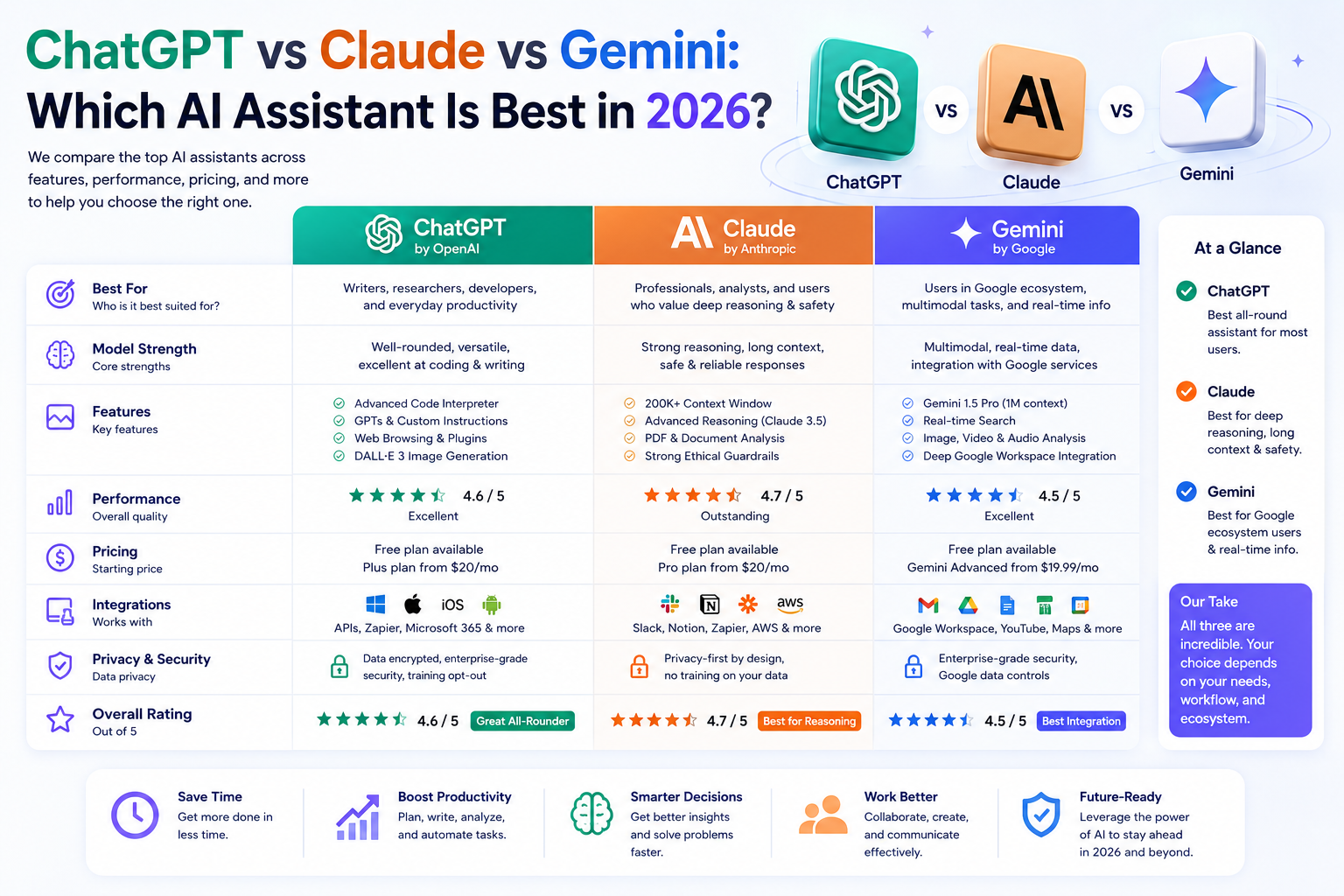
| Factor | ChatGPT | Claude | Gemini |
| Made by | OpenAI | Anthropic | |
| Best at | Versatility, ecosystem | Writing, long docs, coding | Google integration, value |
| Writing style | Capable, can feel templated | Most natural and nuanced | Clear, somewhat plain |
| Custom assistants | Custom GPTs (largest library) | Projects + custom styles | Gems |
| Standout feature | Feature breadth + plugins | Artifacts + huge context | Gmail/Docs/Drive integration |
| Free tier | Strong | Strong | Most generous |
| Premium price | $20/mo (Plus) | $20/mo (Pro) | $19.99/mo (Google AI plans) |
Writing Quality: Claude Takes the Crown
Put the same blog-post brief into all three and the differences appear within two paragraphs. Claude consistently produces the most natural prose: varied sentence rhythm, fewer stock phrases, a willingness to commit to a point of view rather than hedging everything into mush. Long-form is where the gap widens — across 2,000+ words Claude holds an argument’s thread where the others drift toward listy, structurally repetitive output.
ChatGPT is a very strong second with a distinct flavor: organized, confident, occasionally formulaic. It loves headers, bullets and tidy triads, which is perfect for some content and sounds unmistakably like AI in others — careful prompting tames most of it. Gemini’s writing is clear and accurate but the plainest of the three; it excels at functional text (summaries, emails, documentation) more than at prose with personality.
All three improve enormously with voice samples and detailed briefs — the techniques in our prompt hacks guide routinely matter more than the model choice itself.
Winner: Claude, decisively for long-form; ChatGPT close behind for structured content.
Coding: Claude Leads, All Three Are Strong
Developer surveys and our own experience point the same direction: Claude has become the working programmer’s favorite. Its code is clean, its explanations of why are excellent, and its Artifacts feature — running generated apps and visualizations live beside the chat — makes iteration feel like pair programming. Anthropic’s Claude Code has also made it the centerpiece of agentic, multi-file development work.
ChatGPT remains formidable, particularly for quick scripts, debugging and breadth of framework knowledge, and its Canvas offers a comparable iterative surface. Gemini’s coding is genuinely good and improving fast, with the bonus of deep integration into Google’s developer ecosystem. For a non-developer automating spreadsheets, any of the three suffices; for daily development, Claude earns its reputation.
Winner: Claude for sustained development work; ChatGPT for quick-hit versatility.
Research and Current Information: ChatGPT and Gemini Pull Ahead
All three now search the web and produce sourced deep-research reports, but their characters differ. ChatGPT’s research mode delivers the most thorough cited reports and its breadth of integrated tools (browsing, data analysis, image understanding) makes it the strongest general research workstation. Gemini’s advantage is its bloodline: backed by Google Search and able to reach into your own Gmail and Drive, it answers questions that blend the public web with your private documents — something neither rival does as natively.
Claude searches competently and reasons about sources carefully, but its research tooling is the least built-out of the three; its strength is depth of analysis on material you give it — feed it 200 pages and it produces the best synthesis of the trio.
Winner: ChatGPT for general research; Gemini when your own Google data is part of the question.
Features and Ecosystem: ChatGPT’s Lead Persists
ChatGPT’s two-year head start built an ecosystem the others still chase: the custom GPT store with assistants for everything, native image generation, voice conversations, scheduled tasks, agents that operate a browser, and integrations with thousands of third-party tools. If a capability exists in consumer AI, ChatGPT almost certainly has a version of it.
Claude counters with depth over breadth: Projects with permanent knowledge, the largest practical context windows for working with massive documents, Artifacts, and — for automation builders — first-class API and tool-use support that makes it a favorite engine inside Zapier, Make and n8n workflows. Gemini’s ecosystem is Google itself: it lives inside Gmail, Docs, Sheets and Android, which for Workspace-centric businesses means AI woven into existing work rather than visited in a separate tab.
Winner: ChatGPT on breadth; the other two win specific ecosystems — documents (Claude) and Google (Gemini).
Pricing and Value: Gemini Wins the Free Tier War
| Tier | ChatGPT | Claude | Gemini |
| Free | Strong daily limits | Strong daily limits | Most generous + Google apps |
| ~$20/month | Plus: full features | Pro: 5x usage, Projects | AI Pro: advanced model + 2TB storage |
| Power tier | Pro: $200/month | Max: $100–200/month | AI Ultra: premium bundle |
On pure value, Gemini’s free tier is the standout — generous access to a frontier model plus integration with apps you already use, and its paid plan bundles 2TB of Google One storage that many households would buy anyway. ChatGPT Plus buys the widest feature set per dollar. Claude Pro buys the best writing and coding engine plus Projects. The $200-class power tiers from OpenAI and Anthropic matter only for heavy professional use.
Winner: Gemini on value; the premium $20 tiers are all fairly priced for what they unlock.
Privacy and Data Practices
Worth a section because the defaults differ: Anthropic built its brand on safety and offers clear training opt-outs; OpenAI trains on consumer conversations unless you opt out, with business tiers excluded; Google’s model is entangled with the broadest existing data relationship most users already have. All three offer enterprise plans with contractual data protections. For sensitive business material, check the current data-use settings of whichever you choose — and for truly sensitive workloads, consider the self-hosted route in our guide to the Best Open Source AI Models in 2026, which trades convenience for total control.
Speed, Limits and Everyday Usability
Day-to-day friction shapes satisfaction more than benchmark scores. All three respond quickly on standard models, with each offering slower “thinking” modes for hard problems — reserve those for tasks that genuinely need reasoning, because the wait is real. Usage limits are where paid tiers earn their keep: free tiers on all three throttle heavy sessions at inconvenient moments, and the $20 plans multiply caps enough that most professionals stop noticing them.
Interface character differs too. ChatGPT’s app is the most feature-dense, which is power and clutter in equal measure. Claude’s is the calmest — chat, Projects, Artifacts, little else — which writers tend to love. Gemini barely has an interface in the traditional sense for many users, because it appears inside Gmail and Docs where the work already is. Mobile apps from all three are mature, with voice conversation now table stakes across the board.
Use-Case Scoreboard
| Task | Best Choice | Runner-Up |
| Blog posts & long-form writing | Claude | ChatGPT |
| Software development | Claude | ChatGPT |
| Deep research reports | ChatGPT | Gemini |
| Email & docs assistance | Gemini | ChatGPT |
| Image generation | ChatGPT | Gemini |
| Long document analysis | Claude | Gemini |
| Brainstorming & ideation | ChatGPT | Claude |
| Best free experience | Gemini | ChatGPT |
| Automation workflows (API) | Claude | ChatGPT |
Which Assistant Should You Choose?
Choose ChatGPT if…
- You want the most capabilities in one subscription — images, voice, agents, custom GPTs, research — and value ecosystem breadth over any single specialty.
- You are exploring what AI can do and want the largest library of pre-built assistants and tutorials to learn from.
Choose Claude if…
- Writing or coding is your core daily work and output quality is the metric that matters most.
- You work with long documents — contracts, research, manuscripts — or build automations where Claude’s API is the engine.
Choose Gemini if…
- Your work lives in Gmail, Docs, Sheets and Drive — the integration alone outweighs rival features.
- You want maximum capability at minimum cost, starting with the most generous free tier of the three.
Our Real-World Verdict: We Pay for Two
Full transparency on how this shakes out in practice: running this site, we pay for Claude (every draft, every coding session, every long-document analysis) and ChatGPT (research reports, images, the odd custom GPT), while using Gemini’s free tier inside Google Workspace for email and Docs assistance. That split — Claude as the craftsman, ChatGPT as the workshop, Gemini as the colleague inside Google — reflects what each genuinely does best, and some version of it is the most common setup among professionals we know.
If the budget allows exactly one subscription: writers and developers should take Claude; generalists and the AI-curious should take ChatGPT; Google-native businesses should take Gemini. There is no wrong answer among the three — only mismatches between tool and task.
Switching Costs: What You Lose by Changing Later
A practical factor most comparisons skip: these platforms get stickier the longer you stay. Custom GPTs, Claude Projects and Gemini Gems do not export to rivals; chat history transfers nowhere; and the prompts you have refined for one model’s quirks need re-tuning on another. None of this should paralyze the decision — the assistants are similar enough that switching is days of friction, not months — but it argues for trying all three free tiers seriously for a week before paying, rather than subscribing on reputation and discovering the mismatch in month three. Your conversation history is also your best evaluation data: after a week, scroll back and notice which assistant you instinctively opened for the tasks that mattered.
Frequently Asked Questions
ChatGPT is the best all-rounder with the widest feature set; Claude is the best for writing quality, coding and long documents; Gemini is the best value and the best choice for heavy Google Workspace users. Capability differences on everyday tasks are small — choose by your primary use case.
For most long-form writing, yes — Claude produces more natural, less templated prose and maintains coherence better across long pieces. ChatGPT remains excellent for structured content and improves substantially with detailed style prompts.
Gemini offers the most generous free tier of the three, including access to capable models and integration with Google apps. Paid Google AI plans from around $20/month add the most advanced models, higher limits and 2TB of storage.
Claude leads developer preference for code quality, explanation and agentic coding via Claude Code, with ChatGPT a strong second and Gemini improving quickly. For occasional scripting, all three are more than sufficient.
Yes, and many professionals do — typically Claude for writing and code, ChatGPT for research and images, and Gemini free inside Gmail and Docs. The free tiers of any two make an excellent complement to one paid subscription.
All three offer APIs, but Claude is the most popular engine inside automation platforms like Make and n8n thanks to strong instruction-following and tool use. ChatGPT’s Zapier integrations are the easiest entry point for non-developers.
Final Verdict
The 2026 answer to “which AI assistant is best” is a matching exercise, not a ranking. Claude is the specialist’s choice — the best words and the best code. ChatGPT is the generalist’s choice — the most things done well in one place. Gemini is the pragmatist’s choice — frontier AI woven into the Google tools you already live in, at the friendliest price. Pick by your dominant daily task, exploit the other two’s free tiers shamelessly, and revisit the decision yearly — in this market, twelve months is a geological age.
Disclaimer: The information in this article is for general informational purposes only and does not constitute professional, financial or legal advice. Pricing and features are accurate as of publication but may change; always verify details on the official vendor websites before purchasing. AI Automation Hacks is not affiliated with the companies mentioned except through standard affiliate partnerships disclosed above. See our full Disclaimer and Privacy Policy.