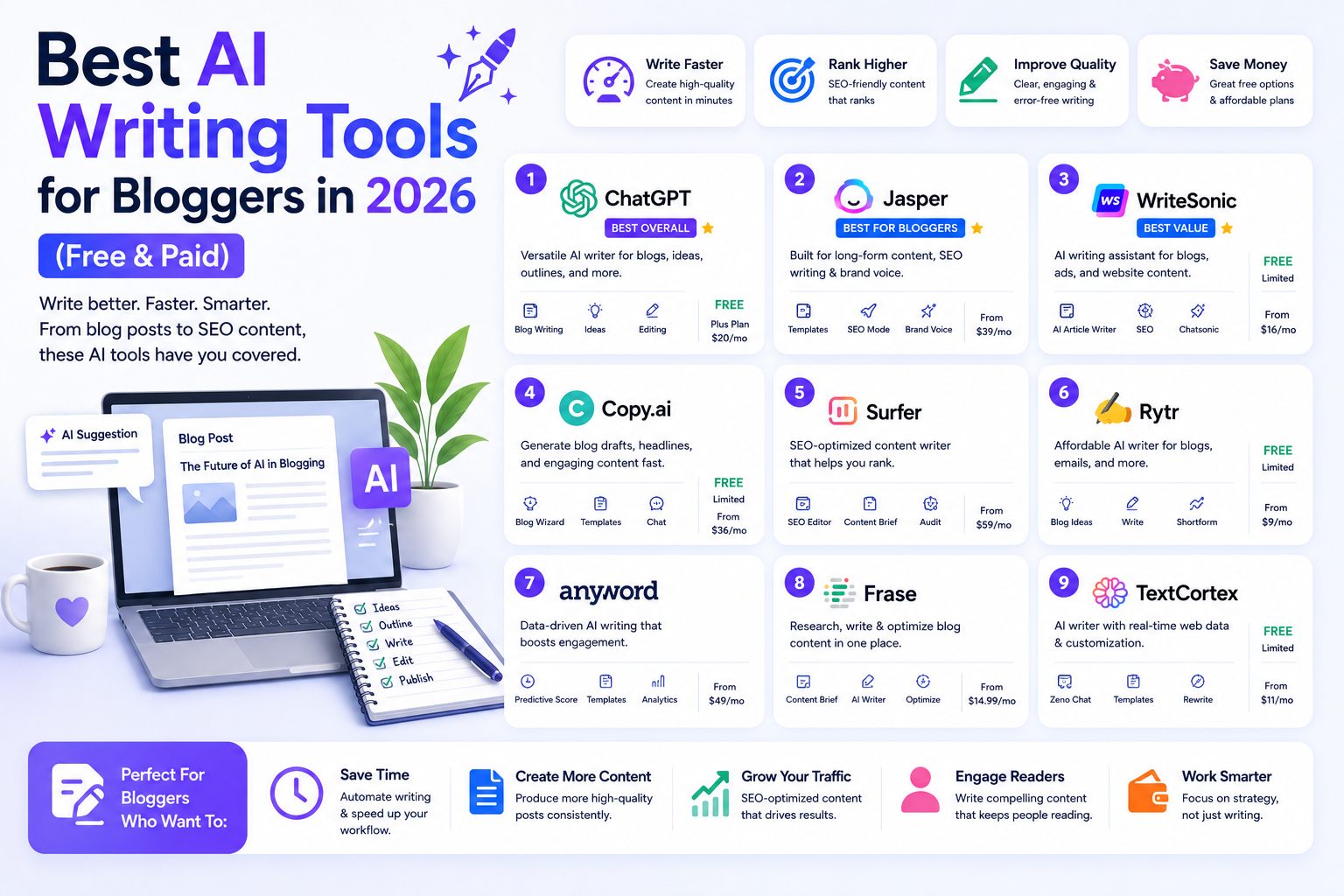
| Quick Answer (AI Overview snippet) The best AI writing tools for bloggers in 2026 are Claude (best draft quality), ChatGPT (best all-round versatility), Jasper (best for brand voice and marketing teams), Writesonic (best built-in SEO article workflow), SurferSEO (best content optimization), NeuronWriter (best budget optimizer), Rytr (best cheap generator) and Grammarly (best editing layer). Free tiers exist for most; paid plans run $9–$39/month. |
AI Didn’t Kill Blogging — It Changed What Bloggers Do
Here is the honest state of blogging in 2026: the internet is flooded with unedited AI content, search engines and readers have both gotten very good at ignoring it, and yet the bloggers winning right now are using AI more than anyone. The difference is in how. Losing blogs publish raw AI output; winning blogs use AI to handle the heavy lifting — research synthesis, outlines, first drafts, rewrites, optimization — while the human supplies the experience, opinions and stories that make content worth ranking and worth reading.
That workflow shift changes which tools matter. You no longer need a tool that merely produces words; words are free now. You need tools that produce good first drafts in your voice, tools that optimize content against what actually ranks, and tools that polish the result — ideally without stacking five subscriptions.
We tested the leading options across a month of real publishing on this site to find the eight worth a blogger’s money in 2026, including what each costs and where the free tiers genuinely suffice. One universal truth up front: every tool below improves dramatically with better instructions, so read our 10 Best AI Prompt Hacks for Beginners before blaming any tool for bland output.
Best AI Writing Tools for Bloggers: Quick Comparison
| Tool | Best For | Free Option | Paid From |
| Claude | Draft quality & long-form | Yes | $20/month |
| ChatGPT | Versatility & research | Yes | $20/month |
| Jasper | Brand voice at scale | Trial | $39/month |
| Writesonic | SEO article workflow | Trial | $39/month |
| SurferSEO | Content optimization | No | $79/month |
| NeuronWriter | Budget optimization | No | $23/month |
| Rytr | Cheap quick copy | Yes | $9/month |
| Grammarly | Editing & polish | Yes | $12/month |
The 8 Best AI Writing Tools in 2026
1. Claude — Best Draft Quality and Long-Form Writing
Ask working writers which AI produces prose they actually want to publish and Claude comes up first more than anything else. Its drafts read less like a template and more like a competent colleague: better rhythm, fewer cliché openers, a real ability to hold an argument across 3,000 words. For bloggers, two features change the game. Projects store your style guide, audience notes and past posts permanently, so every draft starts on-voice. And its long-context strength means you can feed it five of your published articles plus research sources and ask for a draft that genuinely synthesizes them.
Key features:
- The most natural long-form prose of any assistant we tested
- Projects keep your voice, audience and style guide in memory
- Handles huge research inputs in one conversation
- Strong at rewriting and structural editing, not just generating
Pricing: Free plan available; Claude Pro at $20/month.
Best for: Bloggers who care about prose quality first — the strongest pure writing engine on this list. Official site: claude.ai.
2. ChatGPT — Best All-Round Versatility
ChatGPT remains the Swiss Army knife of the writing stack. Beyond drafting, it researches with live web access, analyzes your traffic spreadsheets, generates featured images, brainstorms angles and — through custom GPTs — becomes a reusable assistant trained on your niche and voice. Its raw prose is a touch more formulaic than Claude’s, but its breadth is unmatched: one subscription covers research, drafting, images and data analysis, which for a solo blogger may replace three other tools entirely.
Key features:
- Web-connected research with sources for up-to-date posts
- Custom GPTs as reusable, voice-trained writing assistants
- Image generation for featured graphics included
- Data analysis for content audits and keyword sheets
Pricing: Free plan available; ChatGPT Plus at $20/month.
Best for: Bloggers who want one subscription doing the most jobs — pair it with our guide to automating workflows with ChatGPT on this site. Official site: chat.openai.com.
3. Jasper — Best for Brand Voice and Teams
Jasper earns its premium price when writing stops being one person’s job. It trains on your published content to capture brand voice with uncanny consistency, stores audience and product knowledge centrally, and lets a whole team generate on-brand content — blog posts, newsletters, social spin-offs — from shared templates and campaigns. For a solo hobbyist it is overkill; for a content operation publishing daily across channels it can genuinely replace an agency retainer.
Key features:
- Brand voice training that survives across writers and formats
- Campaigns turn one idea into coordinated multi-channel assets
- Team workspaces, approvals and a central knowledge base
- SEO mode integrates Surfer guidance into the editor
Pricing: From $39/month per seat; 7-day free trial.
Best for: Multi-author blogs and businesses where consistent voice across volume is the whole problem. Official site: www.jasper.ai.
4. Writesonic — Best Built-In SEO Article Workflow
Writesonic’s pitch is the complete pipeline: give it a keyword and it researches competitors, pulls live data, generates an optimized long-form draft with citations, internal-link suggestions and meta tags — then publishes straight to WordPress. No tool here goes from keyword to publishable, optimized draft with fewer steps. Quality of the raw prose sits a notch below Claude, which is the trade: maximum workflow integration versus maximum writing craft. Many bloggers use it for volume pages and reserve a craft tool for flagship posts.
Key features:
- Keyword-to-article pipeline with live web research and citations
- Built-in SEO scoring, meta tags and internal link suggestions
- Direct WordPress publishing
- Includes Chatsonic assistant and image generation
Pricing: From $39/month after trial.
Best for: Niche-site builders and bloggers prioritizing publishing velocity on SEO-driven content. Official site: writesonic.com.
5. SurferSEO — Best Content Optimization
Surfer is not a writer — it is the reason your writing ranks. Its Content Editor analyzes the pages currently ranking for your keyword and scores your draft in real time against the terms, headings, structure and length the results actually reward, turning on-page SEO from guesswork into a checklist. Its AI can generate drafts too, but the optimization layer is the product: write in Claude, paste into Surfer, edit to a strong score, publish. Audit mode does the same for existing posts, which is often the fastest traffic win on an established blog.
Key features:
- Real-time content scoring against live ranking pages
- Term, heading and structure recommendations per keyword
- Content audits to refresh and re-rank old posts
- Integrations with Jasper, WordPress and Google Docs
Pricing: From $79/month.
Best for: Bloggers serious about search traffic — the standard optimization layer of the industry. Official site: surferseo.com.
6. NeuronWriter — Best Budget Optimizer
NeuronWriter delivers a convincing 80% of Surfer’s value at roughly a third of the price. The same core loop — analyze the SERP, score your draft against ranking competitors, recommend terms and questions — plus AI drafting, internal-linking suggestions and a plagiarism checker. The interface is denser and less polished, exports are clunkier, and the SERP analysis runs a little shallower. None of that matters much at this price: for bloggers under $1,000/month in content budget, Neuron is the rational optimization choice.
Key features:
- SERP-driven content scoring and term recommendations
- AI drafting inside the optimization editor
- Internal linking and plagiarism checks included
- Repeatedly available in lifetime-deal promotions
Pricing: From $23/month; lifetime deals frequently available.
Best for: Budget-conscious bloggers who want competitive optimization without the Surfer invoice. Official site: neuronwriter.com.
7. Rytr — Best Cheap Quick-Copy Generator
Rytr knows exactly what it is: a fast, cheap generator for the small pieces — intros, meta descriptions, email subject lines, product blurbs, social captions — in 30+ languages and 20+ tones. Long-form output trails the premium tools noticeably, but for the daily stream of short copy every blog needs, its speed and its price are unbeatable. The free tier covers light use indefinitely, and the unlimited plan costs less than two coffees.
Key features:
- 40+ templates for short-form blogging copy
- 30+ languages and tone controls
- Chrome extension writes anywhere you do
- Among the cheapest unlimited plans in the industry
Pricing: Free plan; unlimited from $9/month.
Best for: Bloggers needing high volumes of short copy on a minimal budget. Official site: rytr.me.
8. Grammarly — Best Editing and Polish Layer
Whatever drafts your AI produces, Grammarly is the quality gate before publish. Beyond grammar, its suggestions tighten wordy AI phrasing, flag tone drift, catch the repetitive sentence structures language models love, and its plagiarism checker verifies originality — increasingly important when AI tools may echo training data. Its own generative features are serviceable, but its role in a 2026 blogging stack is clear: the editor that makes AI drafts read human.
Key features:
- Style and clarity edits that de-AI-ify robotic phrasing
- Tone detection and consistency checks
- Plagiarism checking on premium plans
- Works everywhere: browser, WordPress, Docs, desktop
Pricing: Free plan; Premium from $12/month.
Best for: Every blogger, frankly — the universal final pass regardless of which generator you choose. Official site: www.grammarly.com.
How to Build Your Writing Stack (Without Buying Everything)
- The minimalist stack — $0–20/month: Claude or ChatGPT free tier for drafting, Grammarly free for polish, and manual SEO using the questions in Google’s own results. Perfectly viable for a new blog’s first year.
- The growth stack — ~$45/month: Claude Pro for drafts, NeuronWriter for optimization, Grammarly free. This combination covers quality, rankings and polish at hobby-budget pricing — our default recommendation.
- The professional stack — ~$120+/month: Claude or ChatGPT for craft, Surfer for optimization, Writesonic for volume pages, Grammarly Premium as the gate. For blogs that are businesses.
- The team stack: Add Jasper when multiple writers must sound like one brand — that is the specific problem it solves better than anything else.
The Workflow That Makes AI Content Actually Rank
1. Research like a human (20 min): Read the top results yourself and note what they all miss — that gap is your post’s reason to exist. AI summarizes consensus; only you spot absence.
2. Brief the AI properly (10 min): Give your tool the keyword, audience, angle, your outline and two of your past posts as voice samples. Detailed briefs are the entire difference between generic and publishable drafts.
3. Draft and inject experience (45 min): Generate the draft, then add what no AI has: your results, screenshots, opinions, failures, numbers. These E-E-A-T signals are what search engines now reward most.
4. Optimize (20 min): Run the draft through Surfer or Neuron, work the score up without keyword-stuffing, and write a meta description that earns the click.
5. Polish and publish (15 min): Grammarly pass, de-robotify the intro by hand — readers and algorithms both judge the first 100 words hardest — then publish and add internal links from your related posts.
Total: roughly two hours for a post that previously took six — with the saved four hours going where they compound: original research, real examples and promotion.
Frequently Asked Questions
Claude produces the highest-quality drafts for long-form blogging, while ChatGPT is the most versatile single subscription. For SEO-focused publishing, Writesonic offers the most complete keyword-to-article workflow, and SurferSEO or NeuronWriter handle optimization. Most bloggers do best pairing one drafting tool with one optimizer.
Yes, to start. The free tiers of Claude, ChatGPT, Rytr and Grammarly comfortably support a new blog’s first months. Paid tools earn their cost once you publish weekly or depend on search traffic — primarily through optimization features free tiers lack.
Google’s published position rewards helpful content regardless of how it is produced, and penalizes unhelpful mass-produced content regardless of authorship. In practice: edited AI drafts enriched with real experience rank fine; raw unedited AI output increasingly does not.
SurferSEO is the industry-standard optimization layer, scoring drafts against live ranking pages. NeuronWriter delivers most of the same value from $23/month. Writesonic is best if you want generation and optimization fused in one workflow.
Claude for prose quality and long-form coherence; ChatGPT for research, images and breadth of features. Many bloggers run both free tiers and pay for whichever they reach for more — see our full ChatGPT vs Claude vs Gemini comparison for detail.
New blogs: $0. Growing blogs: $20–50/month for a drafting tool plus a budget optimizer. Professional blogs: $100–150/month adds Surfer-grade optimization and volume tooling. Spend on optimization before spending on more generation — words are abundant; rankings are not.
Final Verdict
The 2026 blogging stack has settled into a clear shape: a craft engine (Claude or ChatGPT), an optimization layer (Surfer or NeuronWriter) and a polish gate (Grammarly), with Jasper for teams, Writesonic for velocity and Rytr for pocket-change copy. Start with the minimalist stack today, upgrade the optimizer the month search traffic becomes your goal, and never delegate the one thing AI cannot supply — the lived experience that makes a post worth ranking. The bloggers thriving right now are not the ones writing without AI or the ones letting AI write alone; they are the ones who learned the division of labor.
Keep building: our Best AI SEO Tools guide covers the ranking layer in depth, and the Ultimate Guide to AI Automation Tools 2026 shows where writing fits in your wider automation stack.
Disclaimer: The information in this article is for general informational purposes only and does not constitute professional, financial or legal advice. Pricing and features are accurate as of publication but may change; always verify details on the official vendor websites before purchasing. AI Automation Hacks is not affiliated with the companies mentioned except through standard affiliate partnerships disclosed above. See our full Disclaimer and Privacy Policy.
Affiliate Disclosure: This post may contain affiliate links. If you purchase a tool through one of our links, we may earn a small commission at no extra cost to you. We only recommend tools we have personally tested and believe will add real value to your business. Read our full Disclaimer for details