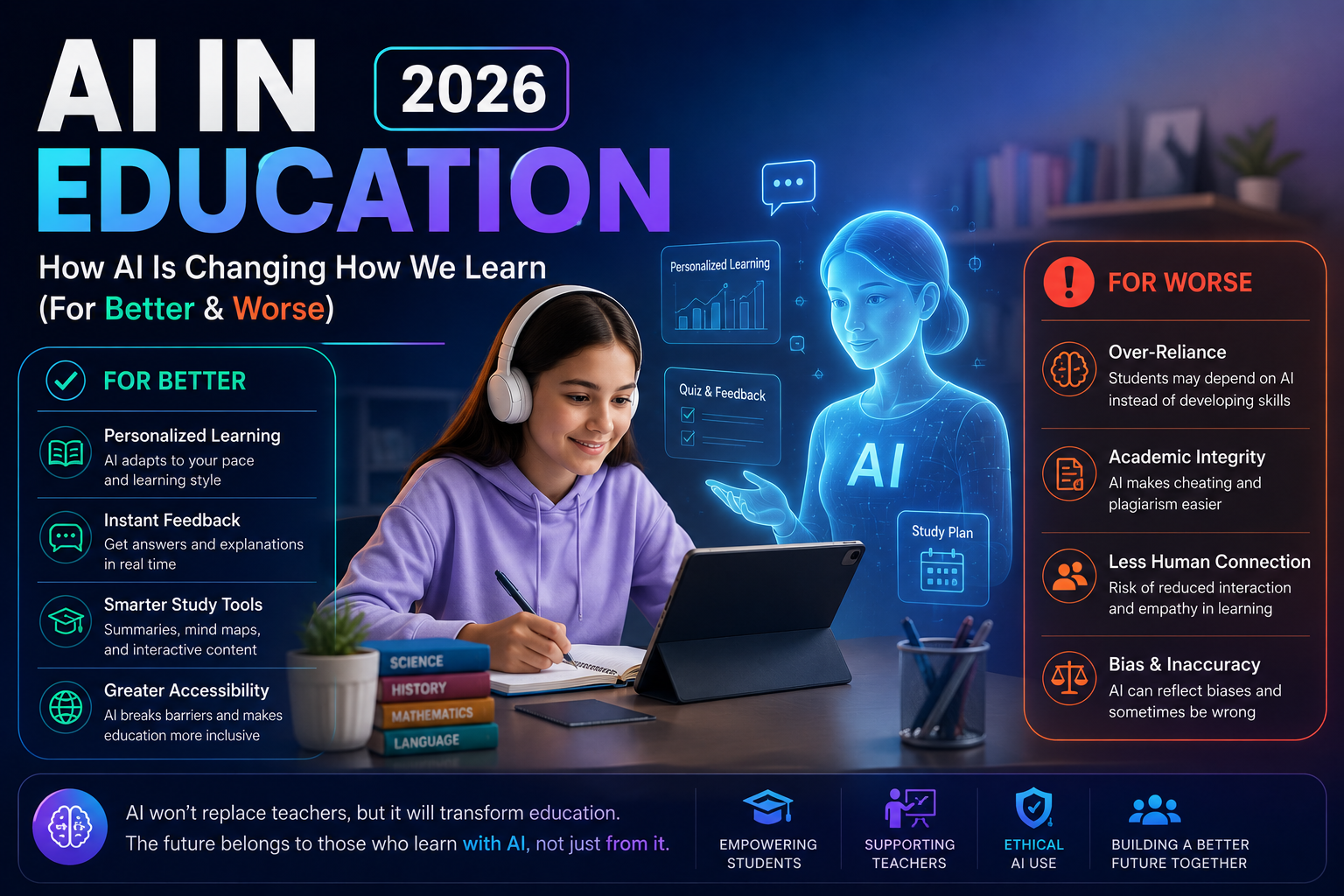
AI in education is transforming how students learn and how teachers teach — but not always in the ways the headlines suggest. In 2026, AI tutors personalize lessons in real time, automated grading tools save teachers hours each week, and adaptive learning platforms help students with learning differences access education more effectively than ever. But there are real downsides too: academic dishonesty is surging, the digital equity gap is widening, and experts are raising serious questions about data privacy and the loss of human connection in learning. This guide covers both sides — honestly.
Walk into almost any school, university, or corporate training room in 2026 and you will notice something has shifted. The relationship between teachers and students has changed. Not because teachers matter less — if anything, the evidence suggests they matter more now than ever — but because AI has fundamentally changed what a classroom can do.
A fifteen-year-old student in rural Gujarat can now access a personalized math tutor that adjusts to her exact learning pace, speaks in her preferred language, and never runs out of patience. A first-generation college student in Lagos can get instant feedback on his essay draft at 2am, hours before any professor would be available. These are real, documented improvements in educational access and outcomes.
And yet. Students are submitting AI-generated essays en masse. Teachers are burning out trying to redesign assessments that AI cannot simply complete for them. Children with less access to reliable internet are falling further behind peers who have AI tutors on demand. The picture is genuinely complicated — and anyone who tells you AI in education is purely good or purely bad is not paying attention.
This guide gives you the full picture. Whether you are a parent, a student, an educator, or a school administrator, here is what you actually need to know about AI and education in 2026.
1. The State of AI in Education: A 2026 Snapshot
AI adoption in education has reached a tipping point. It is no longer the domain of experimental schools or well-funded universities. According to multiple research surveys conducted through early 2026, the numbers are striking.
| Statistic | Finding |
| Students using AI tools for study/homework | Over 70% of university students globally |
| Teachers using AI for lesson planning or grading | ~58% of K-12 teachers in OECD countries |
| EdTech platforms with AI features | Over 80% of top 50 EdTech platforms now AI-powered |
| Schools with a formal AI policy | Less than 35% — most are still working on it |
| Students who have submitted AI-generated work | Estimated 40–60% (varies significantly by institution) |
The gap between student adoption and institutional policy is one of the defining tensions in education right now. Students are using AI tools whether or not their schools approve. Institutions that pretend otherwise are not managing the situation — they are just not seeing it.
2. The Good: Where AI Is Genuinely Improving Education
Personalized Learning at Scale
The most significant positive impact of AI in education is its ability to personalize learning in ways that were simply impossible before. A traditional classroom teacher with thirty students cannot realistically tailor instruction to each individual’s pace, learning style, and knowledge gaps. AI can — and in many documented cases, it does so remarkably well.
Platforms like Khan Academy’s Khanmigo, Duolingo Max, and Carnegie Learning’s AI tutors use machine learning to analyze where a student is struggling, identify patterns in their errors, and adjust the next question, explanation, or example accordingly. Research published in 2025 found that students using these adaptive platforms improved test scores significantly faster than those in traditional instruction-only environments — particularly in mathematics and language learning.
Accessibility for Students with Learning Differences
AI has opened educational doors for students with dyslexia, ADHD, visual impairments, and other learning differences in ways that previous assistive technology never could. Real-time text-to-speech, AI-powered reading comprehension assistance, automatic captions, and adaptive interfaces now allow students who would have previously struggled in traditional settings to participate fully in academic life.
- AI text-to-speech and reading tools have reduced barriers for students with dyslexia
- Automated captions and real-time transcription support deaf and hard-of-hearing students
- Adaptive pacing allows ADHD students to work in shorter, focused bursts without penalty
- Multilingual AI tutors are reducing language barriers for immigrant and refugee students
Teacher Productivity and Focus
One of the quieter but more impactful benefits of AI in education is what it does for teachers. Grading, lesson planning, generating quiz questions, writing parent communication — these are all tasks that consume enormous time and emotional energy. AI tools can handle much of this administrative burden, freeing teachers to do what AI cannot: build genuine relationships with students, mentor, and inspire.
Surveys of teachers using AI tools in 2025 and 2026 consistently show that those who adopt AI for administrative tasks report less burnout and more time for direct student interaction. That is a meaningful outcome in a profession facing a global staffing crisis.
Global Access to Quality Education
Perhaps the most profound long-term benefit of AI in education is its potential to democratize access to high-quality learning. A student in a rural area without access to specialist teachers can now access AI tutors for advanced mathematics, science, or language learning. MOOCs (Massive Open Online Courses) powered by AI are already delivering university-level education to millions of students who could never afford or access traditional higher education.
| ✅ Real Win: In a 2025 pilot program across three Indian states, students using AI-powered vernacular tutors for mathematics showed a 34% improvement in foundational numeracy scores compared to a control group in just one academic year. The impact was largest among first-generation learners. |
3. The Bad: Real Problems We Cannot Ignore
Academic Dishonesty Is Surging
Let’s name it plainly: AI-assisted cheating is one of the most significant educational crises of 2026. When a student submits a ChatGPT-generated essay, Gemini-written code, or an AI-completed math assignment as their own work, they are cheating. And they are doing it at unprecedented scale.
AI detection tools like Turnitin’s AI detector and GPTZero have made progress, but they remain imperfect — they produce false positives that have wrongly flagged honest students, and they struggle to detect AI output that has been significantly edited or paraphrased by a human. Some universities have responded by moving to in-person oral exams and handwritten assessments. Others have banned AI tools outright. Neither approach is fully sustainable.
| ⚠️ Reality Check: A 2025 study found that AI detection tools incorrectly flagged content written by non-native English speakers as AI-generated at significantly higher rates than native speakers. This creates a real equity and fairness problem — punishing students for their language background rather than their academic choices. |
The Digital Equity Gap Is Widening
AI tutors, adaptive learning platforms, and AI-powered homework tools require something many students around the world still do not reliably have: a fast internet connection and a capable device. The result is a new layer of educational inequality being built on top of existing ones.
Students in well-funded schools with strong technology programs gain AI as an educational accelerator. Students in under-resourced schools, rural areas, or low-income households do not get the same advantage — and they increasingly compete for college spots and jobs against those who did. This is not a hypothetical future problem. It is happening right now.
Student Data Privacy Concerns
AI-powered educational tools collect enormous amounts of data about students — their learning pace, their error patterns, their emotional state (some platforms use facial recognition to detect confusion or distraction), and their behavioral patterns over time. The question of who owns this data, how it is stored, and how it may be used in the future is one that most parents and students have not been given clear answers to.
- Many EdTech platforms share or sell anonymized student data to third parties
- Biometric data collected by AI (eye tracking, facial expression) raises GDPR and FERPA concerns
- Data collected about a child at age 10 may be profiled and sold for commercial purposes by the time they are 18
- Parents rarely receive meaningful informed consent disclosures about what data is collected
The Risk of Reduced Critical Thinking
Perhaps the most nuanced risk of AI in education is one that will only become visible over time: what happens to human critical thinking, creativity, and problem-solving skills when a powerful AI is always available to do the hard part?
Cognitive scientists and education researchers are raising legitimate concerns that students who routinely outsource thinking — writing, problem-solving, analysis — to AI may not be developing the mental muscles those tasks were designed to build. When a student asks AI for the answer instead of working through a problem, they may get the correct answer but miss the learning entirely. This is not an argument against AI in education. It is an argument for being thoughtful about how we use it.
4. AI in Education: Better vs. Worse — Side-by-Side
| ✅ Ways AI Is Making Education Better | ⚠️ Ways AI Is Making Education Worse |
| Personalized learning paces for every student | AI cheating is undermining academic integrity |
| Accessibility for students with learning differences | Digital equity gap is widening |
| 24/7 tutoring access regardless of location | Student data privacy is poorly protected |
| Reduced teacher admin burden | Potential atrophy of critical thinking skills |
| Real-time feedback on writing and coding | AI detectors produce unfair false positives |
| Global access to quality education | Loss of human mentorship and social learning |
| Early identification of struggling students | Over-reliance on AI recommendations by teachers |
5. What This Means for You: Practical Guidance by Audience
For Students
AI tools are powerful learning accelerators — when used to enhance your understanding, not to replace your thinking. Here is how to use AI in a way that actually serves your education:
- Use AI to explain concepts you don’t understand, not to generate answers you submit
- Ask AI to quiz you on material you’re studying — this is genuinely excellent for retention
- Use AI feedback on your writing drafts to improve your own version, not as a final product
- Learn your institution’s AI policy — violating it has real academic consequences
- Build skills in AI prompting — it’s becoming a genuinely valuable professional skill
For Parents
Your child is almost certainly using AI tools for schoolwork, whether or not their school officially sanctions it. Rather than banning or ignoring this, a more productive approach is to talk about it openly.
- Ask your child’s school for their AI use policy — and push for one if they don’t have it
- Review the data privacy policies of EdTech platforms your school uses
- Discuss with your child the difference between AI as a learning tool versus AI as a shortcut
- Ensure your child has reliable internet access — if they don’t, advocate for it at the school/district level
For Educators and School Administrators
The schools navigating AI best in 2026 are not the ones that banned it or pretended it does not exist. They are the ones that built honest policies, redesigned assessments for an AI-present world, and helped teachers develop the skills to use AI productively.
- Develop a clear, practical AI use policy that distinguishes acceptable from unacceptable use
- Redesign assessments to include in-person components, oral defense, or process documentation
- Provide professional development for teachers on AI tools — do not leave them to figure it out alone
- Review data privacy practices of all EdTech vendors before procurement
- Focus AI adoption on teacher productivity and student accessibility gains first
6. The Best AI Education Tools in 2026 (Our Picks)
The EdTech market is crowded with AI-powered tools in 2026, and quality varies enormously. These are the platforms we believe deliver genuine educational value — not just impressive demos. (Disclosure: Some links below are affiliate links. We only recommend tools with proven educational outcomes.)
📚 Khan Academy Khanmigo — AI Tutor for Students
Khanmigo is Khan Academy’s AI tutor built on GPT-4, but designed specifically to guide learning rather than just give answers. It asks Socratic questions, walks students through problems step by step, and encourages critical thinking. It is one of the most educationally sound AI tools available. Best for: K-12 students, especially in math and science. Pricing: Free for students in many countries with donor-supported access.
→ Try Khanmigo Free [Affiliate Link]
📚 Grammarly — AI Writing Assistant with Educational Mode
Grammarly’s education features help students improve their writing through real-time feedback on grammar, clarity, structure, and tone — without writing the content for them. Its plagiarism detection and AI detection features help teachers too. Best for: middle school through university students working on written assignments. Pricing: Free tier available; Education plans from $6/month.
→ Try Grammarly for Education [Affiliate Link]
📚 Coursera with AI-Powered Learning Paths
Coursera’s AI-personalized learning system recommends courses, tracks skill gaps, and adjusts learning paths based on your goals and performance. For adult learners and professionals upskilling, it is one of the best structured AI-enhanced learning platforms available. Best for: University students and working professionals. Pricing: Free audit option; Coursera Plus at $59/month.
→ Try Coursera Plus [Affiliate Link]
📚 Duolingo Max — AI Language Learning
Duolingo Max uses GPT-4 to power two features that are genuinely impressive: Explain My Answer (which gives personalized grammar explanations) and Roleplay (which simulates real conversations with AI characters). For language learning, this is a substantial leap forward. Best for: Language learners of all ages. Pricing: Duolingo Max at around $30/month.
→ Try Duolingo Max [Affiliate Link]
7. Frequently Asked Questions (FAQ)
Q: Is it cheating to use AI for homework?
A: It depends on your school’s policy and how you use it. Using AI to explain a concept you don’t understand is generally acceptable and educationally valuable. Submitting AI-generated work as your own without disclosure or your institution’s permission is academic dishonesty — and most institutions now have policies explicitly covering this. When in doubt, ask your teacher before you use AI on an assignment.
Q: Can AI replace teachers?
A: No — and the research is clear on this. AI can automate grading, personalize content delivery, and provide 24/7 tutoring support. What it cannot do is build the kind of relationship, mentorship, and emotional attunement that defines great teaching. The best educational outcomes in 2026 come from AI and teachers working together, not from one replacing the other.
Q: Are AI tutors effective for children with learning disabilities?
A: The evidence is genuinely encouraging here. AI tutors that allow students to work at their own pace, receive patient repetition without stigma, and access text-to-speech or visual alternatives have shown real benefits for students with dyslexia, ADHD, and processing differences. That said, they work best as supplements to — not replacements for — specialized human support.
Q: What data does my child’s EdTech platform collect?
A: This varies significantly by platform, but most AI-powered EdTech tools collect learning behavior data (what questions students answer, how long they spend, where they make errors), and many collect device and usage data. Some platforms — particularly those using adaptive video or engagement tracking — may collect more sensitive behavioral data. You have the right to ask your school what data each platform collects and how it is used, stored, and shared.
Q: How should schools handle AI in exams?
A: Schools that are navigating this well in 2026 are taking a multi-pronged approach: designing some assessments that are impossible to complete with AI (oral exams, in-person observations, process portfolios), allowing AI explicitly in other assessments with disclosure requirements, and teaching students AI literacy alongside subject content. Banning AI entirely is largely unenforceable; ignoring it is worse.
Q: Will AI skills be required for jobs in the future?
A: They already are — in many fields. Prompt engineering, AI tool evaluation, and understanding how to work alongside AI systems are increasingly listed as desired skills in job postings across sectors from marketing to engineering to healthcare. Students who learn to use AI thoughtfully and critically in their education are building genuinely valuable professional capabilities.
Q: Is AI making education better or worse overall?
A: Honestly — both, at the same time, in different ways. AI is making education more accessible, more personalized, and more productive for teachers. It is also enabling cheating at unprecedented scale, widening the digital equity gap, and raising serious data privacy concerns. The outcome largely depends on how institutions, teachers, parents, and students choose to engage with these tools. Technology does not determine outcomes. People do.
Final Thoughts: The Future of Learning Is a Partnership
The narrative that AI is either going to save education or destroy it misses the point. Technology has never been the decisive factor in educational outcomes — people are. The best-performing educational systems in the world in 2026 are those where teachers have real professional support, students are engaged and motivated, and families are involved. AI makes all of those things easier to achieve — but only if it is used with intention.
For students: use AI as a thinking partner, not a thinking replacement. For parents: stay curious and stay involved. For educators: lead the conversation rather than waiting for your institution to do it for you. For school administrators: build the policy framework now, before you are scrambling to respond to a crisis.
The students who thrive in the AI era will not be the ones who used it the most. They will be the ones who learned how to use it well — and who kept developing the human capabilities that AI cannot replicate: empathy, judgment, creativity, and the ability to sit with a hard question long enough to develop their own answer.
Disclosure: This blog contains affiliate links. If you purchase through these links, we may earn a small commission at no additional cost to you. All tool recommendations reflect genuine editorial judgment based on educational effectiveness and research evidence. This article is for informational purposes only.