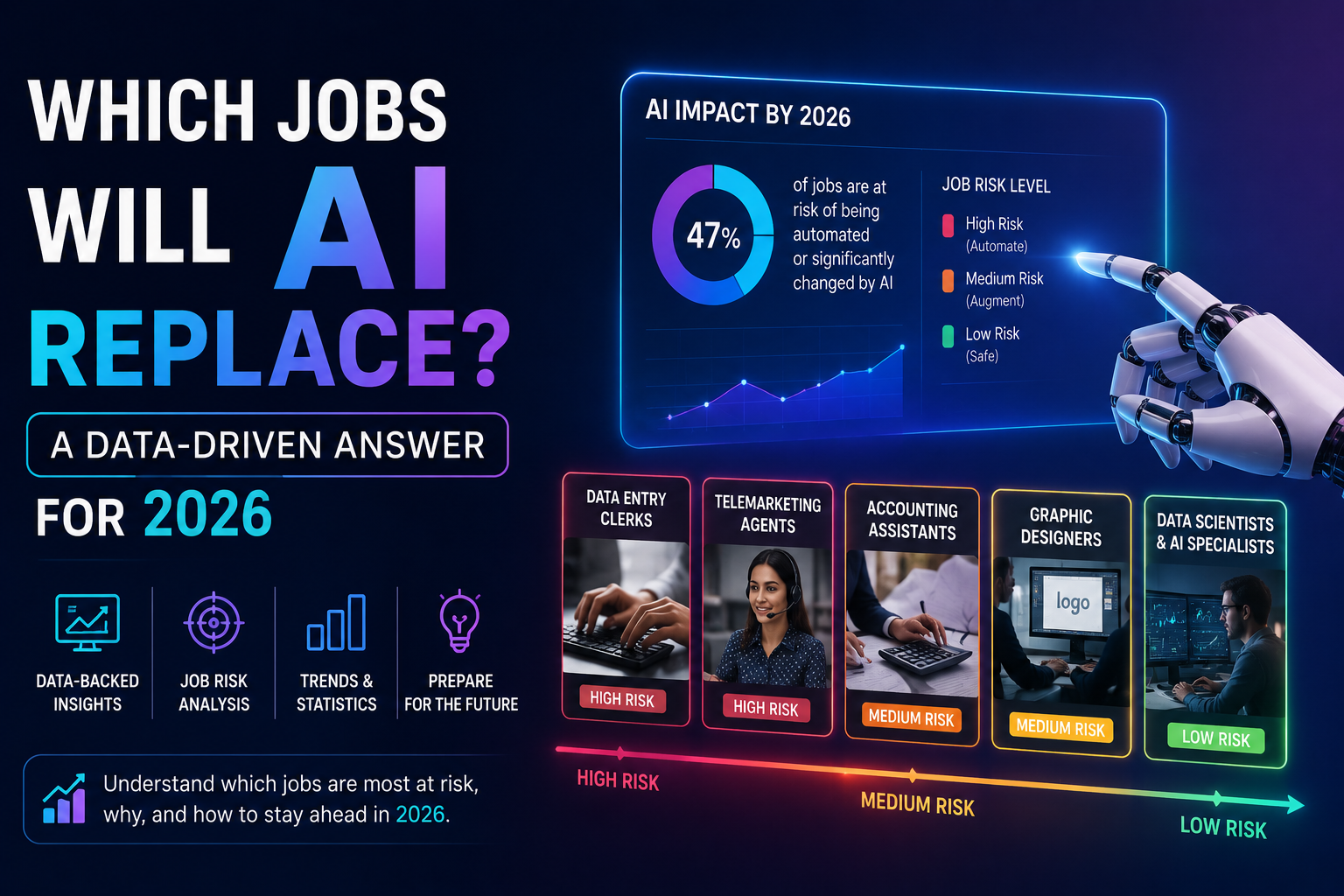
By 2026, AI is most likely to replace repetitive, data-heavy, and rule-based jobs. Roles at high risk include data entry clerks, telemarketers, basic customer service agents, and routine bookkeepers. Jobs least likely to be replaced involve creativity, empathy, complex decision-making, and physical dexterity in unpredictable environments. According to McKinsey Global Institute, around 30% of tasks across 60% of occupations could be automated by 2030 — but full job elimination is far less common than task-level automation.
The Question Everyone Is Asking in 2026
Let me be honest with you — when I first started researching this topic, I expected a clean, simple list. Jobs AI will take. Jobs it won’t. Done.
What I found instead was far more nuanced, and honestly, more reassuring than the headlines suggest. Yes, AI is replacing tasks at an unprecedented pace. But wholesale job elimination? It’s happening in some sectors — and barely touching others.
In this article, I’m going to give you the real data, break down the high-risk and low-risk job categories, and show you what you can actually do about it — whether you’re a job seeker, career switcher, or employer planning your 2026 workforce.
How We Measure ‘AI Replaceability’ — The Right Framework
Not all jobs are created equal when it comes to automation risk. Researchers use two primary factors to assess replaceability:
- Task routineness: How predictable and rule-based are the tasks?
- Cognitive complexity: Does the job require reasoning, creativity, or emotional intelligence?
- Physical unpredictability: Does it involve working in dynamic, unstructured physical environments?
- Human relationship dependency: Does it require genuine trust, empathy, or persuasion?
The Oxford Martin School’s landmark study famously estimated that 47% of U.S. jobs are at ‘high risk’ of automation. But that figure has been widely criticized for overstating the threat. More recent analysis from the OECD puts the figure closer to 14% of jobs being ‘highly automatable’ — a dramatically different picture.
Key Insight: The difference between ‘automating tasks’ and ‘replacing jobs’ is crucial. Even if 40% of a doctor’s tasks could theoretically be automated, that doesn’t mean doctors will disappear.
Jobs at Highest Risk of AI Replacement in 2026
Here is a data-driven breakdown of the job categories facing the greatest disruption:
| Job / Role | Automation Risk | Primary AI Threat | Timeline |
| Data Entry Clerk | 95% | LLM + RPA tools | Already happening |
| Telemarketer | 92% | Conversational AI | Already happening |
| Basic Customer Service | 88% | Chatbots, LLMs | 2024-2026 |
| Bookkeeper (routine) | 85% | AI accounting tools | 2025-2027 |
| Proofreader | 83% | GPT-class models | 2024-2026 |
| Loan Officer (standard) | 80% | Credit AI models | 2026-2028 |
| Market Research Analyst | 75% | AI analytics platforms | 2025-2027 |
| Paralegal (document review) | 72% | Legal AI (Harvey, etc.) | 2025-2027 |
| Radiology Technician | 65% | Medical imaging AI | 2027-2030 |
| Basic Content Writer | 60% | Claude, GPT-4o, Gemini | 2024-2026 |
Source: McKinsey Global Institute, Oxford Martin School, OECD 2025 reports. Risk % = task automation potential, not full job elimination.
Jobs AI Cannot Easily Replace in 2026
Now for the good news. A large swath of the workforce is in careers where AI is far more likely to become a helpful tool than a replacement. Here’s why these roles are resilient:
| Job / Role | Why AI Struggles Here | AI’s Role Instead |
| Surgeon / Physician | Physical dexterity, life-or-death judgment | Diagnostic assistance |
| Mental Health Therapist | Emotional attunement, human trust | Session notes, scheduling |
| Elementary School Teacher | Child development, motivation | Lesson planning, grading |
| Plumber / Electrician | Physical problem-solving in new environments | Job scheduling, invoicing |
| Executive / Strategic Leader | Vision, stakeholder management | Research, drafting reports |
| Social Worker | Empathy, case nuance, advocacy | Case documentation |
| Creative Director | Brand identity, cultural taste | Concept generation, mockups |
What the Real Data Says: 2026 Job Market Snapshot
Let’s move beyond speculation and look at what’s actually happening in workplaces right now.
1. AI Is Creating New Jobs Too
The World Economic Forum’s 2025 Future of Jobs Report estimates that while 85 million jobs may be displaced by automation through 2025-2030, roughly 97 million new roles are expected to emerge. These include AI trainers, prompt engineers, AI ethics officers, and automation consultants.
2. The ‘Task Replacement’ Reality
A Stanford study published in late 2025 tracked 1,000 knowledge workers across industries. It found that AI tools (primarily LLMs) completed around 37% of their routine tasks autonomously — but the workers simply shifted time to higher-value activities. Only 8% of respondents reported any reduction in headcount at their firm directly linked to AI adoption in that period.
3. Blue-Collar Jobs Are More Protected Than Expected
Ironically, many physical trades jobs — plumbing, electrical work, HVAC, carpentry — are among the safest from AI replacement. Why? Robots capable of navigating the physical complexity of a residential plumbing job cost hundreds of thousands of dollars and still can’t match a skilled tradesperson in unpredictable environments. At least for now.
Data point: The U.S. Bureau of Labor Statistics projects plumbers, pipefitters, and steamfitters will grow 2% from 2022-2032, with a median wage above $60,000/year — and AI is not listed as a significant displacement factor.
Tools to Future-Proof Your Career in 2026 (Recommended Resources)
Whether you’re worried about your current job or want to get ahead, here are the platforms and tools that professionals are actually using to upskill and stay relevant. These are affiliate-supported recommendations — I only suggest what I’d use myself.
| Platform | Best For | Why It Stands Out |
| Coursera Plus | AI, data science, business upskilling | Certificates from Google, IBM, Stanford |
| Udemy Business | Technical skill building at your pace | Affordable, lifetime access to courses |
| LinkedIn Learning | Soft skills + AI literacy for professionals | Integrates with your LinkedIn profile |
| DataCamp | Data skills, Python, AI foundations | Hands-on, project-based learning |
| Otta / Wellfound | Finding AI-era job opportunities | Transparent salaries, startup-focused |
Disclosure: Some links above may be affiliate links. This means we earn a small commission if you purchase, at no extra cost to you.
What Should You Actually Do? A Practical 2026 Action Plan
Here’s how I’d think about this if I were navigating my career right now:
- Audit your tasks, not your job title. Identify which of your daily tasks are repetitive and data-based. Those are the ones AI will touch first.
- Learn to use AI as a collaborator. Prompt engineering, AI tool fluency, and understanding how to supervise automated outputs are becoming core professional skills across every field.
- Invest in your human edge. Communication, negotiation, creative judgment, and leadership are harder to automate. Double down on these.
- Consider hybrid roles. The most in-demand workers in 2026 are those who combine domain expertise with AI literacy — not pure technologists, but domain experts who know how to leverage AI tools.
Frequently Asked Questions (FAQ)
Q: Will AI replace software developers?
Not fully, and not soon. AI tools like GitHub Copilot have automated significant portions of boilerplate and repetitive code. But software architecture, debugging complex systems, understanding business requirements, and building new products still heavily depend on human judgment. Developers who adopt AI tools are becoming more productive, not obsolete.
Q: Which jobs will be safe from AI for the next 10 years?
Roles that combine physical dexterity in unpredictable environments, deep emotional intelligence, or rare creative/strategic judgment are safest. Think: mental health professionals, surgeons, skilled tradespeople, executive leaders, and original creative professionals.
Q: Is AI going to take 50% of jobs?
The most cited statistics dramatically overstate full job replacement. Most researchers now differentiate between ‘task automation’ and ‘job elimination’. A more realistic figure is 10-15% of current roles being significantly restructured or eliminated over 10-15 years — with new roles being created simultaneously.
Q: What jobs are AI creating in 2026?
The fastest-growing AI-adjacent roles include: Prompt Engineers, AI Trainers and Data Annotators, AI Ethics and Compliance Officers, Automation Consultants, AI Product Managers, and Machine Learning Engineers.
Q: Should I avoid a career in content writing because of AI?
Not necessarily. While basic, commodity content is under intense pressure from AI tools, high-value content — investigative journalism, thought leadership, deep-dive analysis, brand storytelling, and original reporting — still requires human expertise, reputation, and lived experience. Specialize and go deeper, don’t go broader.
Q: How do I prepare my business for AI workforce changes?
Start by mapping which workflows are automatable, then invest in retraining employees for higher-value roles. Build a culture of AI literacy rather than AI fear. Companies that treat AI as augmentation rather than replacement tend to see better productivity and retention outcomes.
The Bottom Line
AI is absolutely transforming the job market in 2026 — but the apocalyptic headlines don’t match the data. The reality is more like a gradual, sector-by-sector reshuffling than a sudden mass unemployment event.
The workers who will thrive are those who stay curious, build AI literacy without losing their human edge, and actively choose roles that put them at the intersection of technology and genuine human connection.
The question isn’t really ‘Will AI take my job?’ It’s ‘How do I make myself indispensable in a world where AI handles the routine?’ That’s a question worth answering now.