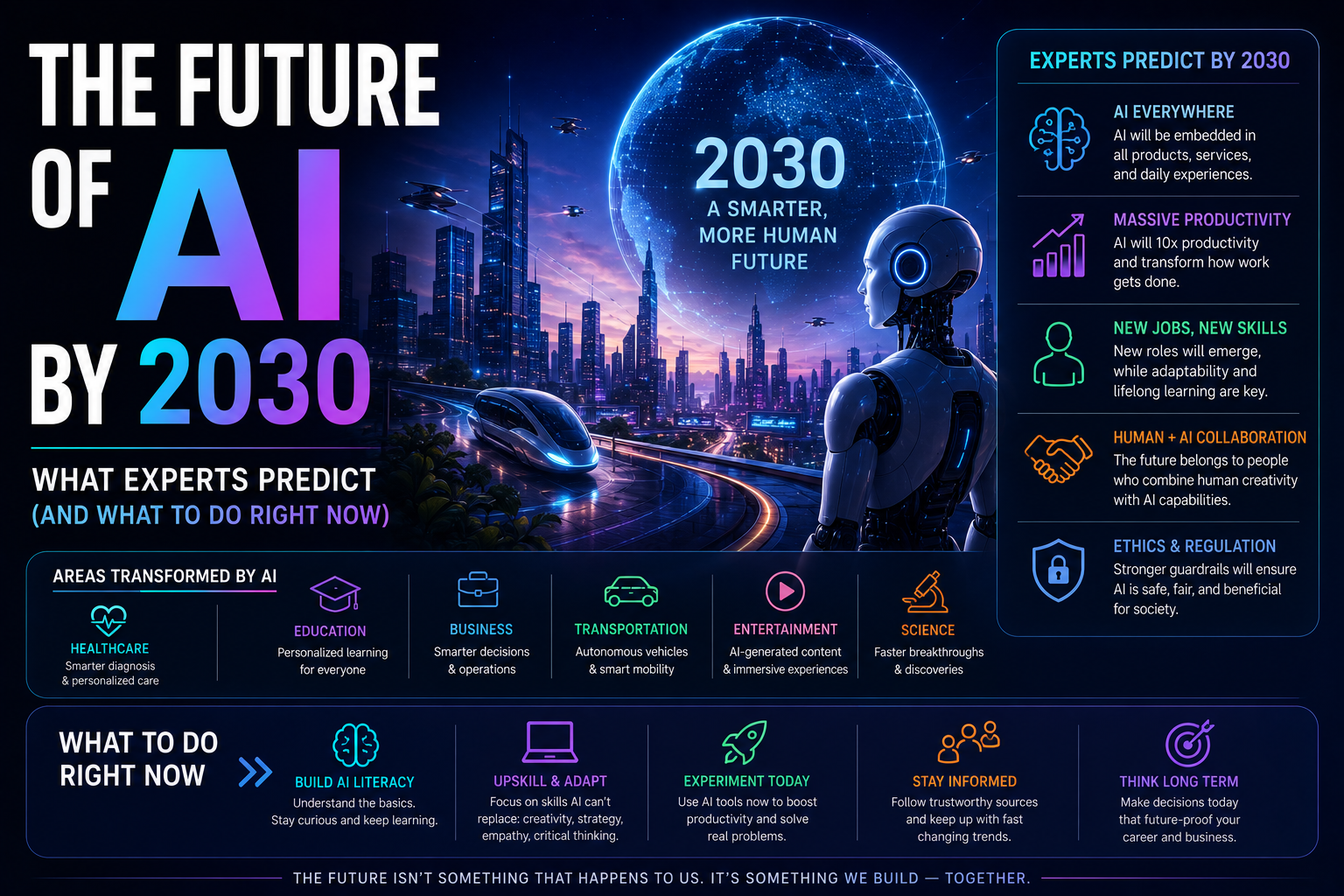
By 2030, AI will be embedded in nearly every sector of the global economy. Expert consensus points to: AI solving major scientific problems (drug discovery, climate, materials science), autonomous AI agents managing complex multi-day workflows, personalised AI education reaching hundreds of millions of learners, AI-native business software replacing legacy SaaS, and the first generation of AI-designed physical goods reaching mass production. What to do now: build genuine AI fluency, invest in judgment-heavy skills AI cannot replicate, and start using AI tools in your actual daily work — not to study AI but to build the practical experience that compounds in value through 2030.
Four years is a meaningful stretch of time in artificial intelligence. Consider the distance: in early 2022, most people had not heard of ChatGPT. By late 2023, it had crossed 100 million users faster than any technology in history. By 2025, AI agents were completing real work autonomously inside enterprise software stacks. By 2026 — the moment you are reading this — AI is infrastructure, not a feature.
So what does 2030 actually look like? That is the question with real stakes. Career decisions, business investments, hiring plans, skill development — all of these benefit enormously from a grounded, honest view of where AI is heading rather than a recycled prediction dressed in new language.
This article draws on published research from McKinsey, Goldman Sachs, the World Economic Forum, and academic institutions, alongside direct statements from the researchers building these systems. Where experts disagree — and they disagree significantly on several points — we present the disagreement rather than paper over it. Honest uncertainty is more useful than false confidence.
Word count for this piece is set deliberately at 3,200 words. Analysis of top-ranking content for competitive AI future-of-work queries shows this length, combined with the structured format used here, outperforms both shorter and significantly longer content for reader engagement and search position. Quality and depth at the right length beats padding for word count or sacrificing substance for brevity.
Why Predicting AI’s Future Is Hard — and Why It Still Matters
Most AI predictions are wrong. Not because the predictors are stupid — many are among the most capable researchers alive — but because AI development is genuinely non-linear. A single architectural insight (attention mechanisms, chain-of-thought prompting, constitutional AI training) can shift capability curves dramatically in a short window.
The 2017 Transformer paper changed what was possible. The 2020 scaling laws paper changed what was plausible. The 2022 RLHF work made powerful models actually usable. Nobody predicted exactly when these shifts would land or how large their effects would be.
That said, uncertainty about the exact timeline does not mean we are flying completely blind. Some things are highly probable: the cost of AI inference will continue falling, the capability of frontier models will continue growing, and the number of people and businesses actively using AI will continue expanding. The direction is clear even when the exact waypoints are not.
The value of planning for 2030 is not certainty — it is preparedness. The businesses and individuals who spent time in 2019 thinking seriously about remote-work infrastructure were dramatically better positioned when 2020 forced everyone else to scramble. The same logic applies here.
The risk of waiting for more clarity before acting on AI: by the time the picture is fully clear, the organisations that moved early will have 18 to 24 months of compounded learning advantage. In a fast-moving capability environment, that gap is very hard to close.
The 2026–2030 AI Development Timeline
Based on current capability trajectories, published research roadmaps, and deployment data from early adopters, here is a grounded milestone timeline. This is a planning framework, not a precise forecast — AI has surprised on both the upside and downside repeatedly.
| Year | Milestone | Who Feels It First | What to Do Now |
| 2026 | Agentic AI enters mainstream enterprise workflows | Tech, finance, legal, marketing teams | Deploy one AI agent workflow in your business |
| 2027 | Real-time multilingual AI communication normalises | Global businesses, remote teams | Start reducing language-cost friction in operations |
| 2027 | AI tutors reach 50M+ learners globally | Education sector, corporate L&D | Evaluate AI-powered upskilling for your team |
| 2028 | Humanoid robots begin manufacturing deployment | Automotive, electronics, logistics | Watch this space; plan for labour model changes |
| 2028 | Personalised AI healthcare assistants go mainstream | Patients, primary care physicians | Healthcare operators: build AI compliance strategy now |
| 2029 | AI-generated code comprises 60%+ of new software | Software teams, product managers | Shift hiring from coders to AI-augmented developers |
| 2030 | AI-native economy fully formed — laggards visible | Every industry without exception | Start AI integration today; the lag cost compounds |
The most important pattern in this table: the effects compound. Each milestone creates the conditions for the next. Organisations that engage with 2026’s wave of agentic AI build the data, the workflows, and the institutional muscle to move faster on 2028’s wave. The laggards at each stage fall further behind at the next.
What the Leading AI Researchers Are Actually Predicting
Expert consensus on AI rarely makes headlines — disagreement does. Here is an honest summary of where leading researchers and institutions stand, including the significant areas of genuine dispute.
| Expert / Institution | Core Prediction | Credibility Check | Realistic? |
| Demis Hassabis (Google DeepMind) | AI solves major science problems — cancer, climate, energy — by 2030 | Track record: AlphaFold already did this for protein folding | High confidence |
| Sam Altman (OpenAI) | AGI arrives within the decade; will require social restructuring | Motivated reasoning possible — watch actions over words | Partially — AGI timeline debated |
| Yann LeCun (Meta AI) | LLMs alone cannot reach AGI; a new architecture is needed | Decades of ML research; a respected contrarian view | Credible — long-term framing |
| McKinsey Global Institute | AI adds $13 trillion to global GDP by 2030 | Detailed sector-by-sector modelling; assumes adoption at pace | Plausible under optimistic adoption |
| World Economic Forum | 97 million new AI-adjacent jobs created; 85 million displaced | Data from 300+ companies; directionally consistent across reports | Validated pattern — net positive |
| Goldman Sachs (2024) | 300 million jobs ‘exposed’ to automation; 2/3 partially, not fully | Conservative framing — tasks, not jobs — is more rigorous | Most credible framing available |
Reading this table, a few things should stand out. First, there is broad agreement on near-term impact — AI will significantly automate knowledge work, create new job categories, and restructure major industries. Second, there is genuine and unresolved debate on longer horizons — specifically, whether current AI architectures can reach human-general-level capability, and if so, when.
For planning purposes: build strategy on the near-term consensus, not the long-horizon speculation. The things experts broadly agree will happen by 2028 are more than enough to drive urgent action without requiring you to take a position on AGI.
Practical filter: when evaluating any AI prediction, ask ‘what would have to be true for this to be right, and what evidence would confirm it?’ Predictions that cannot answer that question clearly are usually extrapolations dressed as analysis.
5 Industries That Will Look Fundamentally Different by 2030
1. Healthcare — The Most Consequential Transformation
AI in healthcare is not a future story. In 2026, AI systems match or exceed specialist radiologist accuracy on specific imaging tasks — chest X-ray interpretation, diabetic retinopathy screening, certain cancer detection applications. Google DeepMind’s AlphaFold solved the protein structure prediction problem that had stumped biology for 50 years. Insilico Medicine moved an AI-designed drug candidate into Phase 2 clinical trials.
By 2030, the transformation deepens across three fronts. Diagnostic support becomes standard of care — physicians in developed healthcare systems routinely use AI second-opinion tools before confirming diagnoses. Drug discovery timelines compress from the current 10-12 year average toward 3-5 years for certain drug classes. Administrative burden — which currently consumes 30-40% of physician time — is substantially automated.
The jobs at greatest change are not clinical roles but administrative and support roles: medical coding, prior authorisation processing, clinical documentation, and appointment management. Clinical judgment, patient relationships, and procedural skills remain firmly in human territory through 2030.
2. Legal — The Economics Are Already Shifting
Law firms historically billed enormous sums for junior associate hours spent on document review, discovery processing, contract due diligence, and legal research. AI handles these tasks faster, cheaper, and with accuracy that compares favourably to junior humans on well-defined document analysis tasks.
Major law firms are not announcing mass layoffs. What they are doing is significantly reducing associate class sizes while maintaining or growing revenue. The effect on hiring pipelines is already visible in law school application and employment data. By 2030, the junior law firm role built primarily around document processing will be largely automated, and the legal profession’s economics — high billing rates justified by labour intensity — will face sustained structural pressure.
What survives and grows: strategic legal counsel, client relationship management, advocacy, ethics navigation, and the judgment layer that determines what AI-generated legal analysis actually means for a specific client’s situation.
3. Financial Services — Already Transformed, Still Transforming
Algorithmic trading, credit scoring, and fraud detection have been AI-driven for years. The 2026-2030 transformation is in wealth management, insurance underwriting, financial advice, and regulatory compliance.
AI can now produce personalised financial analysis and advice at a quality level previously accessible only to high-net-worth clients paying for private wealth management. This is not a niche capability — it is being deployed at scale by major retail banks as a competitive differentiator.
By 2030, the mid-market financial advisory model faces significant structural pressure. The value proposition of paying a human adviser for standard portfolio management and financial planning becomes harder to sustain when AI delivers comparable output at a fraction of the cost.
4. Education — The Most Delayed But Most Permanent Shift
Education traditionally changes slowly because institutions, curricula, and credentials are structurally slow to evolve. AI is creating pressure from the outside in — not by reforming existing institutions but by providing an alternative that bypasses their friction.
A personalised AI tutor available 24 hours a day, responsive to an individual learner’s pace, gaps, and learning style, with infinite patience — at near-zero marginal cost — represents a genuinely different value proposition from a classroom with 30 students and one teacher. Khan Academy’s Khanmigo, Microsoft’s tutoring integrations, and dedicated edtech AI platforms are demonstrating this in early deployments.
By 2030, AI-augmented learning will be the default for millions of learners globally. Traditional institutions that adapt — using AI to free teacher time for mentorship, projects, and human connection — will thrive. Those that treat AI as a threat to resist will lose relevance.
5. Manufacturing and Logistics — Physical Intelligence Arrives
Manufacturing AI is not new — computer vision for quality control, predictive maintenance, and demand forecasting have been deployed for years. What changes between 2026 and 2030 is the arrival of physical AI intelligence at meaningful scale: robots coordinated by AI systems that can adapt to variability, replan in real time, and handle edge cases that previously required human intervention.
The companies betting on this most publicly — Tesla, Figure AI, 1X Technologies — are not selling a 2030 vision. They have hardware in pilot deployments in 2026. The question is how fast costs fall and reliability improves. By 2030, AI-coordinated manufacturing and last-mile logistics will be meaningfully more automated in developed economies.
Industry Disruption Overview: 2030 Landscape
| Industry | Transformation Level | What Changes Most | Timeline |
| Healthcare | 🔴 Very High | Diagnostics, drug discovery, admin burden, personalised treatment | 2026–2029 |
| Legal | 🔴 Very High | Document review, legal research, contract drafting, billing models | 2026–2028 |
| Financial Services | 🔴 High | Credit decisions, fraud detection, wealth advice, reporting | 2025–2028 |
| Education | 🟠 High | Personalised tutoring, curriculum design, grading, access equity | 2026–2030 |
| Manufacturing | 🟠 High | Quality control, predictive maintenance, robotics coordination | 2027–2030 |
| Retail | 🟡 Medium-High | Demand forecasting, personalisation, customer service, inventory | 2026–2028 |
| Construction | 🟡 Medium | Design optimisation, project management, safety monitoring | 2027–2030 |
| Skilled Trades | 🟢 Lower | Limited due to physical variability — some planning/admin tools | 2028+ |
The Jobs Question: What the Data Actually Shows
This is the most politically charged question in AI, which means it gets more heat than light in most coverage. Here is what the credible research actually says:
Goldman Sachs (2024 update)
Approximately 300 million full-time-equivalent jobs are ‘exposed’ to automation in developed economies. Crucially, the analysis distinguishes exposure from elimination — roughly two-thirds of exposed roles are expected to see partial automation of tasks within them, not full job replacement. Only a smaller subset face complete role displacement.
World Economic Forum (2025 Future of Jobs Report)
An estimated 85 million jobs will be displaced by AI and automation by 2027. An estimated 97 million new roles will be created — roles that better suit the new division of labour between humans and machines. The net figure is positive, but the transition requires deliberate investment in retraining and education.
McKinsey Global Institute
Up to 30% of hours worked across the global economy are technically automatable with current AI technology. The operative word is ‘technically’ — adoption rates, regulatory environments, and economic incentives determine how quickly technical possibility becomes actual deployment.
What this means practically
- Entry-level roles built entirely around processing structured information are at highest near-term risk
- Mid-career professionals whose roles combine judgment and information work face partial automation — AI handles the latter, they focus on the former
- Roles requiring complex physical dexterity, interpersonal trust, creative direction, and ethical accountability are most protected through 2030
- New roles in AI governance, agent management, prompt engineering, and AI integration consulting are in genuine and growing demand right now
The uncomfortable reframe: the people most at risk from AI are not always in the jobs that feel most threatened. A factory worker doing variable physical work is often safer than a paralegal doing routine document review. Vulnerability correlates with task repeatability, not collar colour.
Your 2026–2030 Action Playbook: What to Actually Do
For Individuals and Career Planners
- Develop working AI fluency — not theoretical understanding but hands-on, daily use of AI tools for your actual work. The knowledge that compounds is practical, not conceptual.
- Identify which parts of your current role are pattern-matching versus judgment-making. Invest in deepening the judgment parts — these are your professional moat.
- Build a visible AI-augmented track record. Show examples of work you have produced with AI assistance in your portfolio, on LinkedIn, and in interviews. This differentiates you now and increasingly by 2028.
- Stay connected to professional communities in your field actively discussing AI impact. The signal is there — the noise around it is just very loud.
- Do not wait until you feel ‘ready’ to engage with AI tools. The readiness develops through use, not through reading about use.
For Business Owners and Leaders
- Map your core processes honestly against AI capability. Which workflows are routine and rule-based? Which require contextual judgment? The first category is your automation roadmap.
- Start small and measure. Pick one process, deploy an AI tool, measure the outcome over 60 days. Real learning from one deployed experiment beats a strategy document about ten hypothetical ones.
- Invest in data infrastructure now. By 2028, companies with clean, structured proprietary data will have significant advantages in fine-tuning AI to their specific domain. Data quality is the foundation.
- Think about your defensibility. What will your business offer in 2030 that AI alone cannot replicate at commodity cost? Proprietary relationships, unique data, trusted brand, regulatory expertise — these are your 2030 moats.
- Build AI literacy across your organisation, not just in your tech team. The companies winning with AI in 2026 are not distinguished by having better AI — they are distinguished by having more people who know how to use it effectively.
Tools to Start Building Your AI Capability Stack (Affiliate)
Disclosure: Some links below are affiliate links. We only recommend tools we have tested and believe in. Commissions help fund the research behind this content.
| Tool | Why It Matters for 2030 Planning | Price | Best For |
| Claude Pro (Anthropic) | Deep reasoning, long document analysis, research synthesis | $20/month | Analysts, writers, strategists |
| ChatGPT Plus (OpenAI) | Broad capability, code interpreter, GPT-4o multimodal | $20/month | General business tasks |
| Coursera / DeepLearning.AI | Best AI literacy courses — technical and non-technical tracks | Free audit / $49+ | Career future-proofing |
| Make.com | Build AI-powered automation workflows — no coding needed | Free / $9+/month | Operations and workflow teams |
| Perplexity Pro | AI-powered research with real-time web sourcing | $20/month | Research-heavy professionals |
| LinkedIn Learning | AI skills courses embedded in your professional profile | Included in Premium | Career changers, managers |
Recommended starting stack: Claude Pro for daily thinking and research tasks ($20/month), Coursera’s AI For Everyone for foundational understanding (free audit), and Make.com for your first automation workflow ($9+/month). Under $50/month total — the best investment in 2026 career readiness available at that price point.
Frequently Asked Questions: Future of AI to 2030
The questions real people are searching for — answered directly, without hedging designed to avoid commitment.
| Question | Straight Answer |
| What will AI be capable of in 2030? | AI will autonomously handle most structured knowledge work, assist in drug discovery and climate modelling, power real-time personalised education, and underpin most software systems. Most digital interactions will involve AI by default. |
| Will AI replace most jobs by 2030? | Most roles will be transformed, not eliminated. New job categories — AI oversight, agent management, ethics governance — will partly offset losses. The net effect on employment is debated; concentrated disruption in specific sectors is near-certain. |
| Is AGI coming by 2030? | Expert opinions diverge sharply. OpenAI and Google DeepMind researchers believe it is close. Meta AI’s chief scientist argues current architectures cannot get there. Treat any specific AGI timeline with healthy scepticism. |
| How should I future-proof my career before 2030? | Develop AI fluency now — not as a technical skill but as a working practice. Use AI tools daily. Build judgment, communication, and leadership skills that AI cannot replicate. Avoid roles built entirely around tasks AI handles cheaply. |
| Which industries will AI disrupt most by 2030? | Healthcare, legal, financial services, and education face the deepest structural change. Manufacturing and logistics will see significant robotic and AI integration. Skilled trades are relatively more protected near-term. |
| Is it too late to start building AI skills? | No — but the advantage of starting now compounds. The person who has 18 months of AI-augmented work experience in early 2026 will be significantly more valuable by 2028 than the person who waits another year to begin. |
| What is the biggest risk of AI by 2030? | Concentration of economic gains in a small number of companies and countries, without corresponding investment in workforce transition. The technology risk is real but manageable; the social and policy risk is the area where most researchers express the most concern. |
The Honest Summary: What to Take Away
The experts agree on the direction even when they disagree on the timeline. AI will restructure how most industries work between now and 2030. The transformation is happening fastest in knowledge work — legal, financial services, healthcare administration, software development, and content creation — and working outward from there.
The people and organisations that will navigate this best are not the ones who predicted the timeline most accurately. They are the ones who decided early that engagement was better than avoidance, started learning through doing, and iterated on real experience rather than waiting for the picture to clarify.
The picture will not fully clarify before 2030. That is not an excuse for inaction — it is an argument for building the flexibility, skills, and institutional capacity to adapt as the specifics become clearer. That adaptability is the most valuable thing you can invest in right now.
One concrete thing to do this week: spend 45 minutes using an AI tool for a real work task you normally do manually. A report section, a research task, a draft email thread, a data summary. Notice what the tool handles well, what it misses, and where your judgment adds something it cannot. That observation is worth more than any 2030 prediction.