
Artificial Intelligence (AI) is no longer a futuristic concept—it is already shaping how we work, communicate, and run businesses. One of the most powerful applications of AI today is AI automation. From automated emails and chatbots to smart workflows and decision-making systems, AI automation is transforming industries worldwide.
Yet many beginners still ask:
- What is AI automation?
- How does AI automation work?
- Is AI automation useful for small businesses and beginners?
This beginner-friendly guide explains everything in simple terms, with real-world examples, benefits, and practical use cases—no technical background required.
If you’re new to AI or want to learn how automation can save time, reduce costs, and improve productivity, this guide is for you.
What Is AI Automation?

AI automation refers to the use of artificial intelligence technologies to automate tasks that typically require human intelligence.
Definition
AI automation combines automation systems with AI capabilities like learning, reasoning, and decision-making to perform tasks independently.
In simple terms:
👉 AI automation allows machines to think, learn, and act automatically.
Unlike traditional automation, which follows fixed rules, AI automation adapts and improves over time.
AI Automation Explained in Simple Terms

Let’s simplify it further.
- Automation = Doing tasks automatically using rules
- Artificial Intelligence = Machines that can learn and make decisions
Simple Explanation of AI Automation
AI automation means using smart software that can learn from data, make decisions, and perform tasks automatically—without constant human involvement.
🔹 Example:
- Traditional automation sends emails at a fixed time.
- AI automation decides who, when, and what to send based on user behavior.
This intelligence is what makes AI automation powerful.
What Is AI Automation and How Does It Work?

Many beginners want to understand what is AI automation and how does it work in real life.
High-Level Overview
AI automation works by:
- Collecting data
- Learning patterns
- Making decisions
- Automating actions
- Improving continuously
The more data AI gets, the smarter it becomes.
Difference Between AI and Automation

One of the most common beginner questions is the difference between AI and automation.
| Feature | Automation | AI Automation |
|---|---|---|
| Decision Making | Rule-based | Intelligent & adaptive |
| Learning | ❌ No | ✅ Yes |
| Flexibility | Low | High |
| Improvement Over Time | ❌ No | ✅ Yes |
| Human Intervention | Frequent | Minimal |
Key Takeaway
- Automation follows instructions.
- AI automation understands, learns, and decides.
Core Technologies Behind AI Automation

AI automation is powered by several technologies:
1. Machine Learning (ML)
Allows AI to learn from data and improve performance.
2. Natural Language Processing (NLP)
Enables AI to understand human language (used in chatbots).
3. Computer Vision
Allows AI to analyze images and videos.
4. Robotic Process Automation (RPA)
Automates repetitive digital tasks.
5. Predictive Analytics
Forecasts future outcomes based on data patterns.
Together, these technologies make AI automation intelligent and scalable.
How AI Automation Works (Step-by-Step)

Understanding how AI automation works doesn’t require a technical background.
Step 1: Data Collection
AI collects data from websites, apps, sensors, or users.
Step 2: Data Analysis
AI analyzes patterns using machine learning algorithms.
Step 3: Decision Making
AI predicts the best action based on insights.
Step 4: Task Automation
The system performs actions automatically.
Step 5: Continuous Learning
AI improves with feedback and new data.
📌 This learning loop is what makes AI automation powerful.
Benefits of AI Automation

Here are the top benefits of AI automation for individuals and businesses:
✅ Time Savings
AI works 24/7 without breaks.
✅ Cost Reduction
Reduces manual labor and operational expenses.
✅ Improved Accuracy
Minimizes human errors.
✅ Scalability
Handles growing workloads effortlessly.
✅ Better Customer Experience
Instant responses and personalization.
✅ Data-Driven Decisions
AI uses real insights, not guesses.
Examples of AI Automation (Real-World)

Let’s explore examples of AI automation you already encounter daily.
1. Chatbots & Virtual Assistants
- Customer support chatbots
- AI assistants like ChatGPT
2. Email Marketing Automation
- Smart email segmentation
- Personalized campaigns
3. Social Media Automation
- Auto scheduling posts
- AI-generated captions
4. E-commerce Automation
- Product recommendations
- Dynamic pricing
5. Finance Automation
- Invoice processing
- Fraud detection
These are real-world examples of AI automation transforming industries.
AI Automation for Beginners

If you’re just starting, AI automation for beginners is easier than ever.
Beginner-Friendly AI Tools
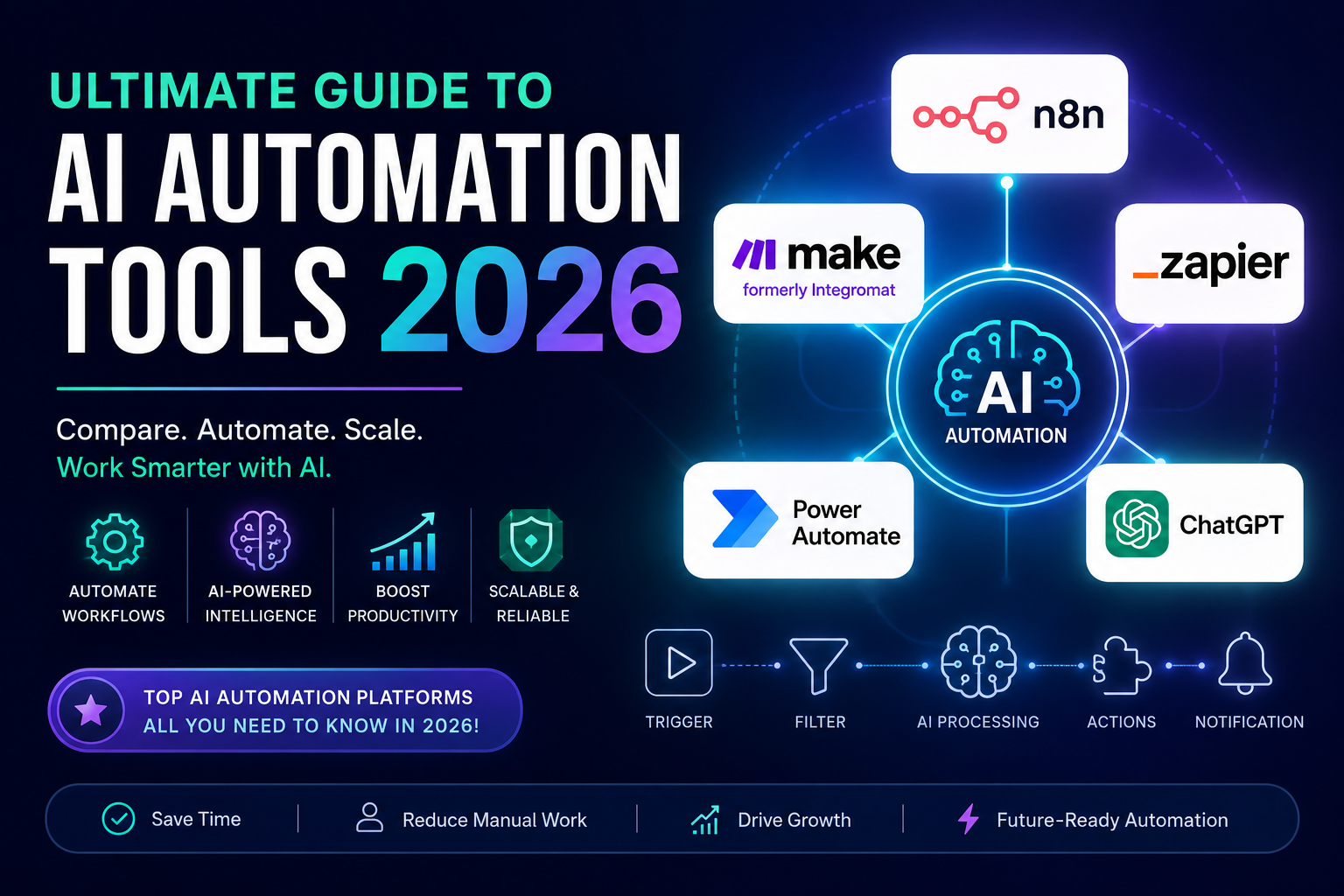
- Zapier
- Make.com
- ChatGPT
- Notion AI
- Canva AI
Why Beginners Should Start with AI Automation
- No coding required
- Affordable tools
- Fast results
- Easy setup
Even non-technical users can build AI workflows today.
AI Automation for Small Business

AI automation for small business helps compete with large companies.
Common Small Business Applications
- Customer support chatbots
- Appointment scheduling
- Email follow-ups
- Lead qualification
- Invoice automation
Why AI Automation Is Ideal for Small Businesses
- Saves time
- Reduces hiring costs
- Improves efficiency
- Increases revenue
AI automation levels the playing field.
Use Cases of AI Automation Across Industries

Marketing
- Campaign optimization
- Lead nurturing
- Ad targeting
Sales
- CRM automation
- Sales forecasting
- Follow-ups
HR & Recruitment
- Resume screening
- Candidate matching
Healthcare
- Appointment scheduling
- Medical data analysis
Education
- Personalized learning
- Automated grading
Finance
- Risk assessment
- Fraud detection
Challenges and Limitations of AI Automation

Despite its benefits, AI automation has limitations:
- High initial setup cost
- Data privacy concerns
- Dependency on data quality
- Ethical considerations
- Limited creativity
Understanding these helps businesses use AI responsibly.
Future of AI Automation

The future of AI automation is promising.
Trends to Watch
- Hyper-automation
- AI-driven decision systems
- Autonomous workflows
- Industry-specific AI solutions
- Human-AI collaboration
AI automation will continue to reshape the global workforce.
FAQs About AI Automation

What is AI automation and how does it work?
AI automation uses AI models to analyze data, make decisions, and automate tasks with minimal human input.
Is AI automation suitable for beginners?
Yes. Many tools are beginner-friendly and require no coding.
Can small businesses use AI automation?
Absolutely. AI automation for small business is cost-effective and scalable.
What is the difference between AI and automation?
Automation follows rules, while AI automation learns and adapts.
Is AI automation expensive?
Many tools offer free or low-cost plans.
Final Thoughts

Understanding what is AI automation is the first step toward working smarter—not harder.
Whether you’re a beginner, entrepreneur, or business owner, AI automation can save time, reduce costs, and boost productivity.
At AIAutomationHacks.com, we believe AI automation is not just the future—it’s the present.
👉 Start small
👉 Learn continuously
👉 Automate intelligently